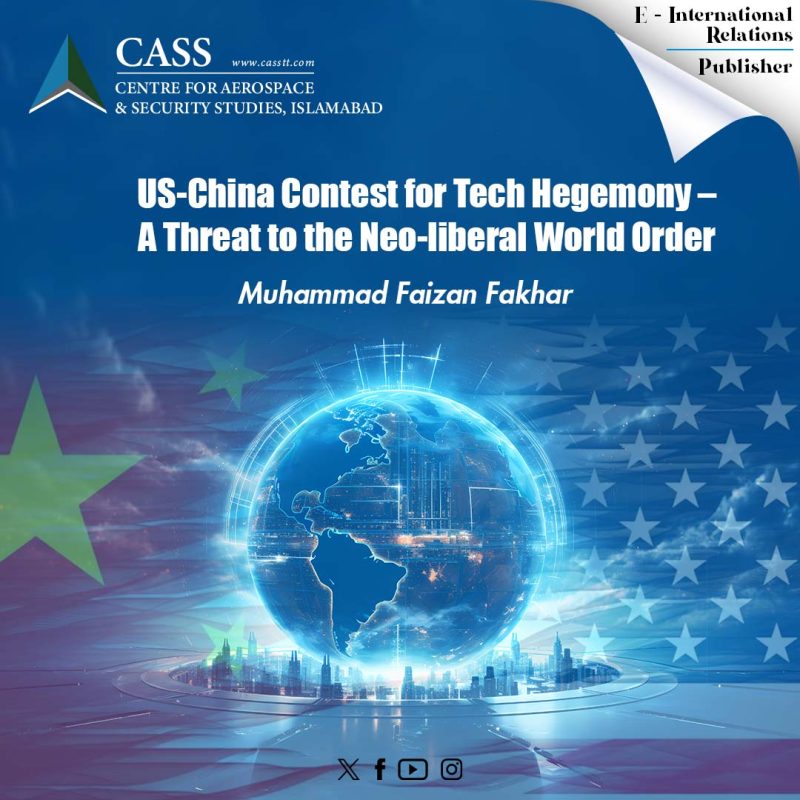
The competition between the US and China for global power has become one of the defining features of the world’s geopolitical landscape in the 21st century. While the power struggle is unfolding on multiple fronts including defence, economy, and geopolitics, technology has become a prominent frontier. From the announcement of the USD 500 billion AI infrastructure project Stargate by US President Trump to the deep tech market upsets caused by the launch of China’s AI Chatbot, Deepseek, the tech race between the US and China is in full swing. Technology is an integral part of almost every aspect of modern life – from communication, navigation, healthcare, defence, and transportation to finance and entertainment. Achieving hegemony in the technological arena would not only translate into economic and military advantages but also yield an ideological dominance in the global governance models and structural norms of the international system.
Areas of Tech Competition
The US-China tech competition is unfolding across multiple sectors and domains. One of the key fronts of this competition is Artificial Intelligence (AI). Over the past decade, global AI markets have undergone a rapid growth with the latest estimates reflecting a market size of a whopping USD 454.12 billion in 2023. The AI market is currently being led by the US, with a spending of USD 328 billion in the five years, 2019-2023. China follows with an investment of USD 132 billion in the same period. Moreover, to gain AI hegemony, both China and the US have also integrated AI-based state policies and initiatives including US’ National AI Initiative Act (2021)and China’s New Generation Artificial Intelligence Development Plan. Multiple other sectors are also interrelated to this broad competition for AI superiority between the US and China. These sectors include semiconductors, AI algorithms, quantum computing, 5G technologies, Big Data and autonomous systems. Both sides have their own unique strengths and weaknesses in each of these sectors. However, to gauge the impact of US-China tech contestation on the neo-liberal world order, an examination of the respective and often contrasting tech development strategies of both sides would be prudent.
US-China Models of Tech Development and Neoliberal Values
The approaches of the US and China for tech development are rooted in their divergent political and economic ideologies. The US’ approach towards tech development is based on a market-oriented economy in which the private sector leads the technological development and innovation. Several US-based companies including Microsoft, Apple, Google, OpenAI, Intel, AMD and Qualcomm are currently leading the way in tech innovation in their respective domains. However, US’ approach towards its tech industry has become increasingly protectionist and interventionist over the past few years, going against the neo-liberal principles of globalisation and free markets. The CHIPS and Science Act of 2022 is a key example, where the US government allocated over USD 52 billion in subsidies to its local semiconductor manufacturing and placed restrictions on the global semiconductor supply chain tied to China. Similarly, competition in the domestic telecommunication sectors of the US has also been limited as evident by the stringent regulations placed by the US on foreign companies including China’s Huawei and ZTE. It is also important to note that big data plays an important role in the competition. Data is considered to be the fuel of the AI and Machine Learning (ML) industry, as these systems are trained on big data. Both the US and China are increasingly restricting the flow of their data, as marked by China’s Data Security Laws and Trump’s bid to ban TikTok. Therefore, despite the US claims of leading tech development through market competition, innovation and global integration, increasing state regulations and interventions in domestic and global markets would result in growth disparities among industries and market fragmentation. This stands in stark contrast to the neo-liberal ideals of globalisation and multilateral cooperation. The US protectionism trend, especially in the tech sector, is only expected to become more pronounced under the second presidency of Donald Trump.
On the other hand, China follows a state-centric and capitalist model of tech development. The government plays a central role in this model as it not only sets up strategic objectives for tech development but also directs resources to national companies such as Tencent, Huawei, and SenseTime. This model is rooted in China’s long-term objective of achieving tech hegemony and self-reliance, as envisioned in Made in China 2025 initiative. While this model offers the advantage of achieving rapid, focused and result-oriented tech growth, there are some associated challenges as well. For example, there remains a risk of a lack of interoperability with global market standards due to the goals of self-reliance and tech hegemony. Moreover, private innovation becomes limited due to over-reliance on state subsidies, and access to global supply chains also becomes restricted due to geopolitical pushbacks. Moreover, China’s emphasis on self-sufficiency in the tech domain has also given rise to a parallel digital ecosystems, which further add to the global market fragmentation of the tech sector. This parallel tech ecosystem – such as alternative 5G, AI, and semiconductor supply chains – reduces the prospects of multilateral cooperation and foreign investments. Therefore, market fragmentation has become a common consequence of the contrasting tech development models being pursued by both US and China. As a result, the rest of the world is now faced with a bifurcated technology market where choices in the tech infrastructure, tech governance and cybersecurity are increasingly aligning with geopolitical considerations rather than neoliberal values of multilateral cooperation, free markets and economic integration.
Bifurcation of the Global Tech Market and Tech Divide
The bifurcation of the global tech market is not only deepening geopolitical tensions but also widening the global tech divide. The developing nations are now caught between contrasting tech ecosystems of the West and China, neither of which fully aligns with the neoliberal ideals of free-market competition, global standardisation, and economic interdependence. This is evident by the rise of competing tech alliances in the last few years, including the West-led initiatives such as Chip 4 Alliance, Global Partnership on AI (GPAI), The Clean Network Initiative, EU-U.S. Trade and Technology Council (TTC), as well as China-led alliances such as Digital Silk Road (DSR), China-CEEC digital cooperation, and BeiDou Satellite Navigation System, among others. As the US and its allies claim to promote open-market, innovation-driven tech, and China advances a state-backed, infrastructure-heavy approach, many countries in the Global South face challenges in getting free and equitable access to emerging technologies, digital infrastructure, and AI development, reinforcing global disparities in technological growth and digital sovereignty.
Conclusion
The US-China contest for tech hegemony is not merely about gaining technological superiority in the fields of AI, Quantum computing and semiconductors, rather it is a struggle for asserting competing values, rules, and institutions that will govern the global technological landscape for decades to come. The neo-liberal values of free market, inclusivity, economic interdependence and multilateralism are being affected by the rise of exclusionist tech alliances, fragmentation and bifurcation of tech market. As this competition intensifies, the global tech divide would further deepen. Consequently, states in the global South are bound to get caught in the middle with the complex task of not only navigating this fragmented digital space but also ensuring their autonomy and development.
Muhammad Faizan Fakhar is a Senior Research Associate at the Centre for Aerospace & Security Studies (CASS), Islamabad, Pakistan. He can be reached at: [email protected]