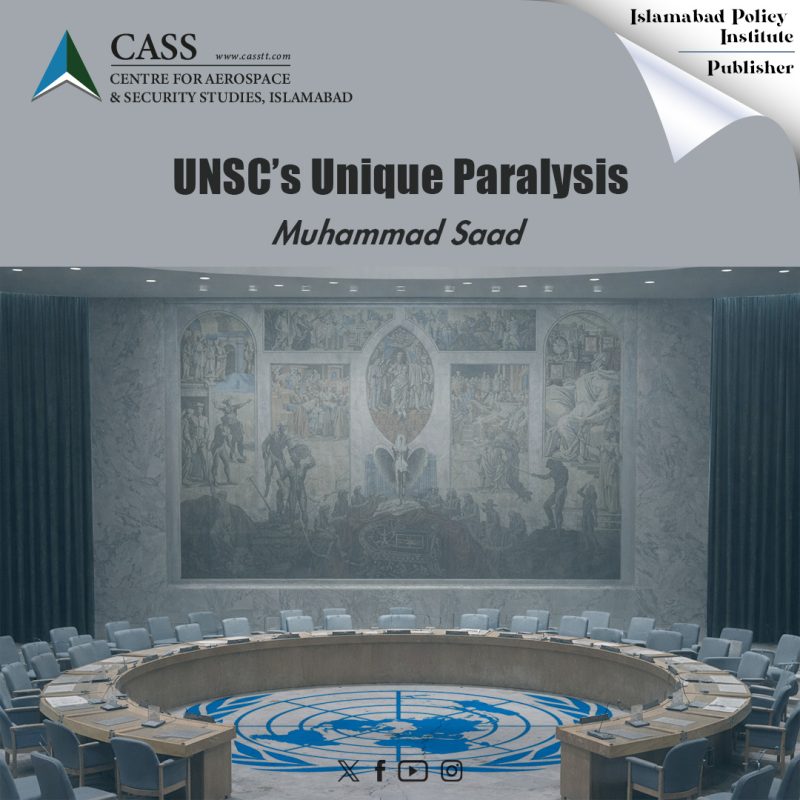
In the recorded history of international relations, institutions rarely fail outright. Instead, they become irrelevant. Contrary to popular belief, the United Nations Security Council (UNSC) is not collapsing due to the weight of idealism or bureaucratic inertia. Instead, it is institutionally becoming obsolete in the face of increasing great-power competition. With veto-wielding powers putting national interests above collective action, the UNSC is in danger of following the same path of the League of Nations into irrelevance, not by dissolution but by empty continuation.
The League of Nations, which was formed after World War I, is commonly regarded as an idealistic experiment. But it was more structural than philosophical in its downfall. Its mandates were enforced based on unanimous agreement between the rival great powers, which was a weak structure that collapsed when the great powers had their own selfish interests. The League, which was based on collective security, collapsed because colonial powers did not meet any significant consequences for their exploitative institutions and bloodshed in the Global South. The lack of an effective yardstick of success implied that the paralysis of the League was not a bug but a characteristic of a system that was poorly equipped to deal with realpolitik.
In the same manner, the veto system of the UNSC, which was meant to be a great-power buy-in mechanism, has been transformed into a power-preservation tool instead of a peacekeeping apparatus. The UNSC was born out of the rubble of World War II and was to ensure that the world did not face another disaster due to the lack of coordinated efforts. However, in reality, it has turned into a battlefield where permanent members, the United States, Russia, China, France, and the United Kingdom, exercise their privileges to protect allies, prevent enemies, and secure spheres of influence.
The veto of the UNSC is not fundamentally a veto of threats to peace, but a veto of responsibility. Votes on emergency issues are often vetoed or diluted, not due to any actual disagreements in the perception of facts, but owing to the geopolitical calculus. The UNSC is increasingly being utilised to delay solutions rather than resolve them, which develops a culture of selective legality where international law is applied selectively based on alliances.
This silence perpetuates hierarchies of victimhood. The confrontations with the Western interests are condemned and penalised instantly, but others stay in the shadow. The inability of the council to implement its own resolutions undermines its power bearing in mind the impasse that has been there between the Israeli and Palestine war over the years. The realm in which people once talked about has become a battlefield of narrative control, in which the great powers are not so concerned with humanitarian needs, but with strategic benefits.
These systemic patterns are highlighted by recent crises not as transient dysfunctions but as precursors of underlying malaise. Humanitarian norms have been relegated to veto politics in Gaza, and the US has used its authority to veto several resolutions demanding immediate ceasefires in 2024 and 2025. Despite the intensification of the conflict between Israel and Hamas, causing catastrophic civilian deaths and a humanitarian disaster, the work of the Security Council resulted in Resolution 2803 on 17 November 2025, which sanctioned an international stabilisation force but has been criticised as legitimising the indefinite occupation of Palestine and marginalising Palestinian self-determination. This selective use of international law underscores the role of veto privileges in favour of allies to the detriment of fair application.
In Ukraine, the enforcement is not universal because of the veto of Russia, which makes the Council useless in stopping the current invasion. Although Resolution 2774, passed on 24 February 2025 by 10 votes to 5 abstentions, lamented the loss of life on the third anniversary of the conflict, it did not go further to impose binding measures, which was a neutral position in the face of ongoing Russian aggression. The Western-led coalitions have offered military assistance and sanctions beyond the UN system, but this informal practice highlights the marginalisation of the UNSC: peace enforcement is becoming increasingly bypassed by the body that is supposed to do it, as the continued Council meetings are producing little more than desperate appeals in the face of escalated airstrikes.
In the case of Sudan, silence has become a trend and not an oversight, and crises such as the civil war in Sudan have been given little substantive action. With the war between the Sudanese Armed Forces and Rapid Support Forces entering its third year, displacing more than 10 million people, and causing famine, the Council has imposed only weak statements, blocked by the threat of veto by Russia and China due to their economic interests. Other areas, like the increasing violence and ethnic conflict in South Sudan, where the UNSC has been warned of the increasing risks, but its response is still disjointed and inadequate, are no exception, and the biases that prioritise non-Western crises are strengthened.
This selective interaction has created a gap of credibility, especially in the Global South. Countries of Africa, Asia, and Latin America are becoming more and more convinced that the UNSC is an outdated artefact of the 1940s power relations, which are unrepresentative and unresponsive. Paralysis contributes to norm contestation, as states dispute Western-dominated interpretations of international law, which is manifested in the sovereignty versus intervention debate.
The emergence of other forums such as BRICS (Brazil, Russia, India, China, South Africa) and ad hoc alliances is an indicator of a change. BRICS, which has now been extended to Egypt, Ethiopia, Iran, and the UAE, provides an avenue of economic and security collaboration without veto politics. Regional solutions are becoming more popular as seen in the African Union peace operations in Somalia or the mediation efforts of the Gulf Cooperation Council in Yemen. This loss of credibility is not a figment of speech alone but of strategy. Once the trust is lost, the UNSC will lose its ability to mobilise the international community and the world will be on the verge of multipolar disintegration.
The League era was tricky, and the outcome was World War II, but now the stakes are even higher. The UNSC, in contrast to the League, which was functioning in a comparatively thin legal environment, is the centre of a dense network of international institutions, including the International Criminal Court (ICC) and trade agreements within the World Trade Organisation (WTO). Its irrelevance does not just isolate the council, but delegitimises the whole rules-based order.
In a globalised world, hollow survival is more dangerous than a complete collapse. The dysfunctional UNSC is an invitation to rogue behaviour: states can violate norms because they know that they will not be enforced, and conflicts or arms races will proliferate. Cyber threats, climate-driven migrations, and pandemics require coordinated actions, but competition, such as the U.S-China tensions over Taiwan or the Russian posturing in Eastern Europe, guarantees stalemate. The threat is in normalisation: once the great powers stop even pretending to collaborate, the system will be rotting internally.
Utopian reform proposals of UNSC reform, whether by increasing permanent membership or by eliminating the veto, are well-intended but useless in the short term, and would need the agreement of the very powers that are enjoying the status quo. Rather, practical ways ahead involve issue-based coalitions, in which like-minded states work together outside of the UN system.
Norm fragmentation is unavoidable. We must accept it by reinforcing specialised institutions such as the World Health Organisation in the case of health crises or local institutions in the case of local conflicts. The burdens could be more evenly distributed by security regionalisation, such as the empowerment of SCO or ASEAN.
Finally, we have to consider whether we are in a post-UNSC security environment? As the great powers withdraw to bilateral agreements and mini-lateral coalitions, the council can be reduced to mere window dressing. This is not defeatism. It is realism in the age of hegemonic struggle.
The League of Nations did not end with a bang, but when great powers ceased to feign cooperation in favour of appeasement and aggression. The UNSC is on the verge of a more gradual death. It is demanding its relevance at a time when the world is evolving. History has taught us that irrelevance is a source of instability. To avoid an actual multipolar free-for-all, there is a need to re-invent global security, and not necessarily to restore a failed institution, but rather to employ strong alternatives that reflect the prevailing realities of power. The question of whether the UNSC can or cannot adapt is no longer a matter of discussion, but can the international community live without it.
Muhammad Saad is a Research Assistant at the Centre for Aerospace & Security Studies (CASS), Islamabad. He can be reached at [email protected]