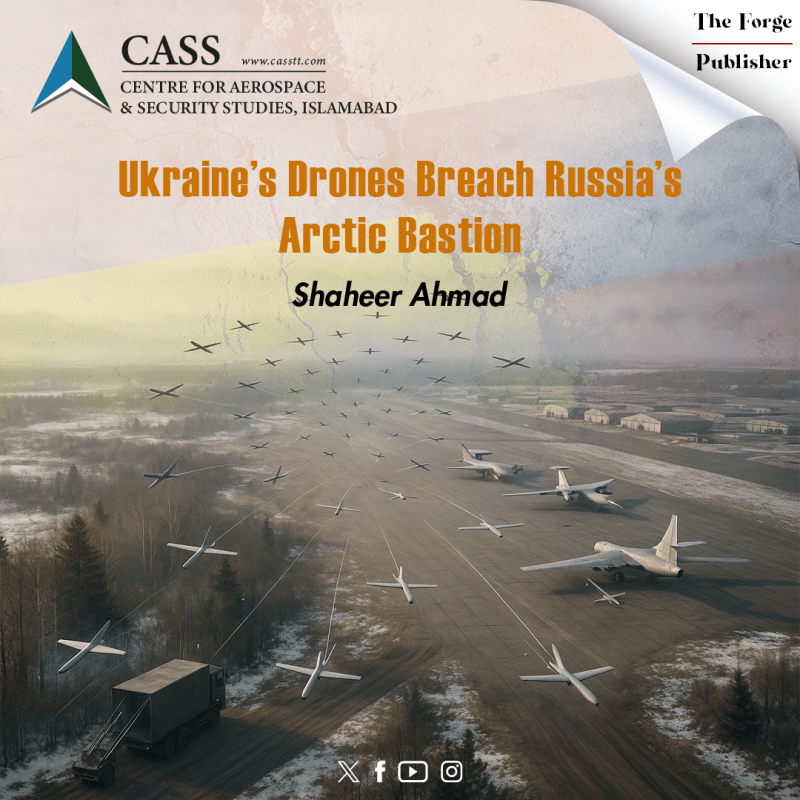
On 1st June, Ukraine struck four Russian aviation mainstays: Belaya, Dyagilevo, Olenya and Ivanovo. Codenamed ‘Operation Spider Web,’ the strike delivered a severe blow to Russia’s strategic air capabilities, targeting key assets such as the Tu-95M and Tu-22M3 long-range bombers, as well as the A-50 airborne early warning and control (AWACS) aircraft, mirroring tactics reminiscent Call of Duty-style operations. These aircrafts were integral to conducting long-range strikes against Ukraine and played a critical role in Russia’s bastion defence strategy and second-strike capability. Due to the operation’s vast geographical expanse, the precisely planned strike challenged the long-held notion of Russia’s geographic insulation, particularly in remote sanctuaries like the Arctic, once thought as impregnable and far from Ukraine’s long-range capabilities.
Eighteen months before the attack, the Security Service of Ukraine (SBU) covertly smuggled 150 small drones, 300 explosive payloads, and modular launch systems compartmentalised inside modified cargo trucks. A critical feature of the operation was its execution through Russian territory, involving civilian participation. The drones were then transported to various locations near the Russian airbases. Once arrived, they were released from the compartments and directed toward their target destinations. To facilitate seamless navigation, drones utilised an open-source software called ‘ArduPilot,’ enabling them to autonomously follow their destined path, As evident in the footage, the drones emerge from containers, follow a stable flight path, and then descend to strike vulnerable sections of the bombers particularly around the wings and fuselages.
The strike has notable implications for Russia’s military and economic posture in the Arctic, potentially disrupting its strategic assets and regional influence. Regarded as a Cold War missile pathway and a nest for its second-strike capability, the Arctic has high priority in Russian military calculus. To secure its perimeter defence, Russia employs a bastion defence strategy, concentrating both offensive and defensive military assets within its Northern Military District. The vast geographical depth of the Arctic region further reinforces this approach, offering a natural buffer against potential foreign incursions. Olenya airbase forms a critical component of Russia’s perimeter defence architecture and second-strike capability. As the base of the 40th Composite Aviation Regiment, its hosts a significant fleet of Tu-95M and Tu-22M3 bombers capable of executing long-range strikes across the Arctic region through the Greenland-Iceland-United Kingdom (GIUK) gap.
The Arctic’s geoeconomic importance, with an estimated 30% of the world’s undiscovered natural gas and 13% of its oil reserves, also underscores its centrality in Russia’s geostrategic calculus, particularly as energy resources become increasingly contested. As outlined in its Arctic strategy 2020-2035, Russia aims to develop the untapped potential of hydrocarbons through the Yamal LNG and Arctic LNG-2 projects; and transforming the Northern Sea Route (NSR) into a global shipping artery, elevating the Arctic as a ‘strategic resource base.’ The stationing of military assets in the Arctic tundra reflects Russia’s intent to project power in the High North while simultaneously securing its claim over the region’s substantial untapped energy resources. At the core of Russia’s Arctic geopolitical calculus s the imperative to deter foreign military presence, safeguard its energy assets, and protect the strategic nuclear forces based in the Kola Peninsula.
Historically, the Russian military has maintained a strong reliance on legacy battle systems. The development of long-range bombers, intercontinental ballistic missiles (ICBM), nuclear powered submarines, and exotic weapons such as doomsday torpedoes reflects its emphasis on deterrence through strategic depth. Rooted in enduring fears of encirclement and foreign invasion, these systems are considered essential for defending Russia’s vast geographical expanse and preventing strategic surprise.
However, this strategic disposition is challenged by the rise of drone warfare. Despite a robust A2/AD environment around the Arctic bases, successful execution of Ukraine’s Operation Web provides a glimpse into future warfare where cheap and hi-tech solutions can target anything, anytime and anywhere. Moreover, the operation’s success across a vast geography unmasks vulnerabilities in Russia’s rear defences. The targeted bombers, notably Tu-95 and Tu-22, constitute a critical leg of Moscow’s nuclear triad that are no longer in production and have no instant replacement. This would be comparable to the United States losing multiple B-52 and B-2 strategic bombers in a single coordinated strike.
Russia has always regarded its geography as a protective barrier. The harsh climate, rugged terrain and vast distances have historically served as deterrents, offering a strategic advantage against the invading forces. Yet, the emergence of unmanned aerial systems is eroding this advantage, much like the rapid incursions of Mongols in the 13th century. These systems, with their speed, flexibility and reach, have become potent force multipliers able to penetrate deep into national territory and strike fortified citadels of strategic assets far from frontlines and mark a major shift in the character of modern warfare.
Shaheer Ahmad is a Research Assistant at the Centre for Aerospace & Security Studies, Islamabad. The article was first published in The Forge. He can be reached as [email protected]