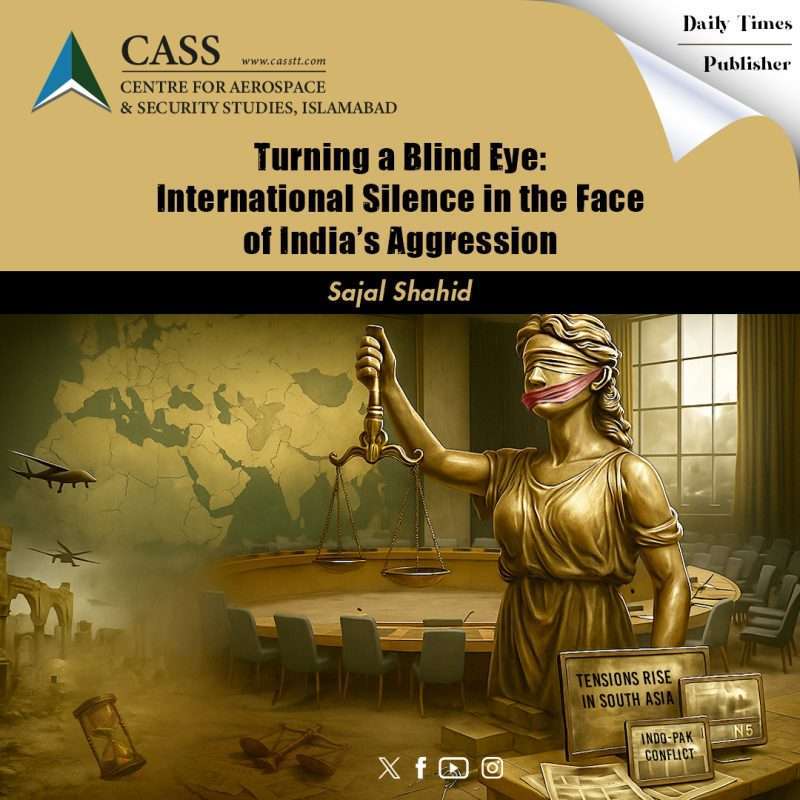
The recent Indo-Pakistan clashes, though following a familiar cycle of escalation and de-escalation, revealed persistent challenges underlying regional conflicts. The most important one being the limited role of the international community in addressing India’s repeated violations of international law.. Immediate responses following India’s unilateral aggression, including those of major powers such as the United States (US), United Kingdom (UK), and France, largely fell short of what the situation demanded; a clear and swift condemnation of India’s blatant display of hostility and instead resorted to treating the conflict as a bilateral issue. This approach only widened the space for India to continue its belligerence against Pakistan without fear of international consequences.
This indifferent approach is nothing new. In fact, it has been a common fixture of most conflicts between the two states. From the alleged Uri surgical strikes in 2016 to the 2019 Balakot cross-border strikes, Western powers have continuously centered global discourse around India’s right to self-defence, punctuated with generic calls for both sides to de-escalate. Notably, the violations of Pakistan’s sovereignty and its right to respond to unprovoked aggression have largely gone unquestioned.
Even in May 2025 with the unlawful suspension of the Indus Waters Treaty to the targeting of civilian and religious sites under Operation Sindoor. India’s provocations were not met with condemnation but with routine calls for restraint. Global media coverage echoed this approach, framing the situation as a symmetric brink of war scenario in a nuclearised region rather than attributing responsibility or denouncing aggression.
This lack of global condemnation in the light of India’s illegitimate aggression marks a sharp shift from international reactions to other conflict scenarios. A key example of this is Russia’s Special Military Operations in Ukraine. However, unlike India, Russia’s actions were not only met with clear and swift condemnation but with heavy sanctions by the European Union, US and UK. The media also followed suit by issuing clear criticism across all major global platforms. In contrast to this, India faces no such censure despite repeated illegitimate strikes, revealing a clear double standard in international responses.
This begs the question, why?
There are a few different factors that potentially play a role. Firstly, India is one of the few militarily and economically resilient states located at a key juncture between South and Southeast Asia. This combined with its competing interests to its bordering China, as well as its deep partnership with the West, allows it to serve as a vital counterweight against China. Secondly, India’s position as a potential supply chain alternative to China, as well as a significant market for goods and services, makes the state an even more valuable partner. Thirdly, India’s portrayal of itself as a victim of terrorism and its actions as pre-emptive is amplified through Indian-funded English media platforms such as WION, and The Hindu. This narrative management helps India project a favourable image internationally, thereby limiting global scrutiny.
However, this detached approach by the international community has far reaching consequences. Lack of international consequences for India’s unilateral aggression creates space for further belligerence, which in turn places the onus on Pakistan to retaliate. Thereby creating a self-feeding loop that significantly increases the likelihood of escalation in an already tense and nuclearised region. Furthermore, repeated global inaction delegitimises Pakistan’s credible security concerns and allows India to pursue covert and hybrid aggression, under the cover of plausible deniability, without fear of international retribution.
For Pakistan, the core challenge is clear: breaking this cycle of global inaction and having its legitimate concerns globally acknowledged. For this, Islamabad must continue to raise the issue of Indian belligerence internationally, particularly in multilateral forums such as the United Nations (UN) and Organisation of Islamic Cooperation (OIC), to ensure its narrative is not sidelined. However, this diplomatic approach must also be backed with economic strength and credible partnerships, built by diversifying exports and deepening relations with key allies such as China. In addition to these efforts, Pakistan should also invest in the development of its soft power, such as through the establishment of an English-language media infrastructure. While similar platforms already exist to an extent, dedicated and purpose driven forums geared towards an international audience are still needed. Ultimately, Pakistan’s ability to navigate this challenge will depend on its capacity to counter India’s narrative and the effectiveness of its international outreach.
Sajal Shahid is a Research Assistant at the Centre for Aerospace & Security Studies (CASS), Islamabad, Pakistan. The article was first published in Daily Times. She can be reached at [email protected]