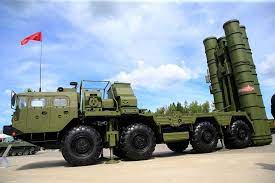
Failing to secure a deal with the United States (US) and other NATO countries for an air defense system, Turkey turned to Russia for the S-400 air defense system. In 2017, Turkey signed a deal worth $2.5 billion for the procurement of four batteries of S-400. This deal was not welcomed by the Western world who viewed it as a threat. Tukey was repeatedly asked by US to abandon the deal and opt for its Patriot air defense systems instead since there were serious concerns in Washington that the deployment of S-400 will pose major compatibility issues between the Russian and NATO equipment, particularly the F-35 fighter jets. However, Turkey proceeded with the deal with the justification that S-400 will not be integrated with NATO equipment and will work on an independent network.
On 12 July 2019, Turkey received its first shipment of the S-400 air defense systems and became the first NATO country to acquire this system. Resultantly, Turkey was sanctioned by USA under the Countering American Adversaries Through Sanctions Act (CAATSA) following this procurement. It was also informed that it will be removed from the F-35 fighter jet program despite the fact that it contributed significantly to the development and finance of this initiative. As soon as the first shipment arrived in Turkey, the training of the Turkish pilots operating the F-35 aircraft in US was halted to signal Washington’s severe disapproval of the deal.
The Trump administration warned Turkey of more sanctions if it did not withdraw from the deal. With the change of administration in the US, renewed efforts were once again made to persuade Turkey to give up the deal. US Secretary of State Antony Blinken met with the Turkish Foreign Minister Mevlüt Çavuşoğlu at the NATO Summit held in March 2021. S-400 was one of the prime issues discussed between both of them. Secretary Blinken urged that Turkey should withdraw from its deal with Russia, reiterating the compatibility issues of S-400 with NATO equipment. Turkish Foreign Minister informed his counterpart that it was a “done deal” and Turkey had no intention to reverse it. As a result, the US officially notified Turkey that it had been removed from the F-35 consortium agreement on 22 April 2021.
The US State Department has warned of “potentially serious consequences” if Turkey activates the systems. When reports of Turkey testing the S-400 emerged, a Pentagon spokesperson stated “We have been clear: An operational S-400 system is not consistent with Turkey’s commitments as a US and NATO ally. We object to Turkey’s purchase of the system and are deeply concerned with reports that Turkey is bringing it into operation.” Compounding Washington’s problems, Russia is offering more jets to Turkey such as Su-35 and Su-57 fighter aircraft to complement the S-400 air defense system.
Efforts towards easing tensions between the US and Turkey have not borne any meaningful results. In 2019, a technical joint working group was proposed by Turkey to assess the operational use of the Russian air defense system. However, the proposal was turned down by the Americans. Similarly, there were speculations of using the Crete Model after the Turkish Foreign Defense Minister Hulusi Akar stated that Turkey was open to negotiations on the S-400 for a settlement similar to the Crete Model. The model refers to the settlement of a conflict which was ignited after Greece purchased S-300 air defense systems from Russia in 1996. Due to strong opposition from Turkey, these air defense systems were never deployed in Cyprus but were shifted on the small island called Crete in Greece. Resultantly, applying the model in this case implies that Turkey would merely possess the S-400 systems and not activate it, rather keep it at a location on which the US and NATO members have no objection. These speculations were short-lived as the Presidential Spokesperson Ibrahim Kalin denied that such a formula was not on their agenda and Turkey’s position on the S-400 was very clear. It is likely that Russia may have objected to this option.
Turkey is caught between the two major powers, with each side aiming to extend its sphere of influence. The issue still remains unresolved even after two years of the arrival of the S-400 batteries as Ankara has not been able to come up with an option which could satisfy both sides.
Another way to look at this issue is that Turkey is signaling its new geo-political status where it has adopted a policy of non-alignment with either the US or Russia rather it aims to balance both sides. It sees itself as a regional actor which can assert itself independently without clearly siding with any major power. In the future, it could use the defense procurement from Russia as a bargaining chip to get some incentives from Washington. At the same time, it could improve its relations with Russia by cooperation in economic, diplomatic, and military domains.
It is yet to be seen how Turkey tries to ease its tensions with Washington and strengthen its ties with Kremlin. However, one thing is clear that this deal is likely to impact Turkey’s position in the region, its alliances, and the great power competition in the Middle East.
Shaza Arif is a Researcher at the Centre for Aerospace & Security Studies (CASS). The article was first published by Khaleej Mag. She can be reached at [email protected]