
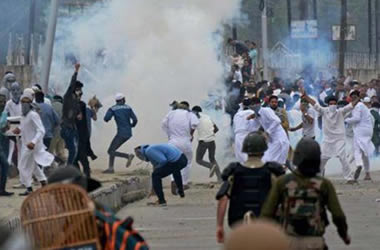
As the annual UNGA session for 2019 approaches and pressure mounts on the Indian leadership due to its gross human rights violation, their defenders have begun to give weird reasoning for the abrogation or “de-operationalization” of Article 370 and 35A of their constitution. All their efforts are focussed on trying to tell the world that people on the Pakistani side of Kashmir are very unhappy while those on the Indian side are extremely satisfied with the change that has taken place with respect to their relationship with the Indian Union. The Indian Ambassador to the United States, Mr Harsh Vardhan Shringla, has written a piece on the subject in the New York Times of September 21, 2019, titled, ”India is building a more prosperous Kashmir.” What the Indian government is doing in Kashmir is indeed a novel and strange way of bringing prosperity to a peoples and a region. However, it is unlikely that anyone would be ready to emulate their model for bringing prosperity anywhere. In Venezuela the life is real bad but even Mr Nicolas Maduro has not been as cruel or hard on protesters as India has been to Kashmiris. They have been sequestered in their homes for the last 50 days against their will, without food or medicine. The ambassador fails to mention that while there’s no curfew or restrictions on the Pakistani side, on the Indian side there is, and people are not allowed to get out. If they are compelled to break out in desperation in search of basic needs, they are confronted with pellet guns, tear gas and armed soldiers with orders to shoot to kill. The details of atrocities committed against unarmed people are harrowing and have to be hidden from the world, so international media is not allowed to report from Indian Occupied Kashmir (IOK). The state and its people are cut off from the rest of the world despite the demand from UN secretary general, US Congressmen and senators, British and EU parliamentarians and human rights organisation like Amnesty International and Genocide Watch, to lift the siege. It is amusing that all these entities and representatives are concerned about the prosperity being brought to the victims of oppression and violence.
The ambassador has assured the world that the lockdown and curfew is to ensure the safety of Kashmiris because that is the first duty of the state towards its citizens. He omits the fact that the threat to these people is from none other than the state security apparatus. The state is the sole perpetrator of violence against “the other”, which in this case are the Kashmiri Muslims, whose rights have been usurped for the last seven decades through the use of force and violence. The RSS supported Hindutva ideology is akin to Hitler’s Nazism. Mr Modi is guilty of crimes against humanity both as Chief Minister of Gujarat and now as Prime Minister of India. The US government had denied him visa due to his support for communal violence as Chief Minister of Gujarat. The democratic façade has been brought down due to his disregard of value and sanctity of life of minorities. Women are raped and people are lynched by thugs because of virtual immunity from punishment for perpetrators. The state just looks the other way if crimes are committed against minorities and by Hindus. Mr Shringla makes an innocent contention that Indian actions have not changed boundaries or had any effect outside its borders. He ignores that they have violated agreements under the UN umbrella, international humanitarian law and Vienna Convention on Laws of Treaties. The Instrument of Accession was signed between two sovereigns and any changes could also only be made by their mutual consent but India has done away with the sovereignty of the other, so its actions are totally illegal.
The real reason is that things have not gone on the way Mr Modi had promised they would. The only way to divert attention from a slowing economy and rising unemployment was to stoke the flames of nationalism and xenophobia. Before the May election, the Indian military, especially the air force, was used to carry out a ‘’surgical strike” at Balakot, in Pakistan, to show to the Indian public that Mr Modi was a tough leader. The military was used for his personal political goals. As it turned out, the Indian Air Force failed in both offence and defence, losing two of their fighter aircraft while Pakistan Air Force came out victorious and unscathed. In an attempt to salvage the dignity of the nation and air force, a shot down pilot was granted a fictitious kill and given an award. The Indian media and public gulped this false story hook, line and sinker.
There is no way that Mr Modi can hide the inhuman treatment he is meting out to Kashmiris and his stay in the US is not going to be easy. He would be shown the mirror repeatedly for the butcher that he has been and he is. Prime Minister Imran Khan would make it loud and clear to the world how fascist the world’s largest democracy has been and who the real terrorists are! Houston awaits Mr Modi, but he may have an unpleasant surprise!
The writer is President at Centre for Aerospace and Security Studies (CASS). The writer can be reached at [email protected]



