Share this event

Facebook
Twitter
LinkedIn

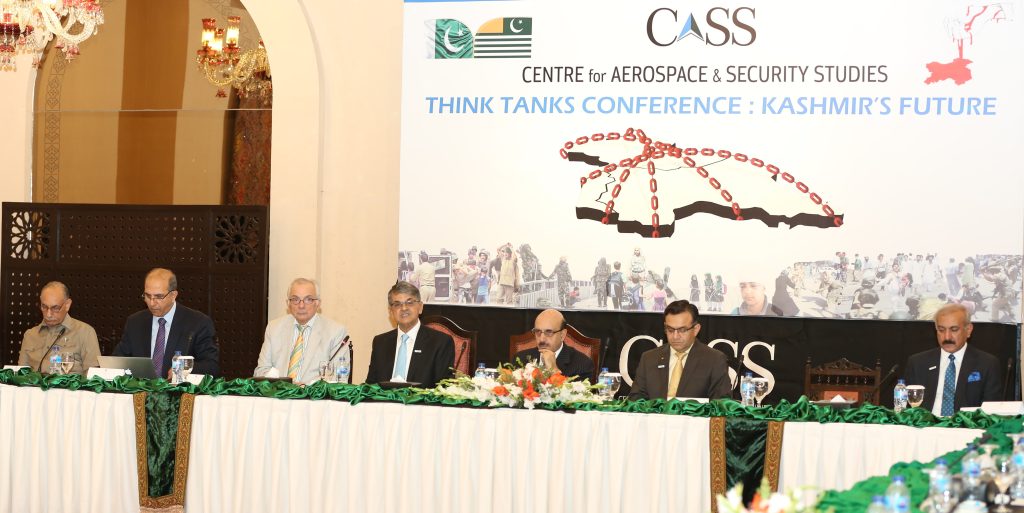
Centre for Aerospace and Security Studies (CASS) organized a one day conference entitled “Kashmir’s Future”, on September 4, 2019 in Islamabad. The Conference was organized to contemplate various policy options for Pakistan in view of deteriorating situation in Indian Occupied Kashmir. Since August 5, 2019, after unilateral revocation of Article 370 and scrapping of Article 35A by the Indian Government and forced annexation of disputed territory of Jammu and Kashmir, the IOK is under siege with growing atrocities by the occupying Indian forces. While the government of Pakistan has initiated a massive diplomatic campaign to highlight the issue of Kashmir at all international forums, it is important to carve out a long term strategy involving all relevant stakeholders in Pakistan and find a definitive way forward.

The Think Tank’s Conference on Kashmir’s Future aimed to create a national forum, seeking expert inputs from intellectual minds of the country, providing different perspectives and recommending a way forward for the Kashmir issue. In this regard, think tanks from Islamabad, Lahore and Karachi were invited to discuss the ongoing situation and available options to the government. Reputed experts from academia, defense services, intellectuals, government departments and media came to attend the discussion. President Azad Jammu and Kashmir Sardar Massod Khan graced the occasion as the chief guest.
Event Report

Other Events

Nuclear Capability: Balancing Global Security and Energy Needs

Recent global developments—including geopolitical tensions, energy crises, and shifting power dynamics—have intensified discussions around nuclear capability. After the Russia-Ukraine conflict and the US-Israel-Iran war, nations are increasingly evaluating nuclear technology not only as a strategic defense mechanism but also as a reliable and large-scale energy source. These developments have brought nuclear capability back to the forefront of international debate.
The dual-use nature of nuclear capability—serving both military and civilian purposes—makes it a critical area of analysis. The ongoing war on Iran has introduced significant uncertainty into the future of Iran’s nuclear trajectory, particularly regarding

Read More »

Catalyst Conversation : The US–Israel–Iran War and the Role of Gulf and Arab States

The ongoing war between the United States-Israel, and Iran has emerged as a defining crisis of the modern world, with significant implications for regional security, global energy markets, and the evolving geopolitical order. While the primary confrontation involves direct and indirect exchanges between these actors, Gulf and Arab states have become increasingly central to the conflict’s dynamics.
Hosting U.S. military assets and located in close proximity to key theatres of escalation, these states face growing security risks, including spillover

Read More »