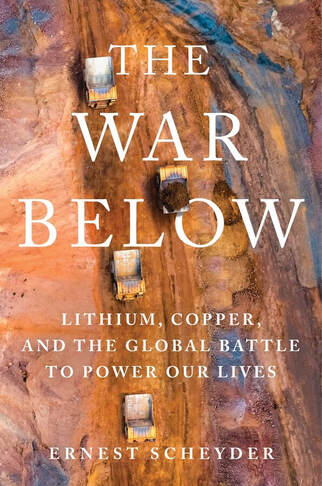
Ernest Scheyder, The War Below: Lithium, Copper, and the Global Battle to Power Our Lives, (New York: Simon & Schuster, 2024)
Reviewed by Sajal Shahid
In today’s age of technology, marked by ever-increasing digitisation and a new shift towards green energy, the topic of critical and rare earth minerals has become increasingly prevalent. From fighter jet engines and submarines to MRI machines and computer screens, critical minerals such as lithium and cobalt form the backbone of contemporary technology. As a result, these components have evolved beyond matters of scientific utility to the realms of energy security and geopolitics. The book, The War Below: Lithium, Copper, and the Global Battle to Power Our Lives, by Ernest Scheyder, a Reuters journalist covering global energy developments, provides a timely and comprehensive exploration of this subject matter.
The book consists of 15 chapters, containing a mix of factual data and historical context, interspersed with personal anecdotes detailing the author’s journey of researching the topic. In the opening chapters, Scheyder introduces the titular mineral, lithium, as a vital element of modern technology and examines its gradual rise to prominence. Though lithium-ion batteries were first introduced in 1977, the mineral’s reactive properties led to fears of spontaneous combustion, due to which they remained underused. It was only in 1990, after the addition of cobalt stabilised the composition, that the lighter, smaller and rechargeable lithium-ion batteries gained traction, eventually replacing the older and bulkier lead-acid and nickel-cadmium cells (pp. 15-18).
From that point onwards, the critical mineral and supporting metals, such as copper, continued to gain importance in the technological and scientific world, and eventually attained policy recognition as the world began to shift from traditional fossil fuels to more sustainable sources of energy.
For instance, the pivotal 2015 Paris Agreement’s goal of reaching net-zero emissions by 2050 to prevent a potentially devastating climate disaster relies fundamentally on a global green energy transition. In other words, it requires a substantive shift from fossil-fuel dependency towards renewable energy sources to fulfil collective needs. In that regard, critical and rare earth minerals are not only beneficial but essential as they form the basis of sustainable technology such as electric vehicles and solar panels, upon which the promise of the low-carbon energy transition rests (p. 26).
However, as highlighted by the author, this shift has its own set of risks. In the prologue, Scheyder introduces a botanist named Tiehm who had uncovered a rare new species of flowering plant dubbed Eriogonum tiehmii, over top of large deposits of lithium. However, in order to access these reserves, mining facilities would have to uproot the wildlife, in turn endangering the unique species.
These juxtaposing themes are present throughout the book, linking the author’s narrations to his greater arguments of the unintended consequences of pursuing regenerative energy. While it is true that increased electrification through the use of critical minerals accelerates efforts to counteract climate change, the mining required to obtain these minerals in turn pollutes waterways, increases exposure to radioactive materials, and generates toxic waste, often at the detriment of surrounding communities (pp. 27-32).
Throughout the book, the author highlights the importance of these minerals as vital components of contemporary technology and argues that the concept of energy security has expanded beyond the scope of crude oil and natural gas alone to encompass critical minerals and supporting metals such as lithium and copper. As a result of this, the geopolitical dynamics surrounding this field have also shifted. Though political and environmental concerns have prevented large-scale growth in the American mining sector, critical and rare earth minerals remain a key global commodity.
The author posits that while hydrocarbons dominated the 20th century, the geopolitics of energy in current times has been increasingly centred towards critical minerals and the countries that produce them. Due to this, economic power has now shifted towards states producing and processing these minerals, such as China, which is one of the largest producers of lithium as well as the owner of two of the largest mineral processing facilities: Ganfeng Lithium and Tianqi Lithium.
The War Below effectively presents a nuanced take on two warring perspectives: the case in favour of building mines to extract these vital minerals and the case opposing it due to its ecologically harmful impact. The author simplifies daunting concepts through accessible language and engaging storytelling, which lends itself well to what is otherwise a subject with limited narrative appeal.
However, that is not to say that the book is devoid of any limitations. The arguments presented, though well-structured and thought-provoking, approach the matter through a singularly American lens. The subject of mining is explored largely within the confines of the US’s regulations and how they, in turn, affect the progress of other bills, such as the ‘Inflation Reduction Act,’ 2022 (p. 3). Similarly, the idea of energy security and the geopolitical implications of the extraction and processing of vital minerals are approached almost entirely from the standpoint of the American audience (p. 222).
Even though the line of approach is beneficial for readers attempting to gain a deeper understanding of the internal workings of the US’s mineral sector, it offers scant value to a global consumer in search of a detailed analysis of the international race for these rare earths. Insights into global alliances shaped by these minerals, the role of states such as Japan and Australia and supply chain partnerships such as the ‘Mineral Security Partnership’ are glaring in their absence. Thus, readers approaching this book with little prior knowledge may find that their expectations deviate from its actual contents.
Though less overtly biased than many of his contemporaries, the author nonetheless veered dangerously close to the same pitfall that has plagued many of his peers: the propagation of an alarmist rhetoric around China with little deliberation into the intricacies of international dynamics. By limiting the discussion surrounding rare earth mineral competition to the US-China rivalry, the overall scope of the book has been needlessly limited. To conclude, The War Below is an effective introduction to the subject due to its approachable prose and compelling narratives balanced with factual data and historical analysis.