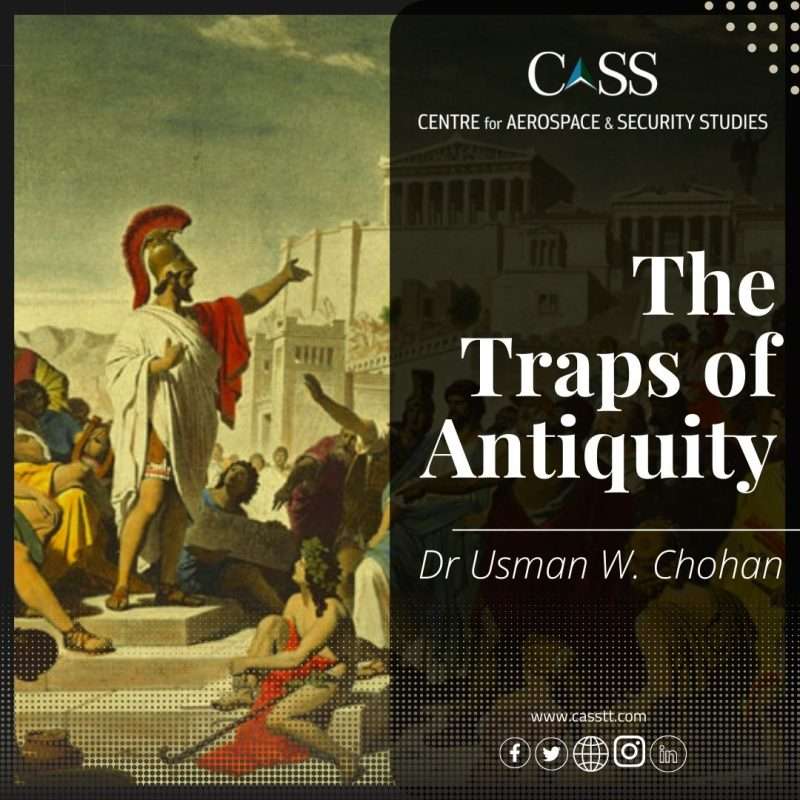
As tensions between the United States and China have simmered in recent years, scholars and strategists have sought to frame the contemporary rivalry between both powers in a wider historical context. The frequent temptation of Western scholars is to refer to the work of Thucydides on the Peloponnesian War (431-405 B.C.E.). Indeed, the term “Thucydides’ Trap” is now almost cliché in Western capitals when pontificating on Sino-US tensions, and the analogy between Spartan unease and Athenian ambition is already the well-worn subject of many texts.
The term “Thucydides’ Trap” was coined by Graham Allison in 2012 to describe the tension between an incumbent power and an emergent one, which worsened as the odds increased of the latter displacing the former. His subsequent work alleges that, out of the 16 major historical transitions of power to a new hegemon, 12 occurred in the wake of open warfare. The Trump-era led many to fear that the same antagonism that colored the Athens-Sparta rivalry would reignite in the Washington-Beijing context, and the Biden-era still leaves it as an open question.
Given the global arena in which both powers seek to compete, most countries (and certainly Pakistan), remain alert to an intensification of the Thucydides’ Trap. Yet there is much more wisdom from the annals of the Peloponnesian War to which Western (and especially American) pundits have paid little heed. Aside from what is now understood as the trap that Washington and Beijing must seek to avoid, there is another trap that is specific to Washington which is of even greater concern than continually stoking the flames against Beijing. This overlooked trap, a Thucydides v2.0, is the plight of Athenian democracy as it was destroyed by Athens itself. For much of the 5th century, Athens’ much-touted democracy preyed upon smaller kingdoms (such as Melos) that it treated with extreme prejudice; and as the Old Oligarch’s pamphlet remarks, Athen’s democracy could only be nourished through violence and material exploitation. But in time, the incompatibility between healthy democracy and violent empire ultimately consumed society itself.
American pundits must look at this more attentively: what happened to Athen’s fragile democracy in its relentless execution of empire. The Athenians went on military misadventures for several decades, such the Silician expedition (415-413 B.C.E.), which consumed insufferable blood and treasure and led to demoralization, financial crisis, and popular resentment back home. The parallel can easily be drawn with America’s longest and most recent war in Afghanistan, not to mention that previously fought in Iraq. Similarly, Athens fomented unrest across the Aegean in smaller societies to upend their social order, support tyrannies, and make them tributaries to its lofty democracy. Thucydides wrote that “the revolution was provoked by defeat in Sicily.”
A litany of such activities, particularly in Latin America, also mars the record of the American empire forcing nations into a tributary status that has prevented them from achieving grassroots democracies of their own. One need not look to the 19th and 20th century lists of inequities imposed on Latin America; even the Trump administration was recently launching such attacks of “regime change” in Bolivia and Venezuela. Backed by a $700 billion defense budget, one would think that Washington’s constant outward push owed much to its impregnability, certainly not at the mercy of 1000 clumsy rabble-rousers who could waltz right into high-offices and force the leadership of a world superpower to cower in a bunker.
Yet Athenian democracy could not sustain its inward institutional integrity with so much outward venal aggression. A financial crisis, popular discontent, and military exhaustion abroad ultimately brought the violence back home just a few years later, in the Athenian Coup of 411B.C.E. The overthrow of the Athenian democratic government came with populist vigor, backed by deep-pocketed elite interests known as the Four Hundred. Seeking to dismantle democracy and institute an elite oligarchy with populist veneer, they drew particular force from a populist smooth-talking figure named Alcibiades, who was “the noble-born but disreputable,” not unlike the first American statesman who was impeached twice.
Is it so much of a stretch for American pundits to see that this too was a “Thucydides’ Trap” worth avoiding at all costs? The insurrection of January 6th on Capitol Hill put many soft-spoken liberals to shame, laying bare a rage that erupted with so tremendous a force that few could dare deny any longer. Yet as with the Four Hundred of the Athenian coup, it was not the MAGA-hatted malcontents that drove the agenda, but rather a web of oligarchs that yearn to upend the system. Most prominent among these are the Mercers, the billionaire hedge-funders who supported Trump’s 2016 election run, and also founded Parler, the bizarre social media outfit dedicated to right-wing conspiracies (and conspirators), that helped fuel the January 6th insurrection.
One should note that what Parler has congregated in America existed in the time of Ancient Athens too, in the form of Hetairiai clubs which acted as angry social outlets for those who reviled democracy. These Athenian underground clubs had oaths that seem to have come straight out of Parler, including one Aristotle recorded in Politics: “I will be an enemy to the people, and will devise all the harm I can against them.” But pointing to the Mercer family and its social media Frankenstein belies a larger cohort of oligarchs who have put their lot in with the Republican party, and have bankrolled the sparks that light the tinder of angst in America. After all, it is a serious allegation against several Republican lawmakers that they were walking around “giving tours” of the Capitol to unusually large numbers of people just days before the storming of the Capitol.
For all serious purposes, the United States cannot be considered a democracy so much as a corporate oligarchy, a point that is articulated by even mainstream political figures such as Senators Elizabeth Warren and Bernie Sanders. Its sources of popular discontent, long understood by critical observers, now appear to be common knowledge after the actions fomented by right-wing elements including Trump himself. In seething embarrassment, many U.S. diplomats shot forth a dissenting cable through the State Department diplomatic channel on January 8th, complaining that “the incident has caused untold damage to U.S. efforts to promote democratic values abroad.” Indeed, one can only imagine the typical American senior diplomat attempting to lecture foreign dignitaries on the virtues of “shared democratic values,” and other half-hearted liberal buzzwords, but with much greater strain in their voices.
While democracy is an ideal worth striving for, and all societies are works-in-progress, the rifts in American society mirror the Athenian tumult so vividly that, instead of harping on Allison’s “Thucydides’ Trap,” Washington’s pundits should be looking to the other trap of which Thucydides’ writings warned: the destruction by empire abroad will come to destroy the democracy within. The coups and regime changes abroad will, when coupled with economic discontent, social exclusion, civic inequality, and ceaseless deception, ultimately undermine the polis itself.
President Biden and his cabinet appointees appear to be much more cognizant of this trap, at least in their rhetoric which actively denounces white supremacists and seeks both better relations abroad and reconciliation within. The scope of their challenge is larger than mere rhetoric will accomplish. If there is a consolation, it is that the Coup of 411 B.C. in Athens was finally replaced by another period of democracy (404-338 B.C.), albeit after the rule of the Thirty Tyrants. If there is a further cautionary tale, it is that the man we revere as Alexander the Greatthen swept across the world, decimating Ancient Athenian democracy once and for all.
The writer is the Director for Economics and National Affairs at the Centre for Aerospace and Security Studies (CASS). The article was first published in THE NATION. He can be reached at [email protected].