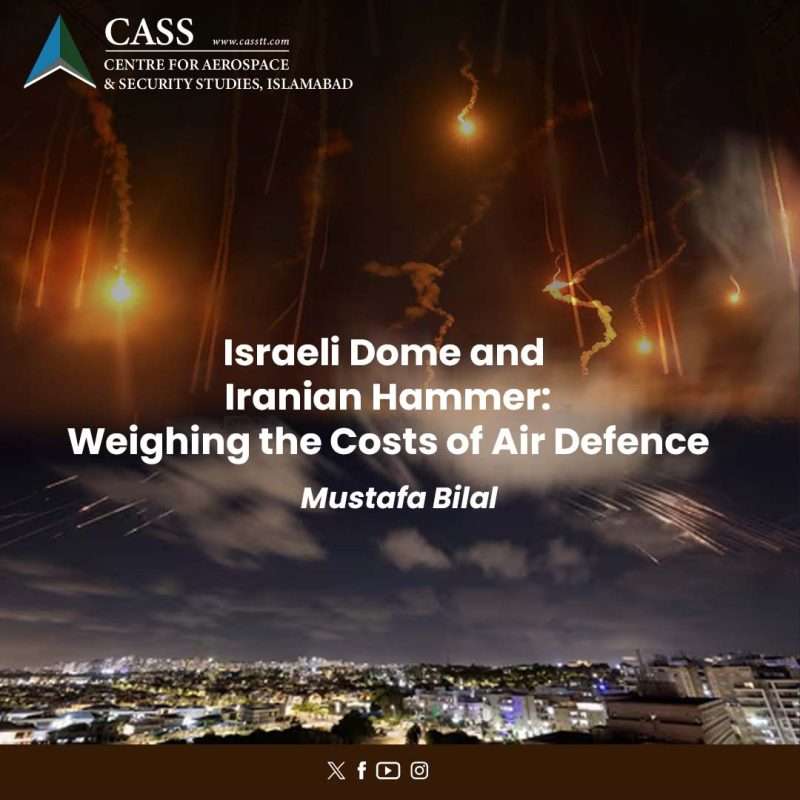
The Iranian missile barrage against Israel on October 1st piqued international interest in the cost-effectiveness of Air Defence Systems (ADS). A subject once bound to military circles is now a hot topic for primetime debates on talk shows. Mainstream reporting has focused on the unsustainable costs of maintaining sophisticated, high-tech ADS like the one Israel relies on.
Several international incidents have fed this narrative. Notably, the US Air Force used four Sidewinder missiles worth USD 500,000 each to down three ‘unidentified objects’ last year that were suspected to be cheap spy balloons. Similarly, the US Navy’s interceptions of USD 2000 Houthi drones with the USD 2.1 million per shot Standard Missile-2 (SM2) made for interesting headlines last year. However, is the cost of air defence as black and white as media headlines portray it?
Answering this question in the case of the recent flare-up between Iran and Israel is complicated. Back in April, it was reported that Israel incurred more than USD 1 billion while shooting down low-cost Iranian drones and missiles. The price tag of an Israeli Arrow interceptor goes up to USD 3.5 million. While the exact costs of Iranian missiles cannot be specified, a commonly held notion is that interceptors are far more costly because of precision and maneuverability requirements. This was true when US Patriot interceptors costing millions targeted Scud missiles in 1991. The argument is still valid today as expensive Israeli air defence interceptors are used to take out far cheaper drones and missiles.
Consequently, Israel is confronted with the paradox of operating an advanced ADS – each interception saves lives and property but comes at a steep financial cost. For instance, it would cost Israel over USD 9 billion if it were to intercept the 3000+ ballistic missiles reportedly in Iran’s inventory. However, Israeli officials claim that the value of protected lives, property and strategic assets, is worth the cost of using expensive interceptors.
Yet, as Iranian missiles lit up Israel’s skies, the dark possibility of a bleeding economy beneath was not far-fetched. The governor of Israel’s central bank had earlier warned that by next year, the cost of war for Israel could rack up to USD 67 billion, which is more than twice Israel’s current annual defence budget. There are also estimations that Israel is draining nearly USD 200 million a day. Coincidentally, USD 200 million is also estimated to be the cost of the recent Iranian missile barrage, as reported by the Jerusalem Post which underscores how comparatively inexpensive they were.
If the Israeli estimates regarding the cost of Iran’s missiles are taken at face value, Iran’s retaliation was equivalent to just two days of oil exports, considering that despite heavy international sanctions, Iran’s annual oil exports stand at USD 35 billion. Therefore, it makes sense for Iran and non-state actors neighbouring Israel to sustain the pressure on the expensive Israeli ADS, forcing it to over-extend against cheaper missiles.
However, while Iran can manage to fire large barrages of missiles now and then, should tensions further escalate, continuing such strikes would become economically untenable. Despite solid oil exports, the Iranian economy has been reeling under skyrocketing inflation, rising poverty, and unemployment. Notably, in February, the Institute of International Finance released a report warning that Iran’s inflation may exceed 100% in the outbreak of a regional war. This was followed by a World Bank report in April warning Iran that a war with Israel would accompany catastrophic consequences for Iran’s economy.
Given such stark warnings and rampant domestic political instability, Iran would likely exercise restraint to avoid an all-out war, which would entail a massive financial burden. Moreover, should such a scenario come to pass, Iran will have to face the operational challenges and dilemmas associated with air defence that Israel has been struggling with till now.
On the other hand, Israel would be backed by the combined military might of its Western allies, primarily the US. Israeli security officials have admitted that military assistance from friendly countries has significantly reduced interception costs. Moreover, the US has given nearly USD 18 billion in special military aid to Israel this year and emphasised the imperative of restocking Israeli air defence interceptors.
Additionally, two weeks after the Iranian missile barrage, the Pentagon confirmed that it is sending the Terminal High-Altitude Area Defence (THAAD) system to Israel for further bolstering its air defence. While Israel would welcome external support, it would also be keen to fast-track development of a cost-effective Iron Beam laser interception system, which is expected to be operational by the end of 2025. However, its effectiveness against cruise or ballistic missiles is debatable.
Ultimately, in the short term, Iran will have an economic edge in the offence-defence balance as it will undoubtedly replenish the expended missiles launched towards Israel and further build up its stockpile. Although in the long run, international support and technological innovations like the Iron Beam might assist Israel in keeping down the high costs of intercepting attritable drones and missiles. However, the economic resilience of Israel will remain questionable as it continues to bleed its economy dry in pursuing its genocide against the Palestinians and similar operations in neighbouring Lebanon.
Mustafa Bilal is a Research Assistant at the Centre for Aerospace & Security Studies (CASS), Islamabad. He can be reached at [email protected]