
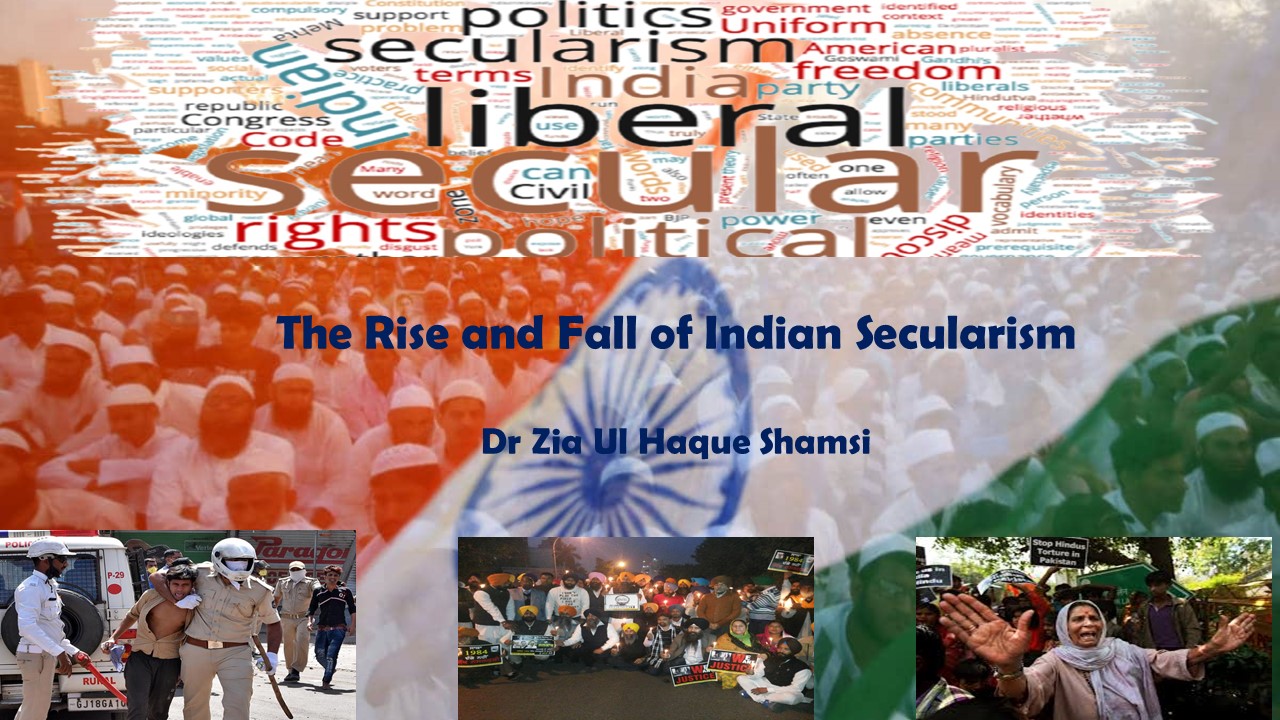
India, the largest democracy in the world, has a questionable record of Human Rights violations against its minorities in general, and in the occupied territory of Jammu and Kashmir in particular. Moreover, India carries the burden of a cruel caste system, denying equal rights and equal opportunities to all its citizens.
With the partition of British India in 1947, India’s founding fathers envisioned a secularist Constitution where all religious entities would be allowed to live together in peace and practise their respective religions with relative independence. However, BJP’s current government under Prime Minister Narendra Modi has moved away from the foundational principles of secularism and adopted the ideological philosophy of Hindutva by Hindu extremist outfit, RSS.
The Government of India Act 1935, stipulated introducing a federal system of government in India. However, at that time, the federal system was not based on any scheme of reorganization of the existing provinces of India and the princely Indian States were given an option to join the Indian Federation.
The state structure of India, as reflected in the Indian Constitution, rests on the concepts of democracy, socialism and secularism. These are considered pillars of Indian polity. It would be appropriate to discuss, briefly, these terms, in general as well as in the perspective of Indian leadership.
Democracy may be described as a system of Government under which the people exercise their governing power either directly or through representatives they periodically elect. Its institutional expressions include – the equal right of all normal adults to vote and stand as candidates for periodic elections, and freedom of speech, publication and association. This explanation of democracy describes it as government by the people as orchestrated by old thinkers such as John Stuart Mill and Abraham Lincoln. Indian thinkers conceived democracy not as a form of government but as a form of society, a way of life whose essentials are equality and fraternity. According to Gandhi, “My notion of democracy is that under it the weakest should have the same opportunity as the strongest.” The distinguished philosopher, Sarvepalli Radhakrishnan thinks, that “democracy is at once a political arrangement and economic approach and an ethical way of life.” To Nehru, “democracy means equality, and democracy can flourish only in an equal society.” Whether these precepts were implemented or not is another discussion but the introduction of a democratic system did increase political consciousness in the vast areas of India.
Another pillar of Indian polity was socialism. The new state emerged from colonialism with a considerable degree of legitimacy. Nehru and his associates were perceived to be the undisputed leaders of the new state. As Nehru consolidated his position in the early years, his brand of socialism became virtually the national ruling ideology. Though the precise content of this socialism was not clear, it involved a commitment to “State intervention in the economic matters … and a modicum of income redistribution.” Despite vocal commitments to create socialism, the Nehru years resulted primarily in the consolidation of the new state power, along with the initiation of industrialization through public support of the private sector. The lower classes did not gain much from this policy and only the nationalist leadership, industrial and commercial classes, and the bureaucratic groups managed to enhance their political and economic interests. The failure to implement redistributive policies exposed the Indian State’s capacity to confront the upper class and added to the miseries of the lower class.
The third pillar of Indian polity was secularism. The Indian land had given birth to four religions of the world – Hinduism, Jainism, Buddhism and Sikhism. The other four religions – Islam, Christianity, Zionism and Zarathustra had come in from outside Indian Territory. India is a proclaimed secular state. It means that the state does not identify itself with any religion, rather respects all faiths. The Indian Constitution guarantees freedom of religious propaganda but does not guarantee freedom of anti-religion propaganda. Theoretically, all these eight religions are allowed to flourish under the Constitution. The Constitutional Acts provide freedom to practice and profess religion in private and public, but freedom of religion does not prohibit the state from regulating, banning or abolishing certain religious practices and dogmas associated with a certain religion. The trauma of Partition in 1947 and the complex religious composition of the country’s population compelled the Indian leadership to adopt a secular approach to project equal respect for all religions. However, the Modi-led BJP government has practically denounced India’s secularity and subjected its minorities to atrocities unparalleled in India’s history. Be it in Indian Occupied Jammu and Kashmir or Assam, RSS fascist agenda has had a toll on India’s claim of secularism. While the Modi regime’s atrocities against the minorities continue unabated, unfortunately, the developed West maintains a deafening silence towards the Human Rights Violations in India, barring a few occasional voices of concerns from some international institutions.
The writer is the author of the book ‘Nuclear Deterrence and Conflict Management Between India and Pakistan’. He is presently working as the Director at the Centre for Aerospace & Security Studies (CASS). The article was first published in Dialy Times. He can be reached at [email protected]
Image Source: Etfa Khurshid Mirza



