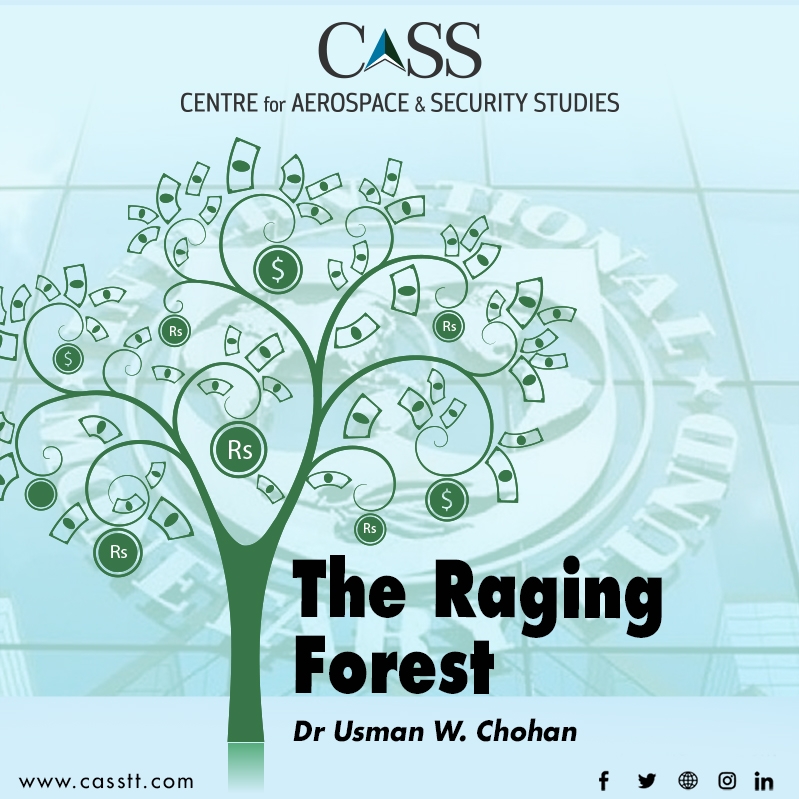
Although the persistent interest of most observers has been on the IMF’s ongoing negotiations with Pakistan on the Ninth Review, it is important for us to see things in a wider perspective. As a recent seminar on the economy held by CASS illustrated that there are profound structural factors, as well as massive cyclical headwinds in the global economy, that have contributed to Pakistan’s economic malaise. To fixate on the ongoing meetings is understandable, given that the IMF’s nod will unlock a series of external disbursements, but to look at this contestation as a singular make-or-break event leads us to miss the forest for the trees.
On the global economic front, many countries face adverse fiscal and balance-of-payments challenges. This is attributable to the commodity supercycle, the war in Ukraine, supply chain disruptions, uneven post-COVID recoveries, and perhaps above all: US interest rate policy. The conjunction of all these problems has been termed the ‘polycrisis’, in which countries are mired in multiple crises simultaneously. There is a litany of countries that face acute socioeconomic difficulties, and Pakistan is but one of them, although one that is disproportionately affected by cyclicality due to its existing vulnerabilities.
That is where, on the domestic front, one has to wonder why the country has gone to the IMF 22 times in the past. For those who view the IMF as an ‘emergency ward’, it is troubling to see that Pakistan goes there on a regular basis. It is necessary to confess, therefore, that there are deep structural issues that afflict the country, and they have been padded over for a very long time, in some cases many centuries. But, one can only kick the can down the road so far.
For this reason, a total fixation on the IMF meetings and reports leads us to miss many fires in the forest that we must ourselves put out. For example, the rule of law is not something in the purview of the IMF, nor is judicial performance, nor is political elite infighting. The IMF is not to blame for the shortcomings of the primary and higher education system, the structure of feudal land ownership, the incessant birthrate of the masses, or the inability to prepare for floods.
The list of problems runs very long, and one cannot address these issues by getting a billion here or there. We import too much relative to what we export because we are an unproductive society with a particularly unproductive elite, who drive consumption but fail to create value for the public. Our government, at both the provincial and federal levels, is too large relative to the value it creates, which means that our expenditures far outstrip our revenues. Having a large government would make sense if it contributed substantial public value, but it does not. Parents still pay for private schools, patients still pay for private healthcare, and so forth.
The IMF Ninth Review meeting appears to have been broad-based and substantive, but even it would not be able to comprehensively look at all that needs to be done. There are too many fires in the forest now, and they must be addressed by the people, for the people.
Dr Usman W. Chohan is Advisor (Economic Affairs and National Development) at the Centre for Aerospace & Security Studies (CASS), Islamabad, Pakistan. He can be reached at [email protected].