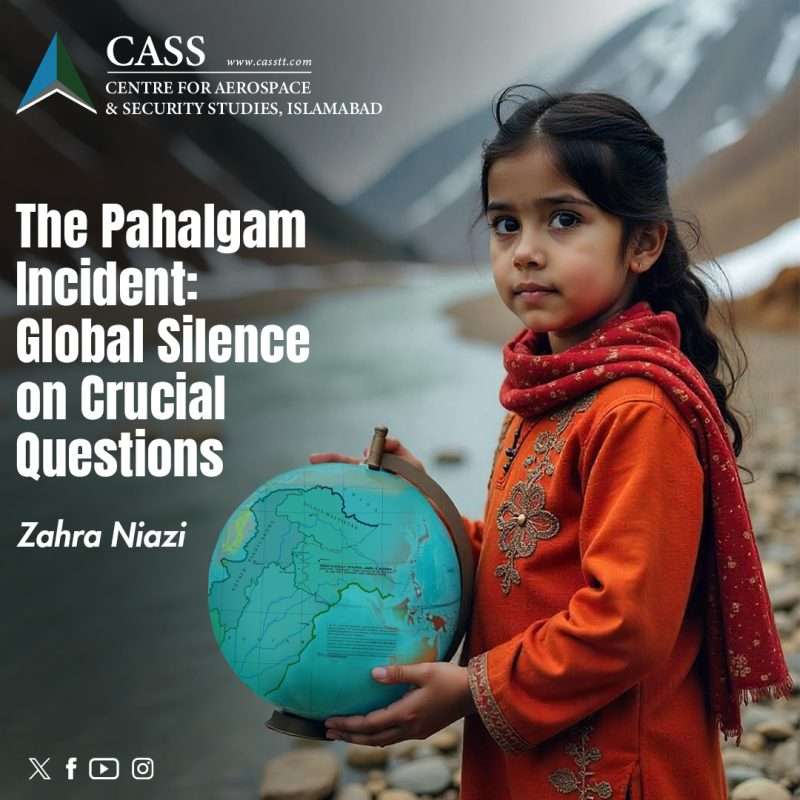
Global reactions to the Pahalgam incident were swift, with countries expressing condolences, issuing statements of condemnation, and extending offers of diplomatic support to India. International media outlets also covered the incident widely, highlighting its gravity. Yet, outside of independent analyses, what has been lacking is a call for deeper reflection into alternative narratives to the dominant cross-border terrorism framework. This risks undermining an impartial investigation and a complete understanding of the incident, allowing one side of the narrative to gradually become accepted as the sole version of events.
Crucial questions such as – What must change in Indian Illegally Occupied Jammu and Kashmir (IIOJ&K)? How was the attack allowed to happen in one of the most militarised places on earth? Why did intelligence and surveillance systems fail to detect or prevent the attack? How can verifiable eyewitness accounts come to the fore in the absence of independent journalism in the Indian occupied territory? How dangerous could the consequences of New Delhi’s unverified claims be? Are post-attack policy actions by India (like suspending the Indus Waters Treaty) opportunistic, dangerous, and illegal? – are not being prominently asked. Such questions do not constitute interference; rather, they arise from logical inquiry and sound reasoning aimed at mitigating the consequences of an already tragic incident and preventing its recurrence.
Despite IIOJ&K’s status as one of the most heavily militarised zones in the world and Pahalgam being known for its three-tier security arrangement, attackers were able to strike a crowded tourist spot in broad daylight, raising obvious concerns about New Delhi’s security apparatus and the root of the incident. Even opposition figures in India have issued strong statements about security and intelligence failures, calling for comprehensive scrutiny. However, without sustained attention from world leader, global media outlets, international organisations, human rights groups, and policymakers, the question risks being sidelined despite its critical importance.
Equally opaque have been the claims and accusations made in the name of eyewitness accounts following the incident. The ‘Jammu and Kashmir Police’, for instance, swiftly released sketches of three assailants, which they claim have been developed based on recollections by eyewitnesses. Two of the attackers were allegedly linked to Pakistan. Similarly, widespread claims suggest that the gunmen selected victims based on their religion. Yet, the credibility of these assertions, and the potential dangers of allowing them to circulate without impartial verification, has received little scrutiny within mainstream discourse.
In the repressive environment of IIOJ&K, the prospect of an impartial investigation is not just unlikely; it is systematically obstructed, ensuring that critical truths remain buried and narratives are shaped to serve political agendas. Press freedom in Indian-occupied Jammu & Kashmir sharply declined following revocation of Articles 370 and 35A in 2019, with local journalists facing surveillance, harassment, and charges under anti-terror laws. Foreign correspondents are deported for critical reporting or denied access. The region has remained under the direct control of New Delhi and operated as a ‘police state’ with high levels of surveillance and incarceration of Kashmiri political leaders and activities. This is the unstable and fragile status quo, under the guise of normalcy, which should have been vociferously challenged when statements of condemnation were issued.
Moreover, India’s response to the attack was alarmingly hasty, rooted in vested political agendas and unsubstantiated accusations against Pakistan, issued within hours of the incident without any reliance on verified facts. Most dramatically, New Delhi announced it would hold the IWT in abeyance, unilaterally suspending a more than six-decade-old water-sharing pact with Pakistan, despite the fact that prior Indian actions already constitute serious breaches of the treaty’s legal framework. The IWT contains no provision for suspension and can only be altered through mutual agreement between Pakistan and India. However, experts opine that IWT suspension can severely impact Pakistan if New Delhi immediately starts constructing dams. Yet, the opportunistic and unlawful nature of India’s policy move, and the dangerous precedent it sets by weaponising essential resources like water, failed to provoke the level of global alarm and condemnation that such a grave violation warranted.
The global community must move beyond perfunctory statements and take decisive action: it must ask the hard questions, demand an independent investigation into the incident, and hold India accountable for its reckless, self-serving actions. It must confront the deeper structural injustices in Indian Illegally Occupied Jammu and Kashmir rather than enabling their erasure through silence. Anything less would not only betray the victims of this tragedy but also ensure that the cycle of violence and oppression continues, costing more innocent lives under the guise of manufactured normalcy.
Zahra Niazi is a Research Associate at the Centre for Aerospace & Security Studies (CASS), Islamabad. She can be reached at: [email protected].