Concept Note
Pakistan’s relations with the United States have been complex, cyclical and critical. This relationship is influenced by global and regional developments as well as domestic factors and dynamics in both countries. The recent swift and complex developments currently underway in the Asia-Pacific and South Asia regions, can have profound and long-term implications for regional security, Pak-US relations and Pakistan’s national security. In addition, global strategic trends such as QUAD and AUKUS, regional developments particularly the US military withdrawal, proposed American legislation on Afghanistan and growing US-India strategic cooperation are significant for the future of Pak-US relations. Furthermore, the deepening influence of Indian diaspora within the US is also affecting Pak-US geopolitical, security, economic and sociocultural relations. Moreover, Pakistan’s domestic cultural, political and bureaucratic norms and dynamics also constrain the country’s ability to effectively negotiate with major powers. Therefore, these key international trends as well as domestic factors deserve timely and comprehensive intellectual reflection to manage this complex and critical Pak-US relationship.
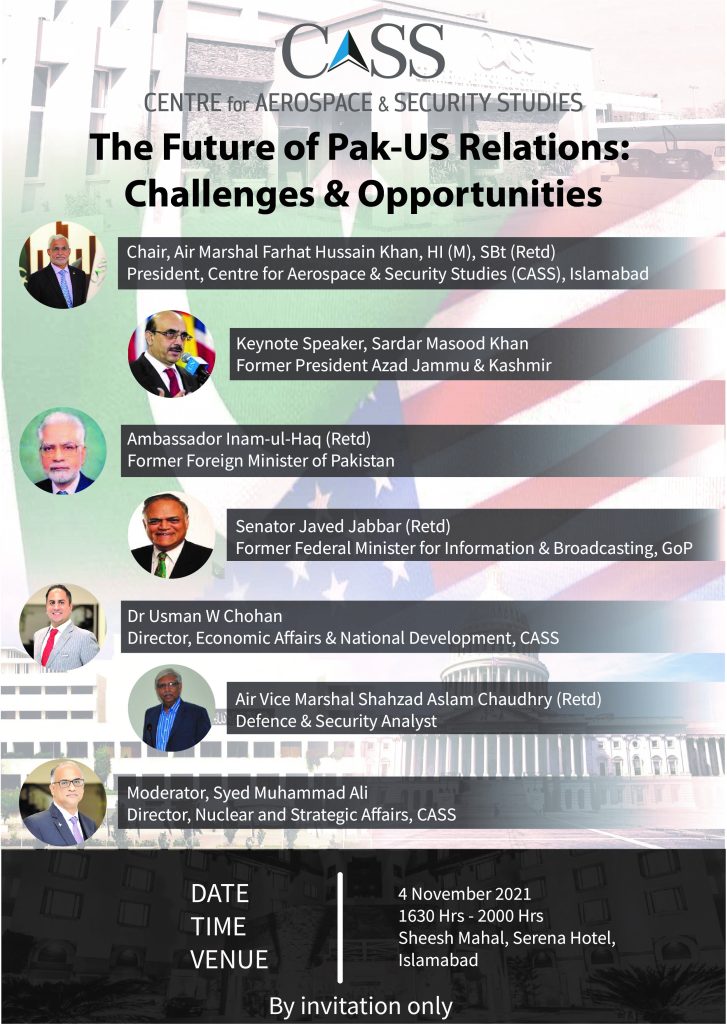
In order to analyse the nature and significance of these international developments and domestic factors, CASS is organizing a seminar on“Future of Pak-US Relations: Challenges & Opportunities” on Thursday, 4 November 2021. This initiative by CASS will allow leading experts to critically analyse the global and regional political, economic, security and cultural dimensions, evaluate the domestic dynamics that affect the Pak-US relationship and also recommend a way forward, in each of these domains. Leading experts will also explore fresh ideas and help identify potential areas of mutual cooperation between the two states, at both bilateral and multilateral levels and fora.
This event will be of interest to the political, diplomatic, strategic and military leadership, relevant institutions, think tanks, media, academia and students who closely follow various aspects of the security, stability and development of Asia-Pacific and South Asia.