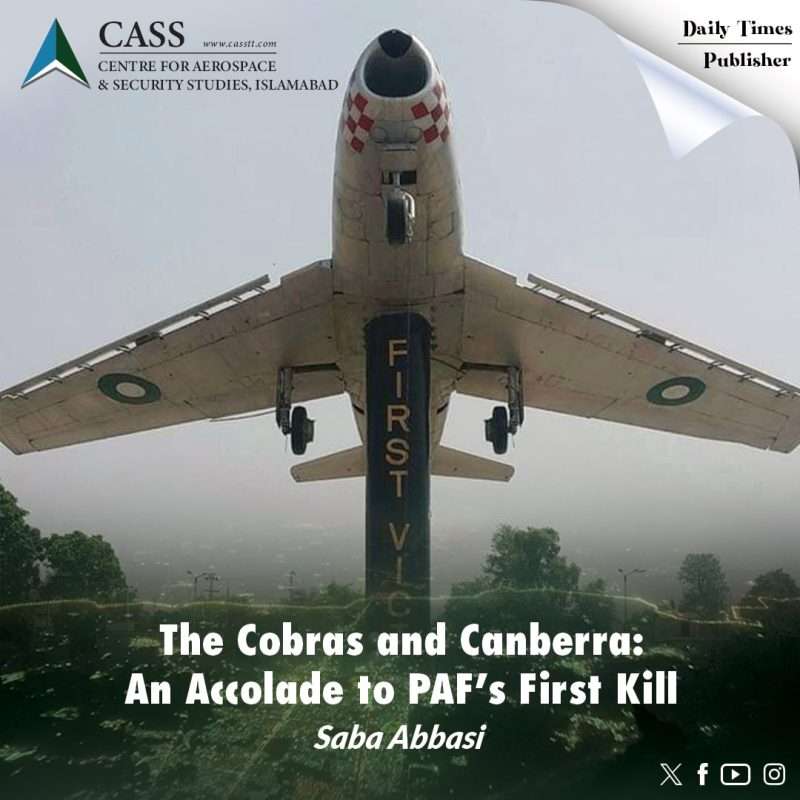
Pakistan Air Force (PAF)’s Squadron 15, known as the ‘Cobras,’ holds a number of notable operational achievements. Its first confirmed aerial victory occurred with the downing of an Indian Air Force (IAF) Canberra on the fateful morning of April 10, 1959. It was Eid-ul-Fitr, with most of the PAF on leave at the Peshawar base. Flight Lieutenant Muhammad Younis and Squadron Leader N.M. Butt, who were among the limited personnel on duty at the Peshawar base, received a scramble alert from the Sector Operations Centre at Sargodha Cantonment. At the same time, the duty air defence controller, despite initial challenges in tracking the intruding aircraft using an aging radar system, successfully identified its coordinates. This enabled the PAF’s F-86 Sabre jets to establish visual contact with the target, specifically: an Indian Canberra PR 57.
Cruising at an altitude of 50,000 ft above Punjab, the photo-reconnaissance Canberra aircraft was far beyond the range of Younis and Butt’s Sabres’ performance envelope, but not beyond the operational ingenuity of the pilots. The ensuing engagement demonstrated notable use of tactical awareness and aerial manoeuvring.
Flight Lieutenant Muhammad Younis executed a calculated move to force the Canberra to bleed altitude. He deliberately allowed himself to be visually acquired by the intruding aircraft, anticipating that upon spotting the Sabres, the Indian pilot would initiate an easterly break toward own airspace. Younis banked right, positioning himself to influence the adversary’s turn geometry. Knowing that sustained hard turns result in altitude loss, he exploited this. The tactic worked! Upon sighting the interceptors, Squadron Leader J.C. Sengupta rolled the Canberra just as anticipated. But then he sighted Squadron Leader Butt on the other side. This compelled him to tighten his turn. The back and forth effort of taking two sharp turns caused the Indian aircraft to considerably lose its altitude. This was the moment when Younis unleashed a round of bullets at the Canberra’s right engine, sending it into a downward spiral. The IAF pilots ejected and remained unharmed. They were later sent back to India.
This interception took place at a time when Pakistan was a young state. It was not technologically at par with its counterpart, India. Yet, PAF’s professional acumen and tactical brilliance established their credibility as an Air Force to be reckoned with. The reduced availability of personnel due to Eid-ul-Fitr was effectively managed through adaptive tactics and efficient use of available resources by the PAF’s young pilots. Secondly, the strategic manoeuvre to neutralise the high-altitude edge of the Indian Canberra by influencing enemy’s disposition was also exceptional.
The timing of the incident, occurring on Eid-ul-Fitr, added a symbolic dimension, as the day is traditionally associated with spiritual reflection and festivity. News of the successful interception of an Indian aircraft on an espionage mission, coinciding with Eid celebrations increased the day’s significance, patriotism and belief in the defenders of the country.
Professional handling of the captured IAF pilots by the PAF reflected adherence to the norms of military conduct. It also reinforced Pakistan Armed Forces’ aim to defend Pakistan’s sovereignty and territorial integrity, but to not escalate the situation after that goal has been met.
The PAF’s commitment to national security was evident in the events of that day. Professionalism of the personnel involved stood out as the limitations of the vintage radar system did not hinder the duty air controller’s determination to locate the Canberra. Despite the altitude advantage of the Indian aircraft, Flight Lieutenant Younis displayed notable resolve and skill in executing his mission and was awarded Sitara-i-Jurat. In fact, operational limitations were turned into tactical advantages through strategies that the adversary did not expect to encounter.
The operation demonstrated effective navigation, timely decision-making, and tactically calibrated engagement, elements that came to define the Cobras’ operational ethos. The eventual release of the IAF pilots reflected professional restraint, consistent with broader strategic and diplomatic considerations. Reflecting on the incident also underscores the continued importance of modernising air defence technologies and systems. The lessons of April 10, 1959 indicate that sustained tactical adaptability, technological advancement and specialised military training is crucial for shaping Pakistan’s air defence strategy in the 21st Century.
Saba Abbasi is a Research Assistant at the Centre for Aerospace & Security Studies (CASS), Islamabad, Pakistan. The article was first published in Daily Times. She can be reached at [email protected]