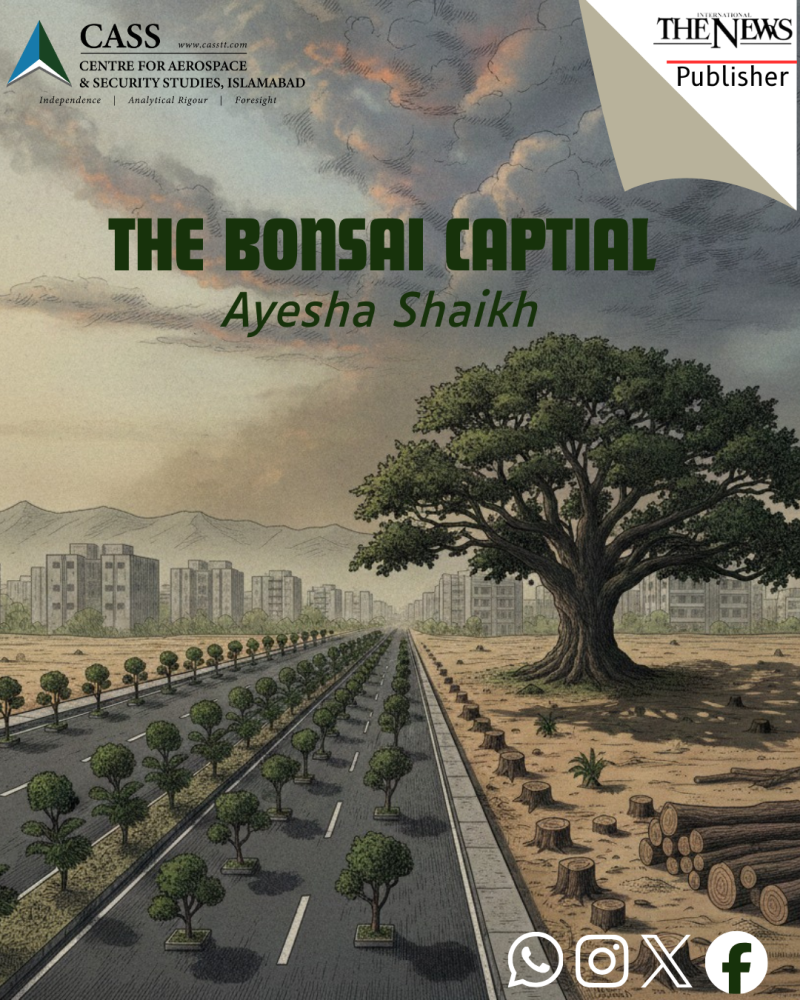
There was a time when, during the extension Margalla Road in Islamabad had bend to go around old trees. However, the city that was once known for its ability to conserve greenery and blooms every season is now under the spell of massive tree-massacre and bonsai plantations. The year 2025 brought along hailstorms and cloud bursts for the calm and scenic city of Islamabad. These extreme weather events are nature’s way of manifesting its discontent towards the disruptive practices of tree-slaughter and dwarfed cultivation in the region. The phenomenon indicates governance inadequacies, and nature is not the only one discontent with it. The traditional patterns of plantation need a tech-based supervision and adequate legislative oversight to escape the adverse effects of Bonsai Urbanism.
Episodic tree-slaughter in Islamabad in the name of urbanism and allergy-prevention attracted severe criticism from society. Authorities decided to erase trees to eliminate pollen allergy, at the expense of reducing the oxygen supply to the citizens. In the face of growing public discontent, the hasty tree-plantation drives were arranged, without catering to the seasonal implications reflecting poor ecological sense. Furthermore, the Islamabad High Court (IHC) also issued directives to prohibit further tree slaughter, but only under mounting pressure of condemnation. Nevertheless, the reactionary model is not a solution to deal with the uncertainty revolving around the growing threat of climate change.
The recurrent plantation schemes, such as ‘Spring Tree Plantation Drive 2025’ or the ‘Aik Beti Aik Shajar’ drive, indicate a mere greenwashing of the climate-insensitive approach. Climate activists from Islamabad expressed concerns about the management of resources allocated for such plantation drives. The nurseries designated to provide plants for such plantation drives deny access, claiming that they do not have suitable species or sizes of plants and instead offer expensive hybrid non-native varieties. Experts further added that the authorities prioritise infrastructural and development plans over the conservation of greenery or promotion of plantation drives, as evident in the recurrent construction schemes along over Islamabad. On 13th January 2026, World Wildlife-Pakistan also issued a statement declaring that the annual tree purge in Islamabad is driven by infrastructural plans and not by the intent to eliminate allergies, as claimed. Even though a few immediate measures have been taken to address the controversy, the state still lacks sufficient legislative instruments, sanction mechanisms, and expert oversight to regulate elimination of old trees and the plantation of new ones.
In addition to the tree-erasure, bonsai and hybrid plants have emerged as a new trend in the capital and around new development schemes. While seeming to enhance the ornamental value of landscape, bonsais offer less, cost much more, and are maintenance-intensive as compared to regular native plants. On the other hand, they do not serve as carbon sinks, soil anchors, and environmental regulators like traditional plants do. The green canopy offered by decades-old Pepal, Banyan, Sukh-chain, Kikar, Bukain, and Sheshum trees during the hot summer afternoons cannot be replaced by the shrub-sized green appearance of a hybrid variety.
Another variant of the ornamental plantation is the extensive shift towards Palm trees. While Palm trees offer an elevated aesthetic appeal, significant to the deluxe development models of Gulf states, they are not suitable for the climate of Islamabad. Palms are accustomed to the hot, dry terrains and tropical coastal areas. In topographies such as Islamabad, they offer less in terms of climate regulation and require more care due to dry winters and less humid summers. The impact is visible through the difference in the Air Quality of sectors susceptible to the bonsai trend. While the impacts are starkly visible in the capital, the trend is not limited to Islamabad alone but spreads to all large cities.
The rows of bonsai trees and hybrid greenery along the Murree Road grab attention as one travels towards Rawalpindi. Furthermore, the emerging housing societies proximal to the inter-city motorway (M-3) all the way to Chakri are another disastrous move. Acres of green arid land have been exploited for urbanisation away from the core urban hubs. One wonders as to why these societies cannot be forced to ensure plantation during construction phases and use tree transplants to shift grown trees.
Overall, this disastrous shift can be attributed to multiple factors. Firstly, governance failures on the part of the Development Authorities. The ‘Mali Culture’ in the governance sector, where the decision makers assume charge as botanical experts to develop plantation plans, detrimental to ecology. The loopholes in these plans allow the ‘Timber’ and ‘Nursery Mafia’ to exploit the environment. While the timber selling gangs directly benefit from the episodic tree-slaughters in the city, the Nursery mafia profits out of the hybrid and ornamental plants that cannot sustain local climate and require investments time and again. In the face of these developments, the best that authorities do is to come up with narratives such as the paper mulberry and new plantation story. If machinery worth millions can be brought for construction why not tree transplanter machines. In fact tree possessing transplanters should be made compulsory for all housing authorities.
Reactionary policies and ad-hoc measures, in addition to the commercialisation of natural resources like trees and the environment, are deteriorating the ecological balance. Sufficient legal oversight and sanction mechanisms are required to deal with the growing threat of climate change. Moreover, policy-making regarding environment-related issues or urban development plans should be inclusive of the inputs from experts from institutes established for such matters. The National Agriculture Research Centre (NARC), Arid Agriculture University, and the Islamabad Wildlife Management Board have sufficient expertise and advisory mechanisms.
The world, both in terms of climate disruption as well as technological upgradation, has evolved. Pakistan is the fifth most climate-vulnerable country in the world, but it is also a state growing in terms of its non-kinetic satellite capabilities. The recently launched Hyperspectral satellite (HS-1) of Pakistan can provide oversight on the nature and impact of tree cutting and rapid urbanisation to facilitate policy making. Furthermore, it can also assist the development of sustainable urban plans. Inclusive policies, appropriate laws and a sustainable approach can pave the way for the conservation of the lifesaving green cover of Pakistan.
Ayesha Shaikh is a Research Assistant at the Centre for Aerospace & Security Studies (CASS), Islamabad, Pakistan. The article was first published in The News. She can be reached at [email protected]