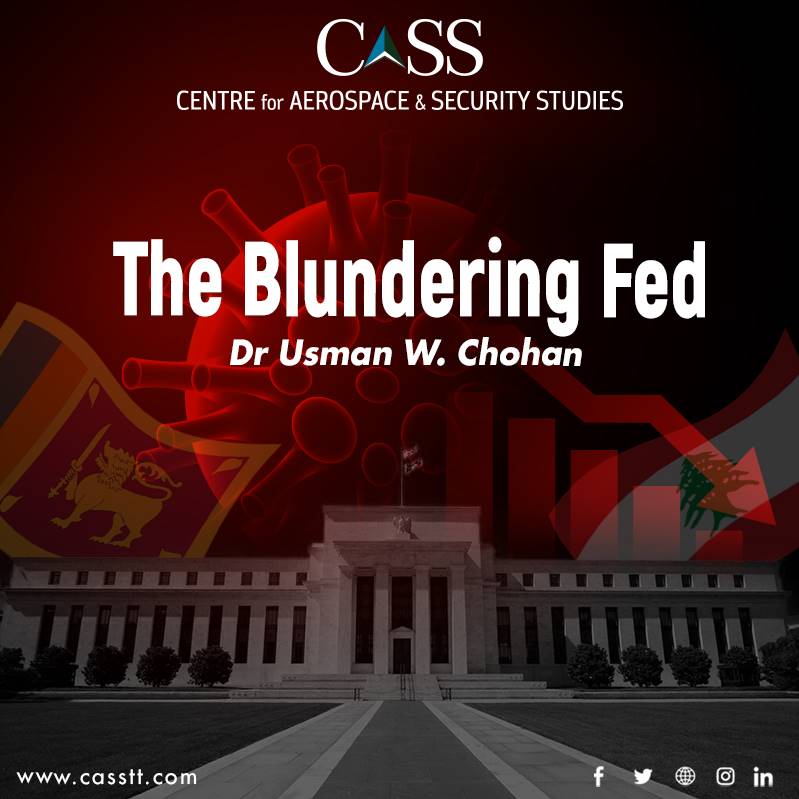
As countries in the developing world have begun to falter economically during the post-Covid era, their publics have begun to seethe with a rage directed at the ineptitude and corruption of their governments. Many countries fall into this category, including Sri Lanka, Lebanon, Argentina, and Pakistan, to name but a few. The publics of these countries are struggling with a brutal combination of heightened inflation and economic stagnation (“stagflation”), and their resentment is being singularly directed towards their leadership’s inability (or even unwillingness) to either show compassion with their plight, or to offer a clear direction for economic recovery. In Sri Lanka, this resulted in the storming of the presidential palace at Colombo in 2022. In Lebanon, it has led to incessant rioting across Beirut and other cities. Similar observations are being made in Haiti, Congo, Argentina, Peru, and many other countries.
Yet at the root of their economic problems lies another institution, one that most people in these countries may not have even heard of: the US Federal Reserve. Its responsibility in creating a new global economic crisis (certainly for the Third World) isn’t short of criminal, if it weren’t simply stupidity to blame. After the world began reopening post-Covid in 2021, the Fed made a monumental miscalculation by stating that “inflation was only transitory,” and that the revving up of the global economy after more than a year of lockdowns meant that inflation was just a short-term phenomenon which the market would fix on its own. The Holy Market did not fix it because the inflation was a result not just of “transitory” economic reactivation, but the consequences of two cyclones of stimulus: 2008 and 2020.
After the 2008 global financial crisis, which was triggered in no small part by the Fed’s poor oversight of corrupt bankers, the Fed decided to give a dose of morphine to the economy instead of resolving the toxic-asset problem in the American economy. The 2008 morphine injection of quantitative easing (monetary stimulus) patched up the problem for a while, but it did not address the roots of economic dysfunction in America: financial lobbying, a revolving door between Washington and Wall Street, and growing inequality due to underinvestment in the public. But the Fed was enjoying the accolades, and the man who spearheaded the stimulus even received the Nobel Prize in Economics (Ben Bernanke). It therefore didn’t tighten monetary conditions because the ride was too good, and because American elites did not want to face up to the actual erosions within the underbelly of the economy.
When the Covid-19 pandemic hit in 2020, therefore, the Fed was still too happy enjoying the buzz of 2008 morphine, and administered another dose of morphine ten times larger than the previous one. If it hadn’t done so, it argued, the economy would have faced more devastation than any war might have unleashed. The 2020 morphine of quantitative easing was also, however, a mere sedative that did nothing to remedy the structural issues that had festered in the American economy. In fact, much of the stimulus went to large corporations rather than to desperate households! It was an elite nomenklatura that captured too much of the stimulus, with trinkets thrown (the $600 stimulus cheques) at the public. The trinkets themselves did not necessarily go into the right end uses either, and much cash flowed through retail investments in stocks, cryptocurrencies, a new housing market bubble, NFTs (a whimsical digital asset), and other eccentric collectibles. The American stock market was up, even as the economy was down.
As such, two massive morphine doses over 15 years, and the Fed somehow thought the withdrawal systems would be mild. “Transitory inflation,” it said. When it realized how off-the-mark it was, inflation had already taken a galloping speed post-Covid. The Fed thus reacted with equally irresponsible timing by shooting up interest rates at the fastest rate in history. This led to massive reverberations throughout the American economy, with the stock market, housing market, cryptocurrency market, and just about all markets collapsing simultaneously in 2022. In 2023, this also led to devastation in the American banking system, including the collapse of SVB and Signature ban. A great deal of fictional wealth was eroded in a brief time span, as shock therapy was being applied to the morphine addict.
Yet, the problem lies not in the withdrawal symptoms of the American economy domestically, but on the repercussions for the rest of the world. As the interest rates rose in 2022, a great deal of international capital moved into the US to profit from a better risk-adjusted return. Many emerging markets saw the near-entirety of their holdings evaporate as they paid for higher energy imports (inflation) and the international investors fled for the door. In April 2022, as an example, Egypt lost $20 billion dollars to capital flight in a single week. Similarly, whereas Pakistan had more than $21 billion of foreign reserves in September 2021, by the end of 2022 it had a minute fraction of this remaining, enough only for a month of imports at best.
Emerging markets thus suffered from the sheer incompetence of the US Fed, administering morphine to its moribund subject but the tremors and backlashes of which were felt by the developing world above all. What the past 15 years teach us is that, for the great power that the US Fed has enjoyed on the world economy since the mid-1970s, it simply doesn’t have the competence or the interest in undertaking this responsibility. The primary enemy of the hungry child in Colombo or Beirut isn’t just her corrupt or inept national leader, her bigger enemy is the incompetent US Fed, which has unwittingly brought many countries to abject economic ruin with the strokes of a pen.
Neither is the US economy seeming to recover, nor are any of the emerging markets that the Fed’s policies have brought to paralysis. The worst part is, if you were to ask the Fed chairman where the countries are on the map which he and his predecessors have inadvertently destroyed, he would not be able to point them out to you. That countries such as Sri Lanka and Lebanon have poor leadership should not mean that the people should be served a death sentence. Yet with the US Fed’s blundering atrocities, this institution is writing the death warrants of millions.
Dr. Usman W. Chohan is Advisor (Economic Affairs and National Development) at the Centre for Aerospace & Security Studies, Islamabad, Pakistan. He can be reached at [email protected].