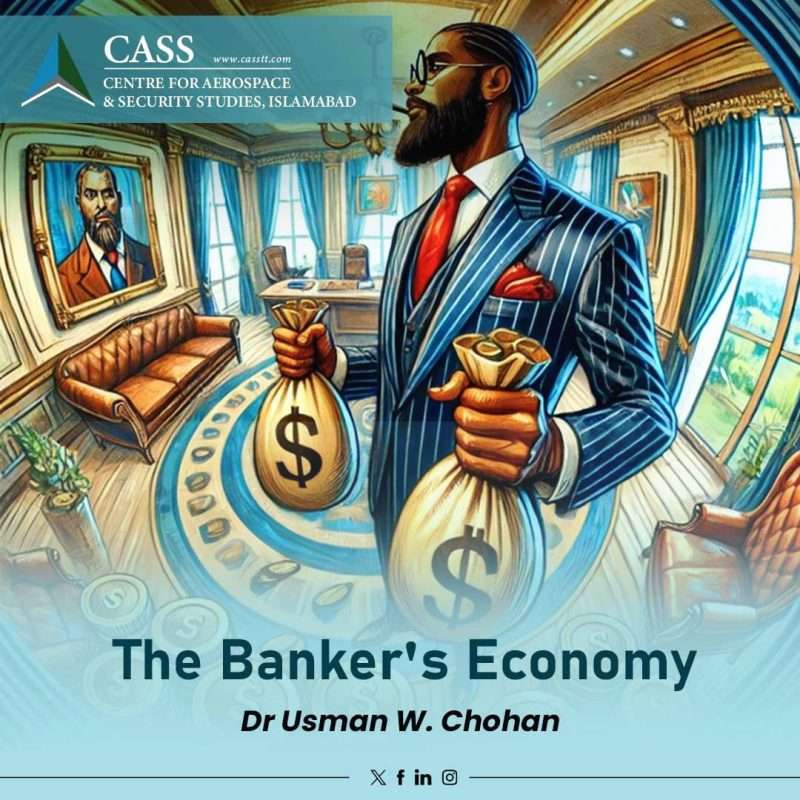
Many societies today face the economic problem of an “outsized” banking system, too powerful in its influence and too distortionary in its impact for the rest of the economy to function properly. In the United States, this problem is often framed as “Main Street vs. Wall Street,” and I have discussed the repercussions of the matter during crises extensively. Although the framed dichotomy of Wall St. vs. Main St. dates back more than a century, it has begun to take on new life in many societies, both rich and poor, as the basis of an acrimonious political confrontation.
The crux of the matter lies in how the financial sector extends its reach into the political and social realms, wielding power over national decisionmaking (politics) through funding and through a revolving door of officials manning key political positions, while also exerting overt and covert influence over public policy (social). The problem is now considered widespread in market economies, with only a few governments that have extremely forceful state power such as Singapore and China holding a tight harness over real banking power.
Pakistan has also fallen prey to a Main St. vs. Wall St. dichotomization, with an undue influence of the banking sector over the economy as a whole, with both political and social categories of outsized influence. The most recent budget gives an indication of this, but the problem is far older and larger in scope than just the annual federal budgetary document would suggest. One way to present evidence for this is in the nominal economic leadership, where the majority of our Finance Ministers over the past four decades have been either bankers or accountants. While bankers and accountants have their own valuable sets of skills and perspectives, what they generally lack is the holistic view of economic life that individuals with a formation in economics (should) possess. The master-economist, as Keynes saw it, was something altogether different from the dollars-and-cents types that bankers and accountants tend to (and need to) be.
But while that is a question of acumen, the acrimony of Wall St. vs. Main St. arises not from issues of competence, but rather from conflicts of interests (the revolving door). A banker heading the economy is the harbinger of a banker’s economy, which the most recent budget reflects. There is something to be deduced from the performance of the banks in Pakistan in comparison to the economy of Pakistan as a whole. Consider the following pattern: every quarter, Pakistan’s banks post “massive” “record” profits, quarter-after-quarter. The banks’ profits are “shooting up”, and admired for being “strong and steady.” Why? Is our economy shooting up? Is our economy strong and steady?
Far from it, the discrepancy lies in the massive distortion in our economy that has ballooned to unsustainable proportions: the commercial banks have become the biggest lenders to the government, and lend risk-free with reckless abandon at usurious interest rates. The banking sectors’ portfolio of government securities now matches the size of total deposits that are made into the banks! Whereas the size of the banking sectors’ advances (lending) portfolio was the same size as the holdings of government securities a decade ago, today the government securities’ holdings are an astounding 2.5x that of the advances portfolio. The cumulative balance sheet of the commercial banks has now doubled in size, and it isn’t because the volume of deposits or number of depositors has increased that substantially; it is because of the binge-borrowing of the federal government from the private banking sector.
In no small part is this the logical outcome of the State Bank of Pakistan Amendment Act (SBPAA), which precluded the central bank from direct lending to the government, and pushed the SBP to inject liquidity through the private banking system instead. The private banks are now reaping the interest and reaping record profits in an erstwhile moribund economy. CASS has studied the problem carefully and from multiple angles, concluding that the SBPAA would be a damaging law, detaching our monetary policy from our economic security. Instead of economic security, the current monetary arrangement pushes us towards greater jeopardy.
We must remember that commercial banks are our institutions, operating in our jurisdiction, dealing with our citizens and our state, under our rules. Yet we are not exacting from them the same measure that we are from the rest of the economy, not least the salaried class, whose backs are being broken under the new budget’s tax measures. Instead, for the banks and their record profits, the federal government has decided to roll back the 15 percent additional income tax on banking profits from investment in government securities. In my forthcoming budget analysis, I lay a very significant emphasis on reshaping the domestic banking system because of the scope of its impact on the federal budget (on the revenue side). It is in fact an area of the utmost concern if we seek to have a viable budgetary architecture.
In addition, we must consider the relative importance of foreign vs. domestic borrowing. We borrow from a foreign country at 2-5% interest rates, but we have been borrowing from our own banking system at >20%! The problem has become particularly acute since the global post-Covid monetary contraction, where the SBP decided to raise rates to catastrophic proportions (22%), to a level at which few businesses could function. Even as inflation had begun to subside, the central bank hesitates to lower rates, with the nod of both the IMF and the commercial banks. Why go on foreign trips with a humiliating metaphorical kashkol for debt rollovers and the like, when local bankers are making a windfall? Is it conceivable to have commercial banks making the profits that they do in the economy we are in? Put another way: should our Wall Street be doing so well when the rest of the economy is so unwell? It does not make sense, and the way that our Main Street is beholden to our Wall Street warrants serious reconsideration.
Dr. Usman W. Chohan is Advisor (Economic Affairs and National Development) at the Centre for Aerospace & Security Studies, Islamabad, Pakistan. He can be reached at [email protected] .