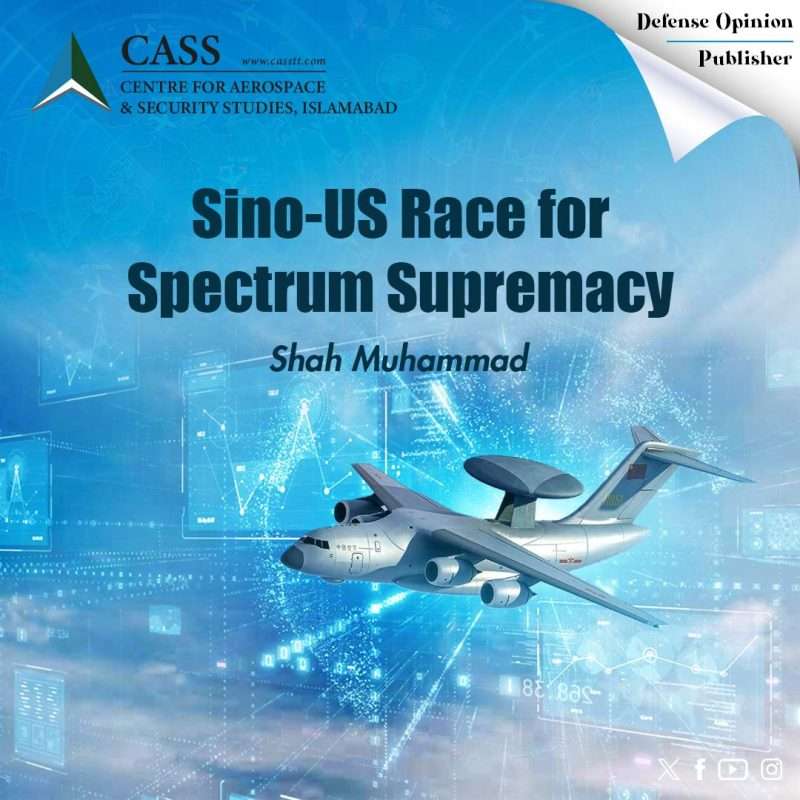
Imagine a future warfare scenario where the two adversaries launch jets and high-altitude drones against each other’s military targets. One side outpaces the other in intercepting the enemy airborne system’s communication channels a few milliseconds faster, effectively dominating the spectrum by blinding the pilots, jamming the drones and paralysing the command-and-control nodes. The prevailing force secures a greater edge by generating thousands of false targets to deceive the enemy’s entire aerial fleet, while its Airborne Early Warning & Control (AEWAC) aircraft is rendered invisible from enemy detection. This spectrum supremacy could be viewed as a prelude to multi-domain supremacy – a trend that is reflective of recent advances in electronic warfare (EW) by China and the US.
In August 2025, Chinese scientists successfully tested a new radar innovation called the Frequency Diverse Array. It can render the AEWAC almost invisible to detection, which has conventionally remained susceptible to enemy Intelligence, Surveillance and Reconnaissance (ISR). This new technique chaotically modulates frequencies to mislead the enemy sensors, thereby protecting the high-value spy aircraft for a sustained EW. The research team has described it as a ‘new paradigm of electromagnetic offence and defence, detecting while jamming, positioning while deceiving.’ In June 2025, China leveraged a 6G-powered EW system to amplify jamming capabilities and seamlessly enhance connectivity across multiple platforms. The system also enables the simultaneous generation of 3600 false targets to disrupt the enemy’s situational awareness.
In August 2024, Chinese scientists developed an analogue-to-digital (ADC) chip that enhances radar detection and response time by 91.46 per cent. The chip converts electromagnetic waves from analogue to digital form, and the troops subsequently analyse the digital insights for operational decision-making. Quicker detection time corresponds to a greater edge over the adversary in high-stakes and time-constrained combat environments. Additionally, the chip filters out the noise in analogue signals, thereby reducing energy consumption by 30 per cent. These military modernisations likely reflect not only China’s deterrent value but also its operational preparedness against the imminent threats.
Importantly, these EW breakthroughs may be viewed in the backdrop of China’s growing assertive posture in the contentious zones. In 2024, the ‘freedom of navigation’ passage of Chinese warships near Alaska was seen as a message to NATO against its further expansion in the Arctic region. Besides the joint naval drills with Russia, China recently deployed its two aircraft carriers east of the Philippines. Lately, the sightings of China’s carrier-based J-15DT – equipped with three EW pods – were also a subject of intense deliberations. The US-China Economic and Security Review Commission’s (USCC) 2024 report revealed to Congress that the People’s Liberation Army (PLA) ‘has developed substantial EW capabilities to detect, target, and disrupt the U.S., allied, and partner forces in the Indo-Pacific.’ The upcoming 2025 report may raise greater alarms, given the rapid pace of recent EW developments by China.
On the other hand, the Pentagon has emphasised the pre-eminence of spectrum in its Joint All-Domain Command & Control (JADC2) Strategy, stating that future warfare will be carried out in ‘degraded and contested’ spectrum. The US military has deployed an anti-drone electromagnetic pulse system called Leonidas that can take down incoming drones through a directed microwave pulse. It could prove effective in protecting the forward bases from a swarm attack and, in turn, facilitating the friendly drones in their offensive strikes.
In April 2024, the US Air Force awarded a USD 6.4 million contract to a defence contractor to develop an algorithmic EW system. It envisages the AI-enabled spectrum supremacy, imparting greater autonomy in the processing of vast information. The US military tested its advanced EW capabilities in the recent Project Convergence Capstone 5 exercise in order to enhance its operational readiness against ‘sophisticated adversaries,’ a departure from counter-terrorism operations against inferior enemies. However, the US is essentially playing catch-up, as the USCC 2024 report acknowledges that Chinese EW capabilities potentially exceed those of the US. Needless to say, continued Chinese EW edge could potentially alter the strategic environment of the Indo-Pacific theatre in Beijing’s favour.
From detection and engagement to jamming and deception, China and the US aim to secure spectrum supremacy for a strong competitive edge on the battlefield. In this regard, the most recent Indo-Pak aerial clash, wherein Pakistan claimed to have downed at least 5 Indian jets, is a befitting case of how spectrum supremacy can result in overall aerial supremacy. The Pakistani military attributed the combat success to spectrum supremacy, in addition to the seamless execution of a networked strike, which corresponds to the shortening of the kill chain. Although China and the US are yet to engage in a real-combat scenario, the Pak-India aerial confrontation informs their operational playbook in light of the fact that ‘future warfare will involve a kill chain vs kill chain scenario in a multidomain environment.’
Situated under the overarching operational umbrella of Intelligentised Warfare, China’s EW breakthroughs could translate into an edge to the PLA. Meanwhile, the Pentagon is unwilling to cede any sort of superiority to the PLA and strives to shape the contours of high-tech warfare. In the new character of warfare driven by multi-domain operations, the victor may not be determined by firepower alone; spectrum supremacy, integrated with advanced technologies, may emerge as central to battlefield dominance. The simmering question is: Will China take a decisive lead over the US in commanding the spectrum in future warfare?