
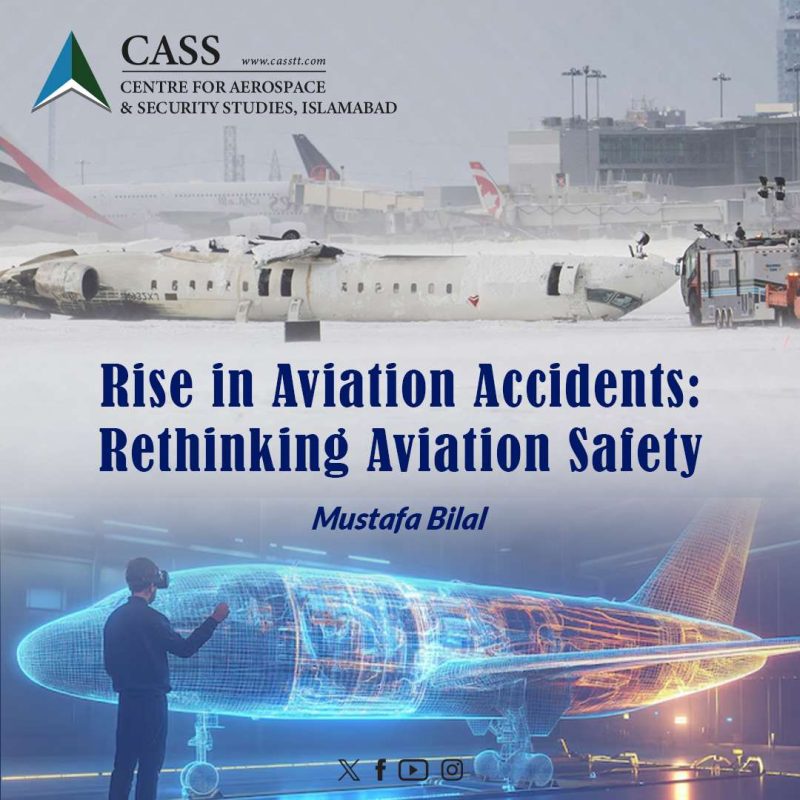
Despite decades of progress in aviation safety (e.g., international air traffic reached record heights post-Covid and crossed 5 billion passengers worldwide), recent incidents remind us that risks remain. In the last week of December 2024 alone, 217 people lost their lives in a series of aviation accidents, pushing the year’s total to 318 fatalities and making 2024 the deadliest year for commercial aviation since 2018, according to the Aviation Safety Network.
In contrast, US statistics have painted an optimistic picture. On December 31, the U.S. Department of Transportation Bureau released a report affirming air travel as the safest mode of transportation, and an earlier MIT study recognised the US as one of the safest countries for flying. However, on January 29 this year, a mid-air collision, the first major US aviation accident since 2009, challenged this optimism.
Although the overall number of US aviation accidents decreased when comparing early 2024 figures (173 accidents) to a later period (106 accidents), and despite a historic decline in air travel fatalities over the past 15 years even as passenger numbers have surged, these recent events cast a shadow on the industry’s safety record.
While some draw comparisons with road travel, arguing that more people die on highways every hour than in annual global airline fatalities, the gravity of hundreds of lost lives in aviation cannot be overlooked. Therefore, while there is no denying that air travel has progressively become safer over the past decades, hundreds of lives are still lost.
The increasing frequency of aviation accidents has shaken the trust of passengers. This is evident in polls and the spike in Google searches concerning aviation safety following the latest accidents. Recent developments have also called into question the prevalence of complacency in commercial aviation. Notably, Ed Pierson, Director of the Foundation for Aviation Safety, implied a sense of statistical overconfidence in the US aviation sector, which downplays safety risks and leads to complacency, resulting in the loss of lives. Janet Northcote, head of communications at the European Aviation Safety Agency (EASA), also noted that there should be no room for complacency regardless of the safety statistics.
However, the facts regarding complacency are pretty concerning. Research by the International Air Transport Association (IATA) indicates that human errors are the primary cause of 70-80% of global aviation accidents. Fatigue and work stress could contribute to human errors, as can be drawn from the recent controversy over understaffed and overburdened air traffic controllers (ATCs). Complacency due to overreliance on automation is another concern, notwithstanding the aviation safety enhancements offered by automation. For example, an IATA report highlighted how dependence on automation degrades responsiveness of pilots in crises. A similar study by the Royal Aeronautical Society Flying Operations Group underscored how increasing cockpit automation has increased complacency.
Additionally, communication failures are responsible for 30% of aviation accidents. Relatedly, it was reported that communication issues and an outdated ATC system played a central role in causing the recent mid-air collision between a passenger jet and an army helicopter in the US. The interplay of these 3Cs (complacency, compliance, and communication issues) in aviation has contributed to an alarming increase in near-midair collisions. The latest such incident occurred on February 24th in Chicago.
Structural failures can also lead to aviation mishaps. For instance, Boeing has faced significant controversies over its manufacturing deficiencies. While the aviation industry continues to address the 3Cs and other production shortcomings, it remains vulnerable to external factors like geopolitical tensions that can disrupt air travel routes. Consequently, flights may be rerouted to avoid conflict zones. The latest in a series of related incidents, an Azerbaijani aircraft was reportedly shot down by Russian air defences near Ukraine, underscoring the risks posed by geopolitical instability.
Looking ahead, the International Civil Aviation Organisation (ICAO) estimates that global air traffic will cross 12 billion passengers by 2030. If the major issues outlined above persist, they will severely undermine efforts to achieve the aspirational goals set by ICAO. Therefore, for overcoming the challenges plaguing aviation safety, ICAO’s Global Aviation Safety Plan (GASP), aims to reduce airline fatalities to 0 by 2030. GASP and the Global Air Navigation Plan (GANP) provide a framework for the formulation of national and regional aviation safety plans and encourage coordination between all relevant stakeholders in the global aviation sector.
Furthermore, integrating AI-enabled communication systems, predictive maintenance, and weather monitoring algorithms are expected to enhance aviation safety. Numerous aviation-AI firms work in this domain, and major airlines, such as Lufthansa, have already embraced AI in day-to-day operations. However, the onus lies with domestic and international aviation authorities to improve vigilance and enforce stringent oversight of regulatory frameworks, prioritising aviation safety over corporate interests. Their overarching objective should be to increase transparency and accountability while reducing human complacency in an era of AI-enabled aviation. To this end, the recent accidents should be meticulously analysed to draw valuable lessons that guide policymaking and regulatory frameworks for improving aviation safety.
Mustafa Bilal is a Research Assistant at the Centre for Aerospace & Security Studies (CASS), Islamabad. Article was first published in The News International. He can be reached at [email protected].



