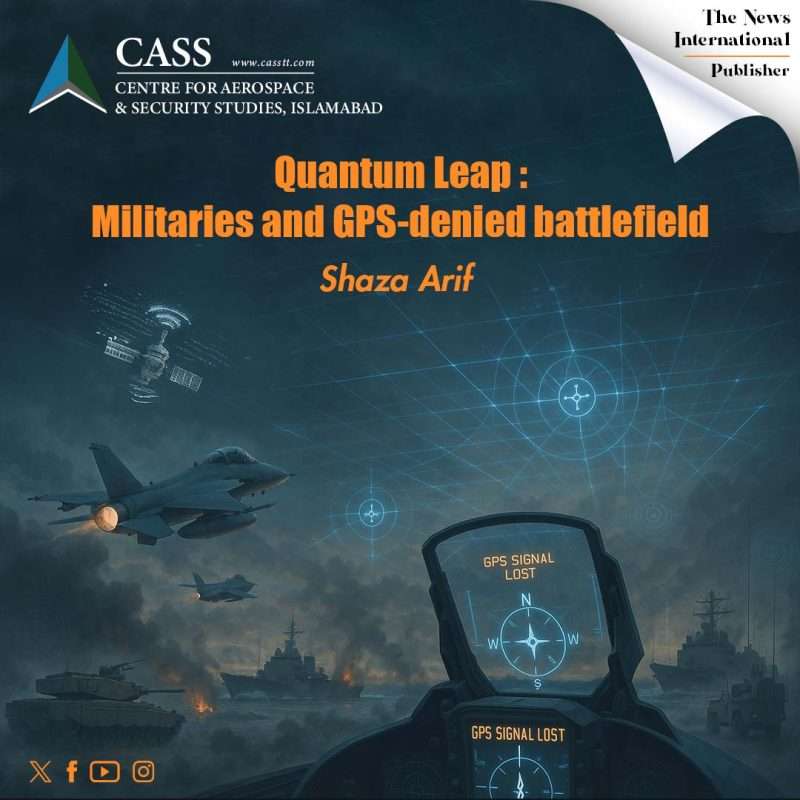
Overtime, navigational requirements have been met via different modes comprising inertial navigation (INS), radio navigation and dead reckoning (DR). In contemporary times, satellite navigation has also emerged as a pivotal aspect in modern warfare. Ever since the launch of its first prototype in 1978, GPS has been providing a strategic advantage for several decades. However, the increasing vulnerabilities are raising questions over the edge provided by the technology, requiring new alternatives. In this context, quantum computing offers a potential solution.
Recently, quantum computing has shown enormous potential in numerous sectors, with quantum navigation emerging as a relevant and interesting application. While both quantum navigation and GPS relies on the subatomic properties, GPS has notable significance on satellite based signals from space. In contrast ,a quantum navigation system leverages atomic-level properties such as behavior as opposed to relying on space-based signals.
Hence, measurements and calculations are based on internal factors such as time, direction and acceleration for navigation. Resultantly, the threat of disruptions by jamming, and spoofing is mitigated using quantum navigation. The technology can also be directly integrated with the equipment or system that requires navigation.
The rising vulnerabilities of space-based infrastructure position quantum navigation as a potential and innovative alternative. Militaries have a significant reliance on satellite-based navigation. This dependence becomes a weakness in cases where operations are disrupted. The surging geopolitical tensions are also marked with risks of increased kinetic and cyber-based attacks in satellites-based infrastructure.
The recent Russia-Ukraine conflict and Iran-Israel conflict have unfolded the loopholes that opposing sides can exploit via jamming space-based assets, impacting military operations vis-a-vis communication and navigation. Similarly, the recent global Starlink outage in July 2025, also reflected the vulnerabilities of even the most advanced constellations, leaving notable impact.
The technology has considerable potential in providing navigation services in areas where satellite coverage is limited. In such circumstances, quantum navigation can play its role in securing critical positioning capabilities given that it operates at the point of use and relies on localised measurements. Such an approach enhances the overall robustness of the navigation system.
In a potential war scenario, it can increase the operational resilience on several fronts. It can enable precision strikes without relying on GPS vis-a-vis missiles, and hypersonic, even in extreme conditions. Similarly, it can improve the performance of drones in contested environments. Likewise, it can provide troop movements in a GPS-denied environment by providing real-time navigation and synchronisation. Similarly, quantum navigation can provide precise positioning in the depths of the ocean. Overall, the technology has the potential to give self-contained positioning autonomy, while eliminating external interference.
The potential of the technologies have not gone unnoticed as different states including USA, UK and China are eyeing the technology. These efforts are also complemented by private entities such Infleqtion and Q-TCRL are also moving towards deployable solutions. In fact, Q-TCRL has made breakthrough innovation in sensing for Australian Defence on board the Royal Australian Navy’s Multi-role Aviation Training Vessel (MATV), MV Sycamore during a 144-hour trial for the Australian Navy. Last month , Defense Advanced Research Projects Agency (DARPA) has also signed a contract worth USD 24.4 million to field quantum sensors on its land, air and sea-based vehicles. Such trends show that the supremacy in the technology is likely to provide decisive edge, and wartime maneuvering, along with peacetime advantages.
While there are numerous potentials, towering challenges also lie ahead. The field deployment of quantum navigation will take time and financial resources before it can demonstrate its optimal results. It needs advanced algorithms, miniaturisation, quantum sensors and cryogenic systems for effective performance. Furthermore, the fragile state of atoms require stable environments.
Creating a stable environment for different domains i.e. underground, sea, land, air and space is likely to be a major challenge. Nevertheless, the technology has remarkable potential across numerous sectors and its advancements are likely to have a profound impact.In order to make advancements, there is a need to develop robust quantum infrastructure, which allows the integration into the required systems.
The mechanisms of integration of future quantum technologies could also be worked out to explore hybrid systems for navigation. For instance, Galileo is currently being upgraded via Open Service Navigation Message Authentication (OSNIMA) for to add a layer of protection against GNSS interference . In this context, quantum navigation can complement GPS in addition to its role as a strong backup in military scenarios to counter adversarial interference.
Quantum navigation can also be adopted by military alliances as part of defence-technology cooperation against potential threats. For instance, the technology can also be integrated into initiatives such as the Defence Innovation Accelerator for the North Atlantic (DIANA) to reduce satellite-based reliance in contested theatres.
Lastly, robust Regulatory frameworks, certification processes and standardisation mechanism are also need to be explored by respective governments. Lastly, the careful coordination of the technology would also require effective policy support.
As modern conflicts evolve, the vulnerability of satellite-based navigation becomes an aspect of notable concern. Hence, securing navigation channels becomes more important than ever While the journey may be long ahead, efforts are underway for ground-breaking innovation. The technology has the potential to provide militaries with an added layer of resilience against adversarial interference, jamming and spoofing efforts – prominent tools of warfare which are becoming only more potent with time.
Shaza Arif is a Senior Research Associate at the Centre for Aerospace & Security Studies (CASS), Islamabad. The article was first published in The News International. She can be reached at [email protected].