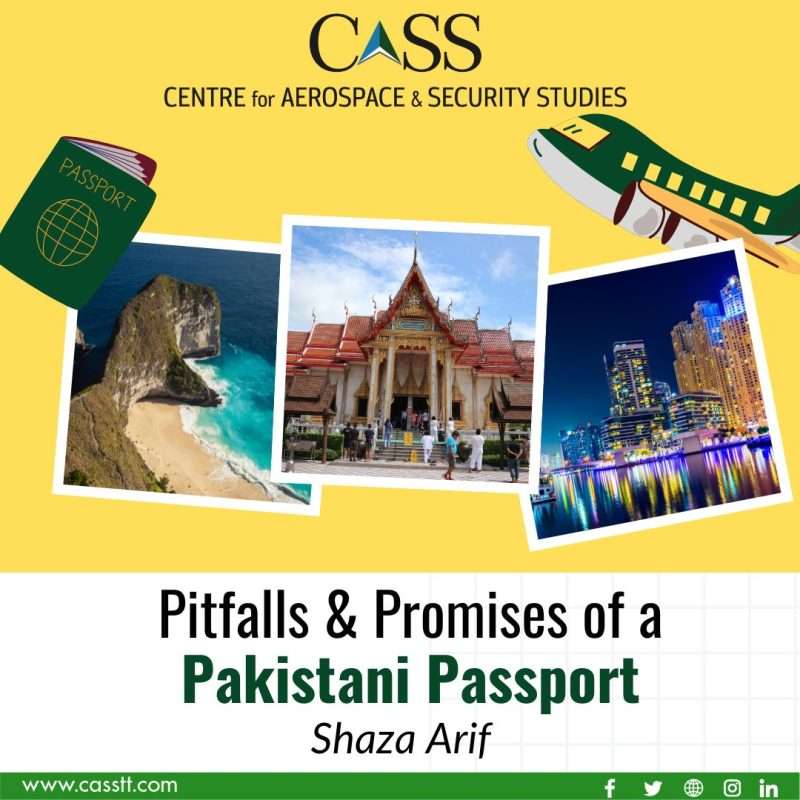
Traveling is undoubtedly one of the most enriching experiences for people worldwide, as beautifully captured in a widely used adage, ‘Of all the books in the world, the best stories are found between the pages of a passport.’ For countless travellers, these pages hold the promise of discovering new places, unlocking new opportunities, embarking on thrilling adventures, embracing diverse cultures, and fostering personal growth. On the other hand, for citizens of certain countries, the same pages seem to carry the weight of considerable restrictions, becoming a formidable barrier rather than a gateway.
In this context, the Henley Passport Index is seen as one of the frequently used indices to evaluate the strength of any passport. The index consists of 199 ‘country’ passports and evaluates them against 227 possible travel destinations, regularly updating the ranking to indicate changes in travel and visa requirements for different states. For each destination, the index assigns a score of 1 if the passport holders of a certain country do not require a visa or if they could obtain a visa-on-arrival or any electronic travel authority (ETA) upon entry. The comprehensive evaluation provides an overview of the travel privileges associated with each passport.
In the most recent ranking, Singapore emerged at the top of the list with the most coveted passport, which enables visa-free access to 192 countries. Tied at the second position, Germany, Italy, and Spain have visa-free access to 190 countries. Likewise, Japan, Finland, Austria, Luxembourg, France, and Sweden secured the third position with visa-free access to over 189 countries. Unfortunately, Pakistan has been ranked as the fourth-worst passport. The consistently low ranking as the fourth-worst passport for last three years is concerning. Until January this year, the green passport had visa-free/ electronic visa access to only 35 counties, but this figure has further declined to 33. The low ranking places Pakistan above only three conflict-ridden countries, i.e., Syria, Iraq, and Afghanistan.
A passport’s strength is beyond mere travel documentation; it reflects a global image, the state’s perceived security situation, and bilateral relations with other countries. It also has significant implications for citizens who want to travel abroad for different purposes, penalising them unfairly for circumstances beyond their control. A weaker passport presents more obstacles not only for personal plans such as tourism or visiting family members abroad but also for academic and professional opportunities. Students who desire to proceed abroad for higher education, exchange programmes, or conferences/workshops have to face increasingly complex visa processes, burdened with requirements such as showing proof of considerable assets in their home country, adding layers of complexities to their academic pursuits. Likewise, business activities can be hampered given limited mobility, making it challenging to access foreign markets and curtailing the state’s economic growth. Unfortunately, Pakistani citizens have to invest considerable time, money, and effort to avail different opportunities due to visa modalities.
Sadly, Pakistan’s internal conflicts, coupled with the external geostrategic environment, have adversely impacted its global image over the years. The recent low ranking reinforces the negative perceptions regarding the state’s internal security dynamics, overlooking the considerable improvement made over the last several years. Therefore, there is a need to adequately reflect this improvement in perception, both locally and internationally.
Thus, enhancing the perception of our passport is intrinsically linked to bolstering the image of our country. Adopting a multifaceted approach becomes imperative in projecting a robust and influential presence on the global stage. In this regard, it goes without saying that Pakistan must address its internal challenges, including political instability, as a crucial step. In parallel, there is a need to actively cultivate better bilateral relations with other countries, foster economic collaboration, promote dialogue and understanding to enhance its diplomatic clout and strengthen the green passport. Relevant ministries, like the Foreign Office, need to direct more focus on visa-free or at least visa-on-arrival agreements with more countries. Tourism in Pakistan can play an important role in this regard – better infrastructure and facilities could make it an attractive tourist destination, easing bilateral agreement processes for visa-free access.
Passport rankings are a reflection of the interplay between nationality and opportunity. They are a reminder that the worth of a passport can become an agent of privilege influencing the extent of freedom beyond one’s national border. The inequality in the strength of various passports and the associated benefits and limitations also mirror the underlying power dynamics of the world and the inherent challenges that countries like Pakistan have to face. Therefore, it is important to recognise that improving our country’s passport ranking is not merely a matter of national pride; a stronger passport unlocks numerous opportunities for citizens and the state. Hence, the issue requires timely attention and measures from the concerned policymakers. With more determination and timely initiatives, Pakistan stands a greater chance of securing a better position in future rankings.
Shaza Arif is a Research Assistant at the Centre for Aerospace & Security Studies (CASS), Islamabad, Pakistan. The article was first published in The News International. She can be reached at: [email protected]
Design Credit: Mysha Dua Salman