
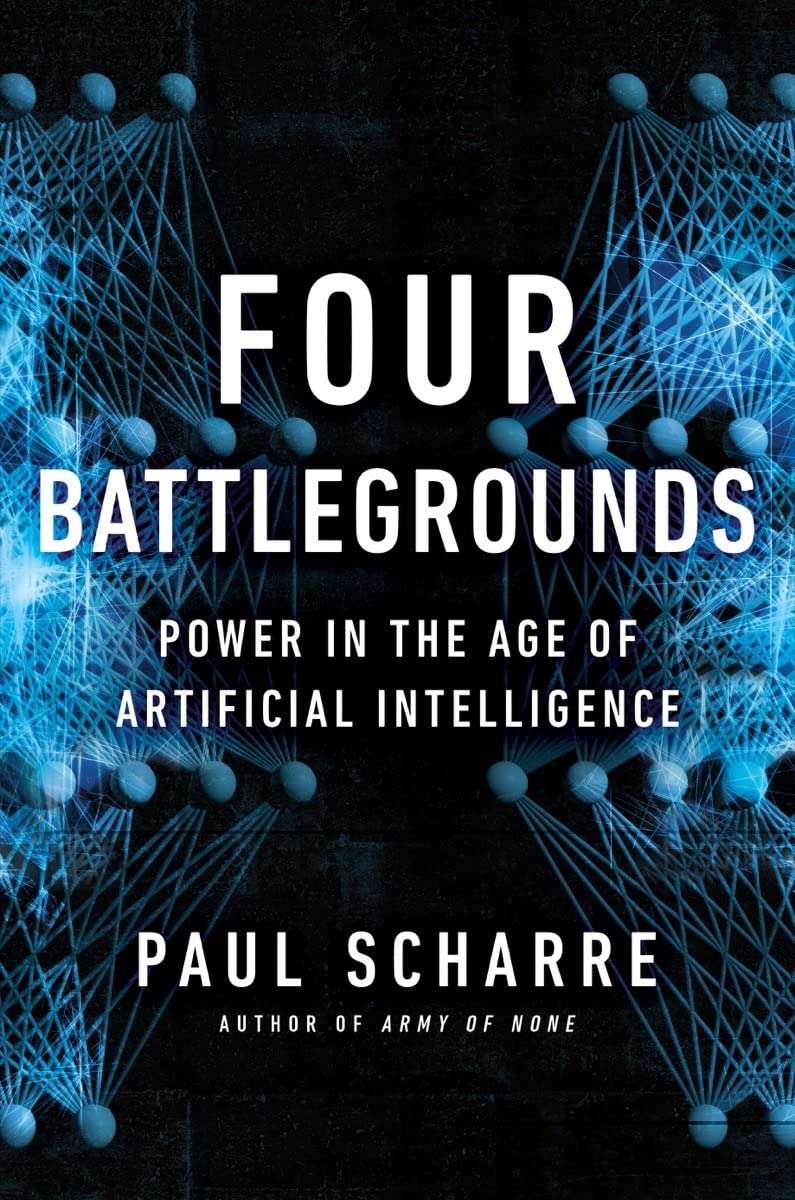
Paul Scharre, Four Battlegrounds: Power in the Age of Artificial Intelligence (New York: WW Norton, 2023).
Reviewed Shaza Arif
Power has long been the central currency of international relations. The pursuit of power has pushed the world towards a perpetual technological race driven by cutting-edge innovations. In this context, it is important to view power dynamics through the lens of technologies such as Artificial Intelligence (AI). The book ‘Four Battlegrounds: Power in the Age of Artificial Intelligence’ is a recent take on the subject. The book has been authored by Paul Scharre, who is one of the most widely read authors on AI, particularly the impact of technology on different aspects of warfare.
In this expansive work, the author explores successive waves of digital innovation, from the explosion of data to the advent of IoT, autonomous technologies, and machine learning. Throughout the book, Scharre discusses the evolving dynamics positioning the United States and China as the principal centres of globalised innovation. He underscores four critical components from Data, Computing Power to Talent and Institutions, which also form the basis of the book’s title ‘Four Battlegrounds’. These are presented as foundational pillars of AI infrastructure, with Scharre arguing that strategic control over them will shape the future balance of power in AI. Notably, he places particular emphasis on the first two, data and computing power, as especially decisive in this contest.
Writing in a comprehensive and accessible style, Scharre unpacks the key phenomena, challenges, opportunities, and implications linked to AI integration. In fact, he argues that resisting AI will be futile. Instead, it is better to embrace it proactively but with caution and he leaves no stone unturned to convey his perspective with clarity and conviction.
Most importantly, the author addresses several prevailing myths surrounding AI integration. He engages with timely questions, for instance: Is more data truly decisive? Why is there such hype around facial recognition despite its limited applications? Has the AI arms race already begun, or is it still on the horizon? Each of these questions is tackled with well-reasoned analysis, robust justifications and empirical evidence. The most interesting section in the book is where the author contests the debate around the nature and character of war. The section provides thought-provoking ideas regarding how these age-old concepts need to be redefined – or perhaps seen through different perspectives. Equally compelling are the author’s insights into how AI is likely to mediate the future of warfare. Adopting this perspective, he challenges the often-oversimplified narratives surrounding AI’s military integration and instead highlights its deeper implications warfare’s cognitive and psychological dimensions.
Despite its considerable length, complex concepts are conveyed in clear and straightforward language, making the text approachable without compromising depth. Visual elements, such as graphs and pie charts, further add to one’s understanding by offering additional analytical insights. Scharre’s earlier work, ‘Army of None: Autonomous Weapons and the Future of War’, was also a best-seller. It offered a holistic overview of how AI will impact the contours of warfare. ‘Four Battlegrounds’ reiterates those concerns with added evidence and projects future trends.
While the book offers valuable insights, it also shows some undercurrents of bias. Throughout, China is pinned as a repressive and assertive state that is exploring AI against its own people and becoming a global concern. The portrayal of Chinese-style surveillance systems in the book tends to be exaggerated and framed in overtly negative terms. While it is true that China employs extensive surveillance mechanisms, similar practices exist, albeit under regulatory frameworks, in many Western democracies. In the concluding chapters, Scharre acknowledges the deep interdependence of the US and Chinese AI ecosystems, noting that Chinese companies implicated in human rights violations may simultaneously receive indirect support through US military-funded research. These realities illustrate the blurred ethical boundaries surrounding AI development, a complexity that warrants a more balanced and critical examination, which remains somewhat underexplored in the book.
From a policymaking perspective, the book reinforces the call for the US government to remain vigilant regarding China’s strategic ambitions in the AI domain. The analysis reflects current developmental trajectories, suggesting that China’s AI ecosystem is rapidly maturing, positioning the state to challenge US leadership and assert itself as a global technological power. Recent breakthroughs, such as DeepSeek’s R1 model rivalling top US systems despite export restrictions, and Alibaba’s launch of the advanced Qwen-32B reasoning model, are indicative of the pace and ambition of China’s AI ascent. Lastly, given the complex nature of how the US and China are handling AI, it points out that regulating the technology will be a considerable challenge.
Although the success of ‘Army of None’is likely to remain intact and unparalleled, ‘Four Battlegrounds: Power in the Age of Artificial Intelligence’ is also a timely contribution especially on US-China technological competition. Technology enthusiasts, students of international relations, mid-career researchers, and policymakers alike should not be deterred by the book’s length. Its depth offers valuable insights for anyone seeking to better understand the strategic implications of AI and its optimal utilisation. Overall, the book is a worthwhile and rewarding read that justifies the time and effort it demands.
Shaza Arif is a Research Associate at the Centre for Aerospace & Security Studies (CASS), Islamabad. She can be reached at [email protected].



