image


Share this article

Facebook
Twitter
LinkedIn

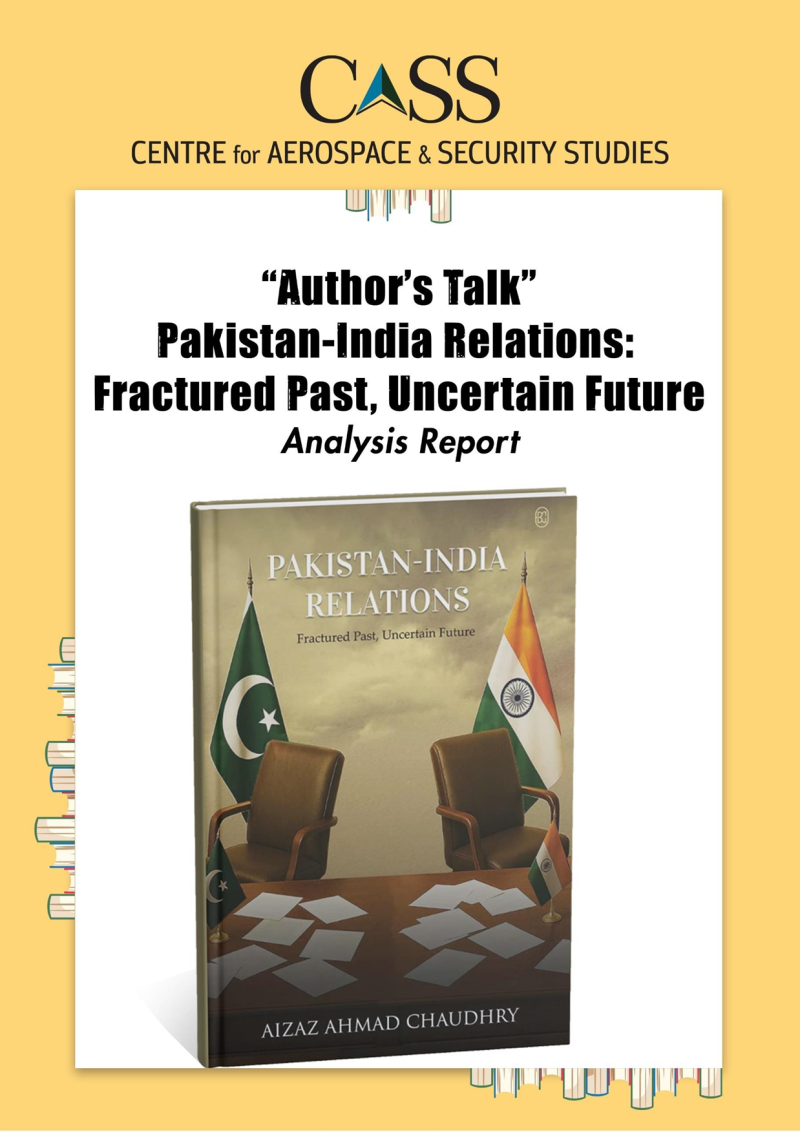
The complex and often turbulent relationship between Pakistan and India remains one of South Asia’s most enduring and consequential realities. Rooted in a shared history yet marked by decades of mistrust, conflict, and unrealised peace initiatives, this relationship continues to shape the region’s strategic environment. In the authors talk series, Pakistan–India Relations: Fractured Past, Uncertain Future Ambassador Aizaz Ahmed, former Foreign Secretary of Pakistan, discussed his latest book and aimed to generate a nuanced understanding of the historical underpinnings, recurring challenges, and possible pathways toward stability in bilateral relations.

The discussion brought forth critical questions: Why has the past remained fractured despite multiple peace efforts? Why does the future of Pakistan–India relations continue to appear uncertain? The conversation contextualised these questions within regional and global shifts, particularly India’s evolving political ideology, its regional ambitions, and Pakistan’s strategic posture. By analysing the recurring patterns of mistrust, territorial disputes, and ideological divides, the event provided a timely reflection on the lessons from history and the imperatives for a more balanced and secure future for South Asia.

Recent Publications

Browse through the list of recent publications.

Golden Dome: Capabilities and Constraints

In an era of novel threats, a layered defensive shield is once again at the centre of US strategy. The announcement of the Golden Dome by President Trump shortly after assuming office has given rise to new expectations, questions, and concerns regarding the project.
The capability is envisioned as a comprehensive missile shield for the continental United States (CONUS) against ballistic missiles, hypersonic vehicles, cruise missiles, and UAVs. Conceived as a multi-tiered system, it aims to integrate existing missile defences with new space-based platforms. The layered system, combining land, sea and space-based sensors

Read More »

Trump’s Coercive Diplomacy: America’s Harder Turn

President Donald Trump renamed the Department of Defense (DOD) to the Department of War in September 2025. Then, just a month later, he threatened at least three countries with war. Trump’s economic war was waged on most states, in the form of tariffs, from the day he assumed office, but the threats and signalling toward an armed confrontation have been growing more frequent and explicit.

Read More »

Do India- Bangladesh Relations Signal a New Strategic Front?

Amidst transforming regional security dynamics, India reinforced its eastern flank by establishing three fully operational military stations at strategic points around the ‘Siliguri Corridor’ near the India-Bangladesh border. The new bases include the Lachit Borphukan Military Station near Dhubri in Assam along with two forward bases at Chopra in West Bengal and Kishanganj in Bihar. Indian Army also reviews a fourth station in Mizoram as part of extended defence arc around the Siliguri corridor. Amidst deteriorating ties with Bangladesh, India’s fortification of its eastern

Read More »