
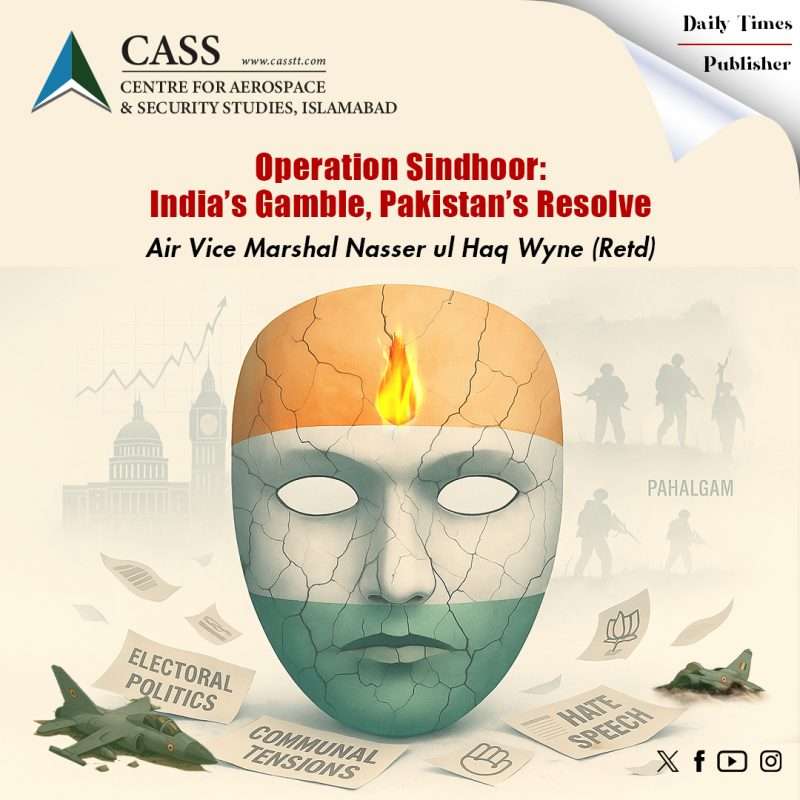
Pahalgam incident in April, 2025 turned out to be a flash point once again for a conflict between two nuclear armed neighbours, Pakistan and India. However, this time the stakes were very high, the conflict did not remain confined to a certain geographical area and the extent of technologies and capabilities employed by either side have far reaching implications. In between the airstrikes and the ceasefire lies a complex web of geopolitical manoeuvring, domestic compulsions, and emerging warfare paradigms that need to be analysed.
The Calculus behind Conflict
India’s decision to initiate Operation Sindhoor disregarded the global geopolitical environment, a time when the international community was determined to end ongoing conflicts. India might have drawn influence from the Ukraine and Gaza situation, where a broader acceptance of kinetic precedents set by stronger nations. Emboldened by a strategic partnership with the West, India’s economic rise and considering that the global criticism would be muted, India interpreted it as a window of opportunity for a punitive operation that could serve multiple purposes. Sensing the electoral fatigue, and diminishing nationalist appeal, the BJP resorted to its well known playbook: externalise internal weaknesses. The Pahalgam incident was a perfect alibi to ignite nationalist fervour.
The Kinetic Exchange
India’s first wave struck at pre-dawn on May 6th. While New Delhi claimed nine targets across the Line of Control (LoC), near the Line of Actual Control (LAC) and even across the International Border (IB), Pakistan confirmed six sites targeted, mostly mosques and worship places. India employed a number of advanced fighter aircraft, loitering munitions and electronic warfare assets, signalling a serious escalation.
Pakistan’s response was swift, measured and doctrinally sound. Operating under an offensive-defence posture, it retaliated by targeting IAF high tech platforms. The use of J-10C and JF-17 Block III fighters equipped with PL-15 missiles, tactful employment of Multi Domain Operations (MDOs) and bold leadership showcased the superiority of the PAF. IAF lost seven platforms right in its first wave; the psychological balance tilted towards Islamabad due to the effectiveness of its response.
Air Power and the Shift to Drones
A crucial takeaway was the prominence of drone warfare. Soon after suffering a severe blow in the first attack, India switched to the deployment of drones to overwhelm Pakistani air defences. Pakistan, however, demonstrated robust electronic countermeasures intercepting and destroying about 100 drones. The evolving drone doctrine, inter-service coordination and early warning systems will shape future engagements. Despite India’s numerical superiority in the air, its inability to suppress Pakistan’s air response highlighted doctrinal rigidity.
Information War: The Battle for Perception
A fierce war was being fought on screens in parallel. Indian media and government mouthpieces, often the hawkish BJP ministers, portrayed a triumphant blitz. Unlike the past, the Western media did not echo the Indian version. On the other hand, Pakistan’s media strategy, more coherent than in past conflicts, utilised a blend of traditional briefings and real-time OSINT to present its side. Influencers, analysts, and military veterans formed a unified front online.
Perhaps the most troubling development was the aggressive use of geo-blocking, bot-driven amplification of nationalist content and suppression of counter-narratives. Information warfare is no longer a supporting domain: it is a battlefield in itself.
Ceasefire and What It Didn’t Solve
By the fourth day, a ceasefire was reached, largely due to firm intervention by the U.S. Some analysts argued that the PAF’s effective use of Chinese hardware posed a threat to the Western defence market, while others attributed the ceasefire to rising concerns over potential nuclear escalation. Regardless of the immediate cause, the ceasefire did little to resolve the deeper, underlying tensions. There was no meaningful diplomatic engagement or conflict resolution process initiated after the ceasefire. Modi’s post ceasefire speeches showed no signs of strategic reconciliation.
Strategic Lessons and the Path Ahead
India’s leadership miscalculated: militarily and diplomatically. A disconnect between political aspirations and military capacity exposed operational vulnerabilities. For all its bravado, the IAF failed to establish dominance, losing seven platforms in just a couple of hours.
Pakistan, while tactically successful, cannot afford complacency. It must now prioritise doctrinal evolution, force modernisation and an integrated national security strategy.
Deterrence in a New Era
The question now is not whether conflict will happen again, but when and how. India is unlikely to accept this outcome quietly. Before any future provocation, it will seek to plug gaps, possibly through fifth-gen platforms, cyber and space dominance and indeed with an improved employment strategy. For Pakistan, deterrence must now be layered: conventional, sub-conventional, and informational. Strategic partnerships must be deepened, but dependency must be avoided. Stability lies not just in credible threat of force, but in coherent political, diplomatic and technological strength.
Final Thoughts
These four days revealed not just the fragility of peace in South Asia but also the transformation of warfare itself. The lines between kinetic and non-kinetic domains, truth and narrative, retaliation and deterrence are all blurring. In this ‘new abnormal,’ strategic sobriety, not symbolic spectacles, will define national survival.
Air Vice Marshal Nasser ul Haq Wyne (Retd) is a Director at the Centre for Aerospace & Security Studies (CASS), Islamabad, Pakistan. The article was first published in The Daily Times. He can be reached at [email protected].



