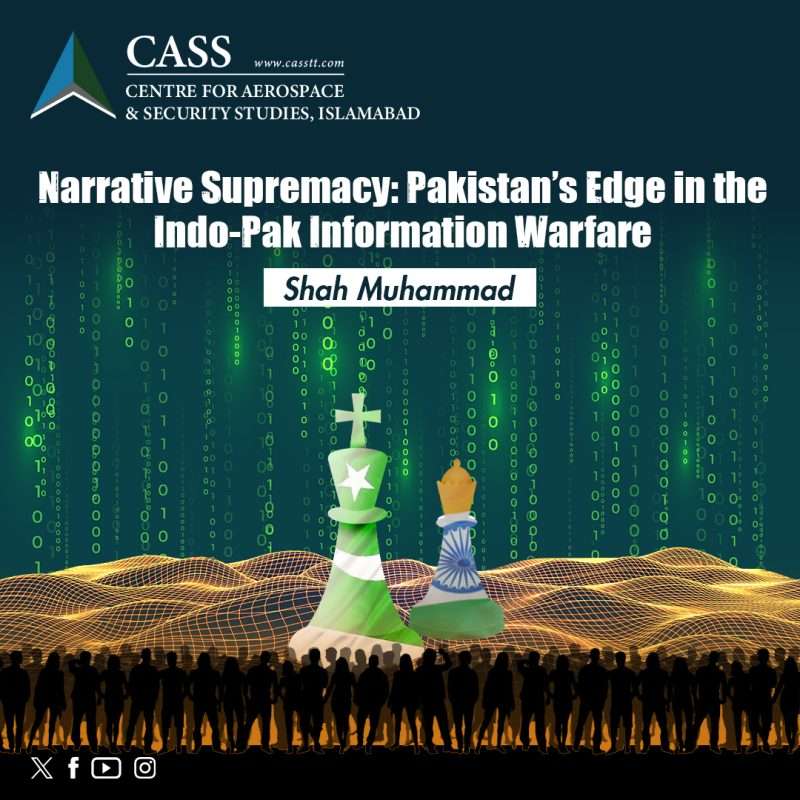
As drones swarmed across Indian states and missiles struck military installations, Pakistan simultaneously edged out the adversary in the war of narratives. Demonstrating operational effectiveness in the cognitive and cyber domains during the recent Indo-Pak skirmishes, the Pakistani military has also advanced its integration of information-centric Revolutions in Military Affairs (RMA). In line with fifth-generation warfare and multi-domain operations (MDO), Pakistan orchestrated a unified information ecosystem that integrated military, governmental, public, and media channels to reinforce operations across land, air, and sea.
Pakistan’s information warfare strategy was characterised by information denial, disruption of adversary’s dissemination flows, rapid identification of cross-border misinformation, and targeted corruption of critical infrastructure. The strategy was effectively applied across three phases of the conflict: pre-hostilities build-up, kinetic exchange, and post-conflict declaration of success.
Following the Pahalgam incident, the Modi government swiftly escalated its war rhetoric. The Indian media degenerated into a hyper-nationalist factory of misinformation, in stark contrast to Pakistani media’s restraint and call for impartial investigation. Although Pakistan’s military maintained heightened vigilance, it also exercised narrative control and denied any information to the adversary regarding the actual level of its operational readiness. Pre-conflict information denial intensified the adversary’s fog of war, and the IAF did not anticipate the PAF readiness.
As James Mattis, the former United States Secretary of Defense, observed in 2009, ‘Capturing the perceptions of foreign audience will replace seizing terrain as the new high ground for the future joint force.’ Pakistan’s legacy media and digital platforms successfully highlighted Indian media’s subversion of basic journalistic ethics. Throughout the conflict, Pakistan effectively shaped adversary perceptions. Notably, Indian analyst Pravin Sawhney acknowledged Islamabad’s information superiority during the hostilities. He noted that the evidence-based approach of Pakistan’s tri-service press briefing strengthened its credibility, in contrast to the visible disarray on the Indian side. The detailed presentation that included intercepted audio of a downed Rafale pilot and electronic identifiers of destroyed aircraft further reinforced Pakistan’s position in the eyes of international media.
At the Indian tri-service press briefing on May 11, the lack of confidence and a sense of disarray were quite visible among the Director Generals of Military Operations (DGMOs) of all tri-services. When asked if Rafale had been downed by PAF, Air Marshal A.K. Bharti replied ‘This is a combat, and losses are part of it.’ He further stated that ‘Revealing operational details would only benefit our adversary.’ Hence, these statements reflect a tacit acknowledgement of aerial losses as well as a limited grasp of the dynamics of information warfare.
In fact, Pakistan may have now become one of the first countries to have effectively operationalised information-based RMA and MDOs within the South Asian theatre of warfare. This sends a clear message to the world: the Pakistani military is a technologically advanced force, deeply embedded in future warfare. Adding credence to its multi-domain capability, the international media declared that ‘Pakistan’s fleet of J-10 defeated the Indian Air Force.’
Another distinct dimension of the recent Indo-Pak conflict was the ‘meme-ification of warfare’ as Pakistani users transformed social media into a space of strategic satire to challenge Indian jingoism, turning the digital battleground into a theatre of narrative resistance. In this conflict, memes shed their image as mere ‘time-pass humour’ and evolved into tools of counter-narrative and misinformation disruption.
Pakistan’s multi-domain dominance delivered a clear rebuttal to India’s attempts at establishing a ‘New Normal.’ In the second tri-services press conference, Pakistan asserted operational success and reaffirmed its commitment to the ceasefire. The strategy of information denial was reinforced as the Director General Inter-Services Public Relations (DG ISPR) remarked that the adversary still remained unaware of many other formidable capabilities within Pakistan’s military arsenal. Moreover, US President Donald Trump’s reference to Jammu & Kashmir has placed India in a diplomatic bind and galvanised Pakistan’s long-standing narrative on Indian Illegally Occupied Jammu and Kashmir (IIOJK), which consistently advocates third-party intervention to counter New Delhi’s efforts to internalise the dispute.
Conversely, India appears to have underestimated that modern warfare has undergone a paradigm shift from platform-centric to information-centric. Unlike the seamlessly centralised narrative emanating from Pakistan, India’s operational messaging was fragmented across the tri-services, the Ministry of External Affairs, the Ministry of Defence, and legacy media. Indian media’s journalistic integrity evaporated after its reckless indulgence in the propagation of fake news and misinformation during the conflict: from INS Vikrant’s bombing of Karachi to the ouster of Pakistan’s civil-military leadership.
Pakistan fused its tactical operations with an integrated narrative strategy utilising synchronised information, communication disruption, and perception management to dominate the cognitive battlespace. In an era defined by fifth-generation warfare and multi-domain integration, Pakistan’s Armed Forces have proven themselves as a digitally enabled, command-and-control-resilient force with operational superiority in the infosphere.
Shah Muhammad is a Research Assistant at the Centre for Aerospace & Security Studies (CASS), Islamabad, Pakistan. He can be reached at: [email protected].