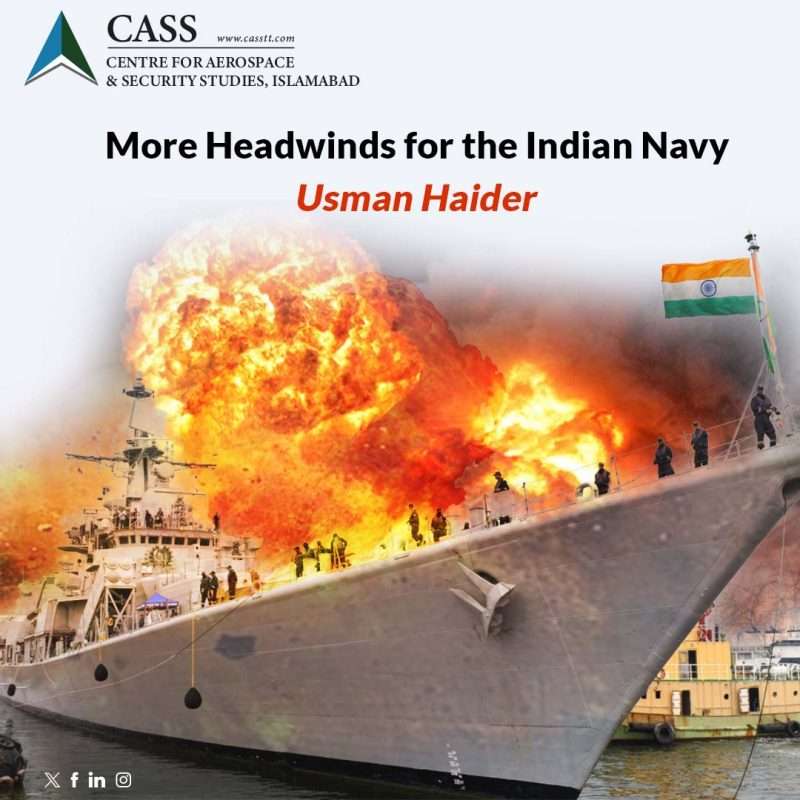
The Indian Navy frequently appears in the headlines, often not for its achievements but for accidents. The INS Brahmaputra incident is the latest in a series of accidents that have plagued the service over the past two decades. A report released earlier this year highlighted that between 2000 and 2023, the Indian Navy experienced 26 major accidents, along with several minor ones. The report attributes this pattern of accidents to inadequate/substandard training and a failure to adhere to standard operational procedures (SOPs). The series of accidents also stem from human error, material failure as well bureaucratic obstacles. These issues were also acknowledged by former Indian Naval Chief Admiral Dhowan, who stressed the need for changes in training guidelines and the induction process for sailors to prevent further incidents
The latest incident, involving INS Brahmaputra, was the result of a fire while it awaited major refit at Mumbai’s dockyard. The warship suffered substantial damage and is presently ‘lying on its port side’, while the Navy seeks international salvage experts for its recovery. Once salvaged, it would take approximately six to twelve months for INS Brahmaputra to become combat-ready. However, in light of past records, it seems highly implausible that the repair work will be completed on time.
The infamous INS Arihant accident in 2017, where a sailor neglected to close the rear hatch of India’s first ballistic missile nuclear submarine (SSBN), was a clear example of human error compounded by the absence of adequate supervision. It highlighted deficiencies in the Indian Navy’s standardised training regime. The sailor’s negligence allowed seawater to enter the SSBN’s propulsion compartment, leading to corrosion of pipes carrying radioactive water, which ultimately rendered the submarine out of active service for nearly a year. In a similar vein, the flipping of INS Betwa at Mumbai harbor in 2016 was also attributed to human error. This incident resulted in three naval officers being found guilty and subsequently court-martialed following an inquiry.
Besides these isolated accidents, on a few occasions, Indian naval vessels have collided with other platforms, at times in broad daylight. In one such incident, INS Vindhyagiri collided with a merchant ship due to the crew’s incompetence and lack of technical expertise. In yet another incident, INS Sindhugosh bumped into a cargo ship during fleet-level manoeuvres in the Arabian Sea.
In addition to accidents related to poor training, the Service has also encountered multiple accidents due to material failures. INS Chakra, a nuclear attack submarine (SSN), sustained an accident because of a material failure which occurred when a ‘high-pressure air cylinder’ located between the submarine’s outer and inner hulls exploded. This explosion caused significant damage to both hulls of the SSN. In another incident, one of the torpedoes on INS Sindhurakshak had oxygen gas leakage, which triggered an explosion. The blast not only sank the submarine but also claimed the lives of 18 sailors.
Red-tapism and bureaucratic hurdles have also contributed to the Indian Navy’s poor operational record. For instance, mishaps have occurred at harbours due to the government’s failure to authorise much-needed dredging.
The Indian Navy has also been slow in adopting international safety regimes. A dedicated safety department was not established until as late as 2014. Even after its creation, the department faced years of delay awaiting government approval. This delay has undoubtedly hindered the development of a safety culture within the Navy. Without the attribute of safety being ingrained in the philosophy of its training, a large navy cannot be expected to perform optimally.
The notion that the United States (US) can rely on India as a strategic naval partner, particularly in its aspirations to become a blue water navy, seems far-fetched given the persistent challenges facing the Indian Navy. The series of accidents and safety incidents has severely undermined the Navy’s operational readiness, with warships and submarines frequently confined to dockyards for repairs. This not only reduces the availability of combat-ready vessels but also disrupts the arrival of ships awaiting refits, thereby delaying crucial fleet refurbishment and modernisation efforts. Such delays inevitably weaken the Indian Navy’s operational preparedness, raising concerns about its capacity to meet the rigorous demands of modern naval warfare.
India’s role as a key player in the ‘Indo-Pacific Strategy of the United States’, specifically in countering China’s regional influence through platforms like QUAD and IMEC, is also brought into question. Despite being home to one of the largest naval fleet in the Indian Ocean, India’s naval force suffers from a poor safety record and low levels of professionalism, making it difficult for the country to meet US expectations. In essence, the Indian Navy’s operational setbacks not only hinder its modernisation but also cast doubt on its ability to serve as a reliable maritime partner for the US in the region.
Usman Haider is a Research Assistant at the Centre for Aerospace & Security Studies (CASS), Islamabad, Pakistan. He can be reached at [email protected].