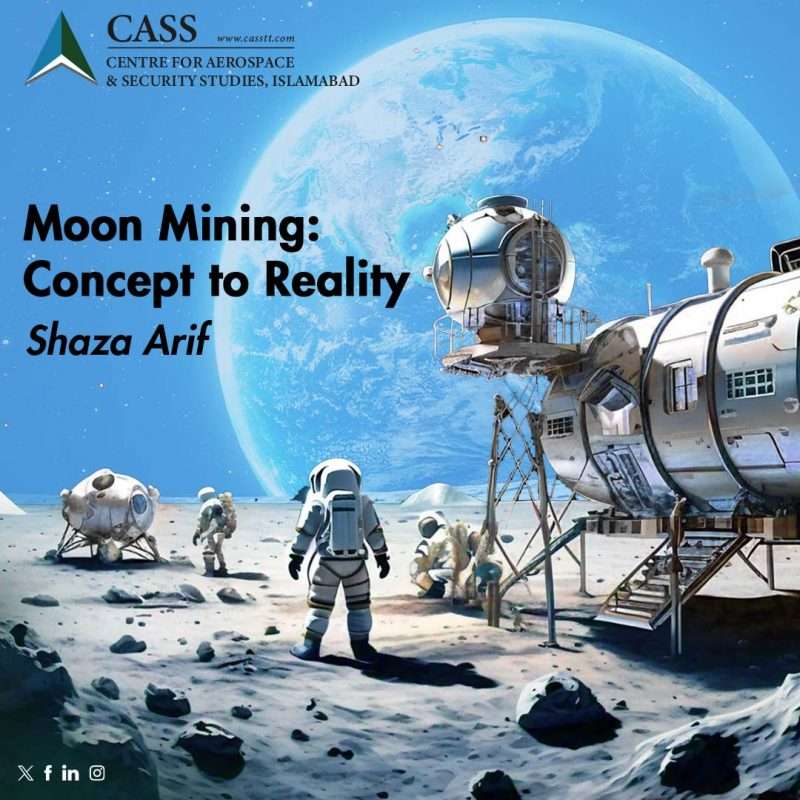
The Apollo 11 mission marked ‘a giant leap’ in humanity’s quest for space exploration, as it was the first time mankind set foot on the Moon. Since then, technological advancements and increasing collaboration between space agencies and the private sector have expanded the frequency and scope of activities on this celestial body. These developments have fuelled optimism about ambitious endeavours like lunar mining, which involves extracting raw materials from the Moon’s surface – a concept gaining attention for its commercial and scientific potential.
The lunar surface consists of valuable minerals, including gold, iron oxide, and platinum, etc. Today, geological maps help identify the presence of different formations and mineral deposits across the Moon’s surface – a tool that can be used for mining missions in the future. Moon mining is envisioned as a potential way to mitigate the environmental impact of traditional mining on Earth. Most of the metals found on the Moon are similar to those on Earth, with some exceptions like Helium-3, which could be used in future fusion reactors to provide a remarkably clean energy source.
Although extracting minerals from the Moon presents an appealing solution for supplementing Earth’s resources, the potential scope of lunar mining extends far beyond mere resource extraction. One promising application is in-situ resource utilisation (ISRU), which involves using materials extracted directly on the lunar surface, rather than transporting them back to Earth. This approach could support the development of lunar bases and facilitate deep space exploration by providing essential supplies, such as fuel, water, and construction materials, directly where they are needed. The process could provide considerable attractive advantages. For instance, the lunar rock Regolith – contains 40 to 45 percent oxygen. The oxygen could prove beneficial for future habitats on Moon and produce fuel to bring space missions back to Earth. In addition, the resources mined on the Moon could also be used to build infrastructure and research facilities as well as generate interest in space tourism. In fact, moon mining could also help open ways for further space exploration. The gravitational force on the Moon is 1/6th of the Earth, which makes it a relatively easier site to launch missions deeper into the galaxy. Therefore, generating rocket propellant from the ice deposits can be envisioned as one of the long-term goals of moon mining.
As fascinating as lunar mining may seem, it faces several challenges that require careful consideration. One of the primary obstacles is the substantial cost involved. For instance, the expense of launching a rocket to transport materials to the Moon is estimated to be around USD 24 billion limiting its economic viability. Beyond the whopping price tag, it would require development of complex mining, extraction, and processing technologies and infrastructure to support the process. Furthermore, systems will have to be designed to resist lunar temperature and radiations. Likewise, the logistical requirements in planning and executing such missions would have their own complexities.
Then, there are legal concerns. The 1967 Outer Space Treaty, prohibits states from laying claims over the celestial bodies, yet it is unclear on mining. Similarly, the Moon Agreement 1979 also asserts that the lunar environment should not be disturbed and should only be used for peaceful purposes, but it has not been ratified by most countries, including major space powers. In parallel, different states have adopted their own framework vis-à-vis mining activities. In such circumstances, there is a likelihood of relying on competing governance systems established in the absence of international agreements. For instance, in Luxemburg, mining materials from space and using them for commercial activities on Earth does not carry any legal consequences, if there is compliance with the national framework.
With the private sector stepping up its efforts in space mining endeavours, there is an increased probability of conflicts arising from differing interests without clear regulations. Like in the past, there is a likelihood that geopolitical issues on Earth may be reflected in space. These trends also highlight the current tech divide, where few countries and tech companies are leading the technological race, limiting potential profits to a handful of entities. Likewise, with increased lunar activity and more missions, moon mining could complicate the existing space debris challenge. Furthermore, while we see numerous advantages associated with the phenomena, attention is also required regarding the level of mining without degrading the lunar surface. Changing the lunar surface is directly linked with Earth’s tides, raising severe ecological concerns.
The ongoing trends suggest that effective governance, technological advancements, economic viability, and responsible practices are crucial to making moon mining a reality. While the process will likely take time, the motivation is strong, with entrepreneurial spirit fuelling new technologies. The real challenge, however, lies in executing lunar mining in a way that respects and preserves the Moon’s delicate ecology.
Shaza Arif is a Research Associate at the Centre for Aerospace & Security Studies (CASS), Islamabad, Pakistan. The article was first published in Modern Diplomacy.She can be reached at [email protected].