Pakistan is a peace-loving nation that respects the sovereignty of other states and avoids interfering in their internal matters. Unfortunately, the state has repeatedly been subjected to Indian aggression under the guise of counterterrorism, as witnessed after the Pulwama and Pahalgam incidents. India’s May 7 incursions across the Line of Control (LoC) and the International Border (IB) were met with Pakistan’s decisive response through ‘Marka-e-Haq’. The operation served as a tool of strategic messaging, underscoring Pakistan’s status as a responsible nuclear state given its measured response to Indian aggression and its non-negotiable stance on national sovereignty.
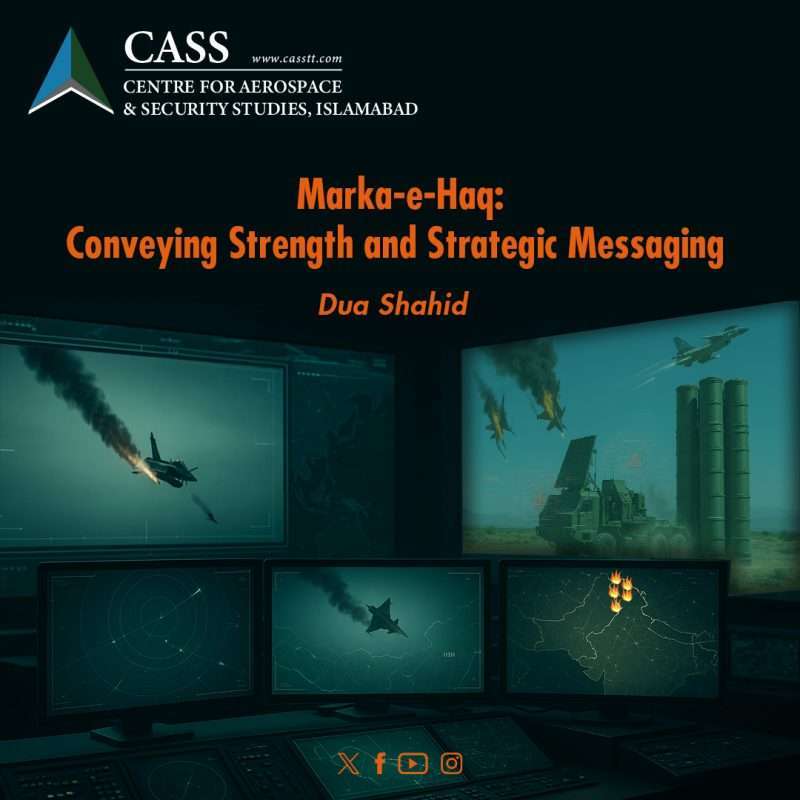
Marka-e-Haq was not merely a measure against New Delhi’s Operation Sindoor, but a cohesive national response against India’s repeated aggression to display deterrence through punishment. The operation gained significant global attention less for its defensive and offensive execution, more for the restraint and deterrent message it conveyed, while underscoring Pakistan’s ability to coordinate actions across three fronts: operational, tactical, and diplomatic.
On the operational front, Pakistan responded swiftly through the integration of air, land, and cyber capabilities. Pakistan’s operational performance was exceptional, with six confirmed Indian aerial kills, including three Rafale aircraft, and handling of drone attacks in modern combat indicating Pakistan Air Force’s systematic investment in defence, readiness, and mastery of aerial warfare. Likewise, the Pakistan Armed Forces engaged 26 military targets that sustained major damage, in both Indian Illegally Occupied Jammu and Kashmir (IIOJK) and mainland India, utilising long-range precision artillery munitions, which also included newly tested missiles Fatah I and Fatah II. Similarly, Pakistan’s advanced cyber operation capabilities temporarily disrupted or crippled communication and logistics of the Indian military. The synergy displayed during this operation has shown Pakistan’s integrated capabilities and maturity across air-land-cyber domains, and remains cognisant of the nuclear threshold.
Tactically, Pakistan responded to neutralise immediate threats to its sovereignty by shooting down Indian aircraft. Islamabad’s response was aimed at defending its citizens and national territory. Therefore, the operation was carefully planned, only targeting key military installations and facilities, including Indian air bases, missile facilities, logistics, and other military support centres that were used to launch an attack against Pakistan. Islamabad’s response was, thus, restrained and lawful under the legal norms, unlike Indian’s surgical strikes that incriminatory killed Pakistani civilians.
On the diplomatic front, Islamabad provided legal justifications for the operation and credible evidence of Indian aggression to the international community. It called for an independent investigation into the Pahalgam incident and briefings to the global community after Operation Bunyan-um-Marsoos, demonstrating its commitment to maintaining its position as a responsible nuclear state while remaining within the bounds of international law. Notably, this operation not only attained international attention but also became a powerful metaphor for national integration by successfully unifying public sentiments under a common banner.
Thus, Pakistan, by giving a befitting response through Marka-e-Haq, conveyed its non-negotiable position to the international community, leaving no ambiguity. Pakistan has signalled that any external aggression will be handled proactively and is committed to rejecting India’s nefarious designs.
Similarly, the operation has reignited international attention on the Kashmir issue, challenging India’s narrative of the disputed region being an internal matter. Despite India’s attempts to alter the region’s demographic composition through the abrogation of Articles 370 and 35A, the issue has resurfaced globally with renewed urgency. This growing international discourse reflects the weakening of India’s diplomatic position. Even US President Trump expressed willingness to mediate the Kashmir dispute, signalling that the world no longer views the situation through India’s unilateral lens
Pakistan has also drawn a clear line that any attempts to threaten its sovereignty through water weaponisation will be met with a firm response. The state will not permit the Indus Waters Treaty (IWT) to be weaponised for political ends. In this way, Islamabad has shown its resolve to protect its water rights.
India’s sustained aggressive stance has posed a persistent threat to Pakistan’s security. But Pakistan successfully deterred this threat with a calibrated response during Operation Bunyan-um-Marsoos. This operation reinforced deterrence under the nuclear threshold. It has also defined Pakistan’s rules of engagement, which clearly demonstrated to the world that its national sovereignty cannot be violated. Misreading this could have unprecedented consequences for the region.
Dua Shahid is a Research Assistant at the Centre for Aerospace & Security Studies (CASS), Islamabad, Pakistan. She can be reached at [email protected]