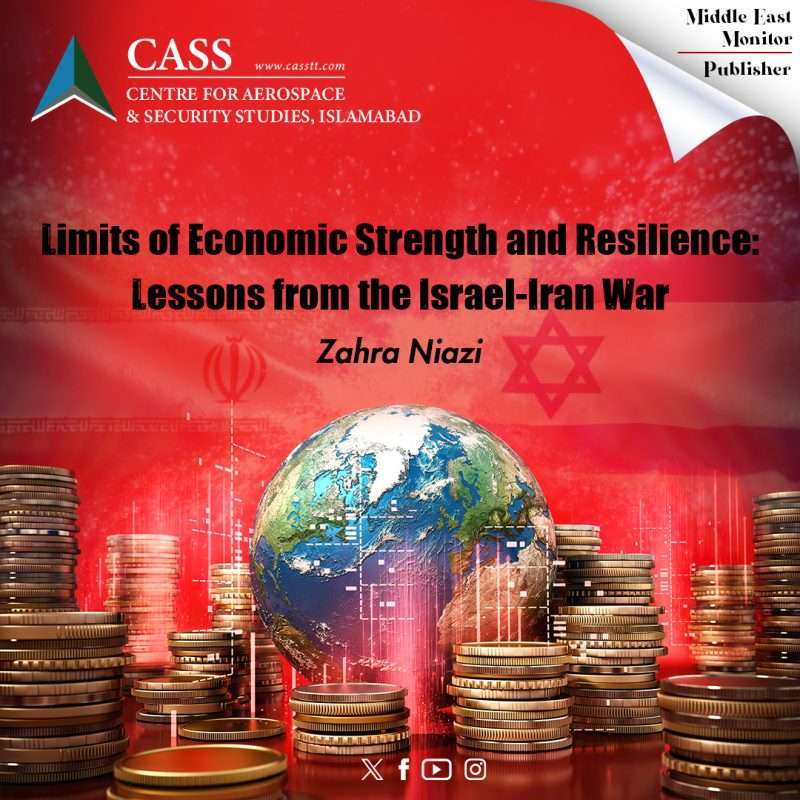
The 12-day war between Israel and Iran ended with a fragile ceasefire. A review of the war’s economic toll suggests that a prolonged conflict would have been economically unsustainable for both sides. For Iran, this was anticipated given the country’s decades-long exposure to sanctions, but for Israel, the war marked a test of its economic strength and resilience and exposed deeper vulnerabilities. As recently as last year, the Israeli Finance Minister had stated with striking confidence that ‘the Israeli economy is strong by all measures, capable of sustaining all war efforts, on the front line and home front, until, with God’s help, victory is achieved.’
Israel’s direct military costs averaged USD 725 million per day – more than eight times its estimated daily defence expenditure, considering the annual allocation of approximately USD 33 billion (NIS 109.8 billion) for the Ministry of Defence in the 2025 state budget. Airstrikes on Iranian targets cost around USD 590 million in the first two days alone, while interceptions are estimated to have cost at least USD 200 million daily. Even at this tremendous cost, missile defence operations could not prevent Tehran’s retaliatory strikes following the attacks on military and civilian infrastructure across the country from causing direct damage to Israel exceeding USD 1.5 billion, including to key financial and economic centres of activity.
The nerve centre of Israel’s financial market – the Tel Aviv stock exchange building – was directly hit. While stocks quickly erased early losses during the war, leading the Israeli Finance Minister to hail it as ‘proof of Israel’s economic resilience–even under fire,’ attacks on Research and Development (R&D) centres, considered the most dynamic part of Israel’s economic core, i.e., the high-tech sector, represented a loss of decades of research, development, trial and error, and investment. Particularly consequential was the strike on the Weizmann Institute, known for its links to military projects and targeted in retaliation for the assassination of several Iranian nuclear scientists, which led to the destruction of 45 laboratories. One of the labs struck, for instance, had material from 22 years’ worth of research. Any future war could push the boundaries further, with even more vital sites likely to be targeted.
Israel’s economic growth this year is projected to decline by at least 0.2 per cent, with the government’s budget deficit likely to reach 6 per cent of GDP, surpassing the 4.9 per cent cap set by the Finance Ministry. Last month, an Israeli official had hinted at the possibility of Tel Aviv seeking additional financial support from the United States to offset the war’s costs and address urgent defence needs.
A 12-day war causing such significant economic consequences reveals how brittle and vulnerable the Israeli economy is.
For Iran, the financial cost has been equally significant. The missiles alone cost Iran around USD 800 million, more than its estimated 12-day defence budget, based on the USD 23.1 billion annual allocation for March 2025-26. Tehran has now reportedly planned to triple its budget in 2025, reflecting the need to replenish resources.
Iran’s economic core – the oil and gas sector – was also severely impacted. The drop in oil exports during the war reportedly cost Iran USD 1.4 billion in lost revenue. Some of Iran’s vital oil and gas facilities, including the major South Pars gas field, were directly hit. Unlike Israel, Iran’s defence systems were not as advanced, making it less capable of preventing strikes on vital sectors of the economy. However, analysts opine that Iran demonstrated more resilience than initially thought by avoiding a total collapse, and reportedly, maintained some of its oil exports during the war through a ‘shadow fleet’ of tankers.
The primary lesson that emerges from this is not one of ‘strengthening resilience’ to mitigate the economic consequences of future wars, but that there are limits to technological and economic strength in the face of war. In fact, states with advanced economies and sophisticated defence systems, such as Israel, can overestimate their capacity to absorb and manage the consequences of war, thereby lowering their threshold for initiating a conflict. Even if enough resilience is built that vital infrastructure and sectors remain immune during a war, military expenditures can reach levels so high that their opportunity costs (the loss of potential gain from other alternatives when one alternative is chosen) can last for decades.
It now falls upon Israeli and Jewish voices to ask the hard questions boldly and without fear. At what cost does Israel pursue its military adventurism? How long will taxpayer money be poured into the bloodshed of innocent civilians? The same questions ought to be raised by the American voices, given the United States’ direct support to and complicity in Israel’s military campaigns. The actions of political leaders arguably become unsustainable once the domestic population (in large numbers) begins to understand and categorically question the price of wars that their governments fight in their name and take pride in.
Zahra Niazi is a Research Associate at the Centre for Aerospace & Security Studies (CASS), Islamabad. The article was first published in the Middle East Monitor. She can be reached at: [email protected].