Doctrinal Primacy in Future Air Warfare
The future air battles will not be shaped by aerial assets alone, but by the minds that employ them. Indeed, keeping pace with technologies will be a must, but doctrine and strategic leadership acumen to execute a carefully crafted strategy will be the decisive factor. The recent four-day conflict between India and Pakistan served as a vivid reminder; numerical strength and modern platforms alone do not guarantee success. India’s embarrassment, despite fielding a technologically diverse and numerically superior Indian Air Force (IAF), was not merely a tactical defeat but a doctrinal revelation.
IAF’s Capability and Employment Strategy Gaps
As India absorbs the lessons of this encounter, it is expected to undertake a comprehensive overhaul of its airpower doctrine. IAF’s wish list is predictable: fifth-generation fighters, improved electronic warfare (EW) capabilities, a robust space and cyber posture, and above all, a reimagined employment strategy. The absence of a reliable “first-shot” kill capability and ineffective utilisation of ISR assets were glaring gaps exposed during the conflict. Coupled with weak EW and cyber resilience, these shortcomings paralysed the IAF’s offensive action.
IAF’s Likely Combat Readiness Plan
To compensate, India may accelerate its efforts towards acquiring fifth-generation aircraft, through the AMCA project, foreign collaboration, or both. Given its growing alignment with Western powers, joint training exercises with them and especially Israel will likely increase. IAF’s broader doctrinal evolution may include better integration of cyber and space elements into its warfighting structure, and a pivot toward decentralised, autonomous combat systems.
PAF’s Strategic Doctrine Development for Future Air Superiority
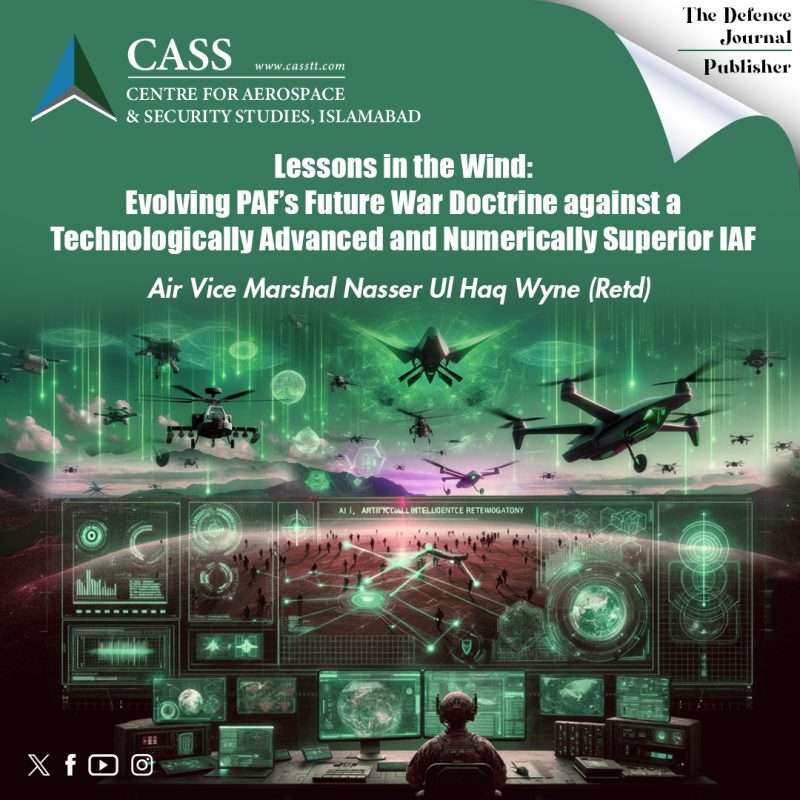
The Pakistan Air Force (PAF), on the other hand, finds itself at a critical juncture, needing to consolidate its success while anticipating the transformations of its adversary. PAF has historically maintained a proactive approach despite resource constraints, and it is this spirit of smart adaptation that must now define its doctrinal evolution. PAF has never focused on numbers alone; it has always invested in high-quality training, dynamic leadership qualities and an offensive operational mindset. Future warfare would also demand the same: a careful balance, integrating next-generation platforms and systems while crafting strategies that exploit asymmetries. PAF’s response to the IAF’s modernisation will not be a mirror build-up; instead, it will focus on adopting efficient technologies and adaptive strategies to counter specific threats.
To stay ahead, PAF’s future doctrine must be anchored in three core pillars: smart inductions, adaptive doctrine and multi-domain integration.
First, on the induction front, PAF’s path must remain practical and visionary. The acquisition of the J-35 stealth fighter, if realised, would serve as a game-changer, adding much-needed stealth, range, and sensor fusion capabilities. Complementing this with unmanned combat aerial vehicles (UCAVs), loyal wingmen, and high-altitude ISR drones will provide the PAF with a winning punch. Smart munitions, stand-off weapons and swarm drones should be prioritised over expensive, limited-use platforms.
Second, doctrine not hardware, will determine outcomes. PAF’s leadership must evolve a doctrinal framework designed not just for parity with IAF, but for deterring or defeating a much more advanced air force. This will mean preparing for high-tempo, multi-axis operations, robust command structures, and dynamic targeting using real-time ISR. The focus must shift from platform-centric planning to network-centric warfare, where decision loops are compressed and tactical actions are synchronised with strategic effects.
Third, PAF must integrate cyber, space, and electronic warfare capabilities into every layer of its war doctrine. Future conflicts will start long before the first missile is fired through data manipulation, satellite disruption, GPS spoofing, and information warfare. Targeting adversary vulnerabilities in these domains offers a cost-effective path to neutralising superiority. Psychological warfare, too, will be central, whether through calibrated release of strike footage, control of information narratives, or pre-emptive influence campaigns designed to shape global perception and enemy morale.
Importantly, unity of command and clear delegated decision authority will be non-negotiable in this future paradigm. War in the next decade will be fast, fragmented and highly fluid. Only a command system that encourages initiative, empowers field commanders and relies on real-time data will thrive. PAF’s traditional strength in training and professionalism will be critical here; pilots, ISR analysts, cyber operators, and EW teams must all be trained to operate within an integrated battlespace, with shared situational awareness and synchronised objectives.
While all PAF capabilities are integrated for Multi Domain Operations (MDOs), interoperability with Army and Naval assets, especially integrated air defence, long range vectors and space surveillance, needs to be strengthened for doctrinal jointness. Wargaming, exercises and simulation platforms should increasingly model integrated, multi-domain warfare scenarios that reflect the kinetic and non-kinetic aspects of modern conflict.
Of course, challenges remain. PAF’s budgetary constraints are real. Pakistan’s economic pressures limit large-scale acquisitions. India will continue to outspend and outnumber the PAF. But this disparity also forces PAF to remain sharp. History shows that airpower effectiveness is not simply a product of how many aircraft you have, but how well you use them.
Conclusion
The winds of change in air warfare are not just technological; they are doctrinal. The PAF’s success in the recent conflict was not accidental; it was the result of a clear-headed doctrine, professional training, smart employment, and confident leadership. To stay ahead, the PAF must augment these strengths while integrating the thoughts of tomorrow. PAF’s effectiveness will not depend on symmetric warfare, but on smart warfare, where agility trumps mass, where minds matter more than machines. Air battles of the future will be shaped less by numbers, more by clarity of thought and adaptive doctrine.
Air Vice Marshal Nasir Wyne (Retd) is Director at the Centre for Aerospace & Security Studies (CASS), Islamabad. Email: [email protected]. The article was first published in The Defence Journal.