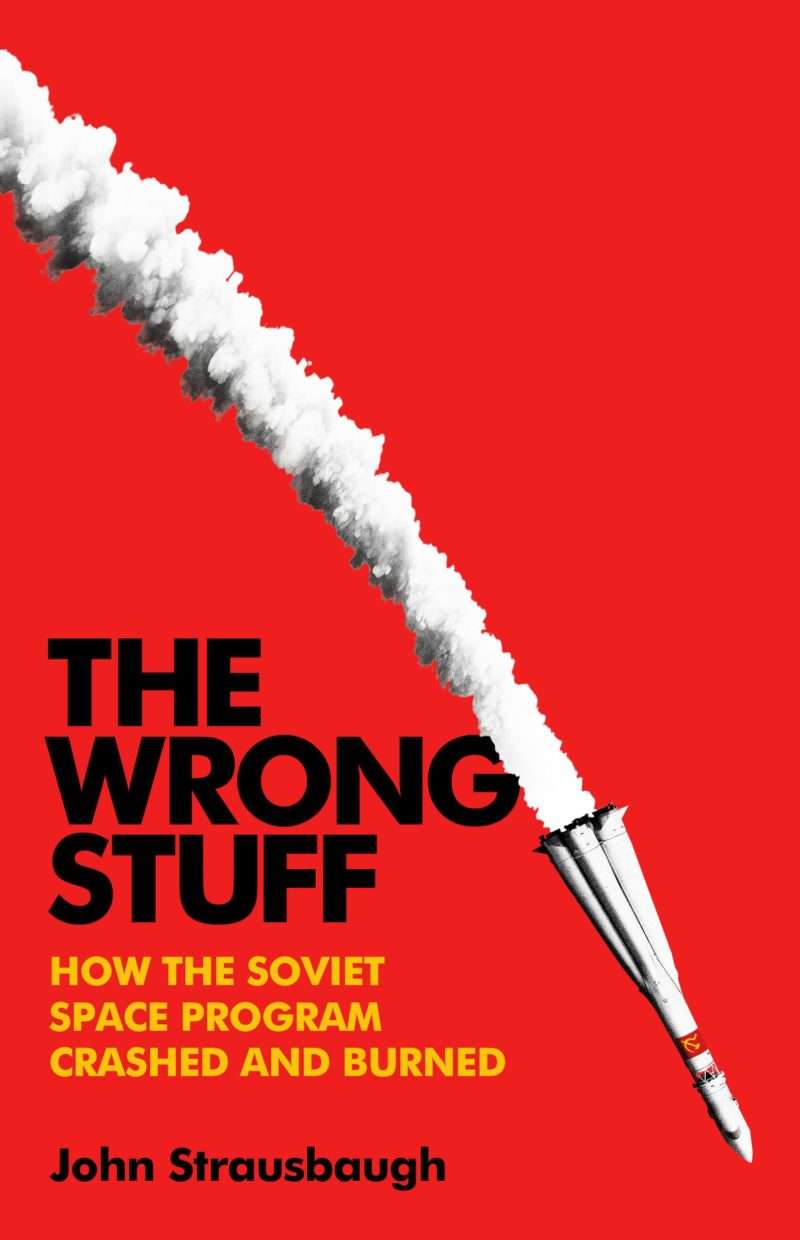
John Strausbaugh, The Wrong Stuff: How the Soviet Space Program Crashed and Burned (New York: Public Affairs, 2024).
Reviewed by Usman Haider
John Strausbaugh is an American writer, and columnist, who also worked for The New York Times. His latest book, ‘The Wrong Stuff’ is based on the history of the nascent Soviet space programme. It covers a 25-year period of the Soviet space programme, beginning in the 1950s and continuing through 1975. It aims to present a history that was largely unknown to the general public. In doing so, it also highlights the failures and challenges the USSR encountered in pursuit of its ambitious goals in space exploration.
The book briefly examines the key figures behind the Soviet space programme, including Nikita Khrushchev, Sergei Korolev, and Yuri Gagarin. It outlines Khrushchev’s ambitious vision to land a man on the moon before the United States (US) and details the measures undertaken by his administration to achieve this goal. However, ultimately it was the US which became the first to successfully land a human on the lunar surface. Strausbaugh attributes this, in part, to the fragmented nature of Soviet decision-making where bureaucratic and political elites, each seeking personal recognition, often undermined coordinated progress.
According to Strausbaugh, the Soviet space programme was marked by a lack of transparency, with authorities routinely concealing failures and accidents from the public. One notable incident cited in the book occurred on 23 March 1961, when Soviet cosmonaut Valentin Bondarenko died during a training exercise inside a pressurised, environmentally controlled chamber at a laboratory in Moscow (p. 94). He also talks about the problems and propaganda that the Soviet cosmonauts had to face. Such information was never made public because of extensive censorship, which aimed to portray only a positive image of the space programme.
Strausbaugh also covers the initial successes of the USSR’s space programme, such as Sputnik and Vostok 1, which made it possible for the Soviets to remain competitive in the space race with the US. Albeit rather briefly, he also sheds light on the Salyut programme, which allowed Moscow to establish its maiden space station. Nevertheless, the book ends on an optimistic note by quoting Soviet cosmonaut Alexei Leonov, who advocated for bilateral cooperation in space exploration during his visit to the US in 1973 (p. 186). It concludes that the successful launch of the Apollo–Soyuz mission in 1975, a joint Soviet-American venture, marked the end of the first phase of the space race (p. 197).
The book predominantly depends on secondary sources, such as other historical texts from the period, as indicated by only a two-page bibliography; the closest primary sources are Boris Chertok’s ‘Rockets and People’ and Gagarin’s autobiography.
Strausbaugh’s narrative largely maintains a derisive tone, portraying the Soviets as scarcely more competent than the Keystone Cops. He highlights the series of misfortunes that plagued the Soviet space programme. These include the death of Vladimir Komarov during the ill-fated Soyuz 1 mission and Alexei Leonov’s near-fatal struggle during the first-ever spacewalk on the Voskhod 2 mission. He also recounts the Nedelin disaster, in which a prototype long-range rocket exploded on the launch pad, killing an entire engineering design team, as well as the repeated failures of the N-1 Moon rocket launches (p. 59).
In addition, Strausbaugh’s tone reveals a discernible bias in his portrayal of the Apollo-Soyuz Test Project (ASTP) (p. 193). Although the project was a collaborative effort with comparable technological contributions from both the Soviet and American sides, Strausbaugh writes about the Soviets’ astonishment at American technological advancements. Under ASTP, American astronauts trained at the Baikonur Cosmodrome, while Soviet cosmonauts received instruction at the Kennedy and Johnson Space Centers in the US. However, the author overlooks the fact that American astronauts also expressed appreciation for the Soyuz spacecraft’s operational efficiency. Later, during the Shuttle-Mir programme, NASA formally acknowledged Russian expertise in long-duration spaceflight and the valuable knowledge that could be gained from collaboration with their Russian counterparts. Including these perspectives would have offered a more balanced and candid account of the technological exchange and mutual learning that characterised the joint missions.
While the book clearly displays a bias against the Soviets, it also underscores a troubling reality: for the Kremlin, human life was often secondary to the overarching objective of winning the space race. Significant human and material losses were considered acceptable, justified in the name of national security and the glory of the motherland. As commercial space exploration gathers momentum, the book offers valuable lessons. States can benefit from understanding the missteps of the Soviet programme. In particular, countries with active private space enterprises, such as the US, should adopt a more cautious and measured approach when issuing licenses. Robust regulatory frameworks must be established to safeguard human life and promote transparency in the rapidly evolving space sector.
If one is unacquainted with the history of the Soviet human spaceflight programme, ‘The Wrong Stuff’ will offer an introductory overview, especially regarding its early developments. However, the well-informed readership of the preliminary Soviet space history would find little novelty. The book, while engaging and accessible, is fundamentally frivolous in tone and should be approached with a degree of scepticism. As the title itself suggests, the author relies on negative stereotypes to frame the Soviet space experience. This bias is evident in the way the USSR’s notable achievements, such as the first human spaceflight, the pioneering mission of the first female cosmonaut, and other significant milestones, are mentioned only in passing or are downplayed. As a result, the book reads less as a balanced historical account and more as a one-sided critique of the Soviet space programme.
Usman Haider is a Research Assistant at the Centre for Aerospace & Security Studies (CASS), Islamabad, Pakistan. He can be reached at [email protected].