A Story of JF-17 Program which led to the Expansion of Pakistan’s Aviation Industry
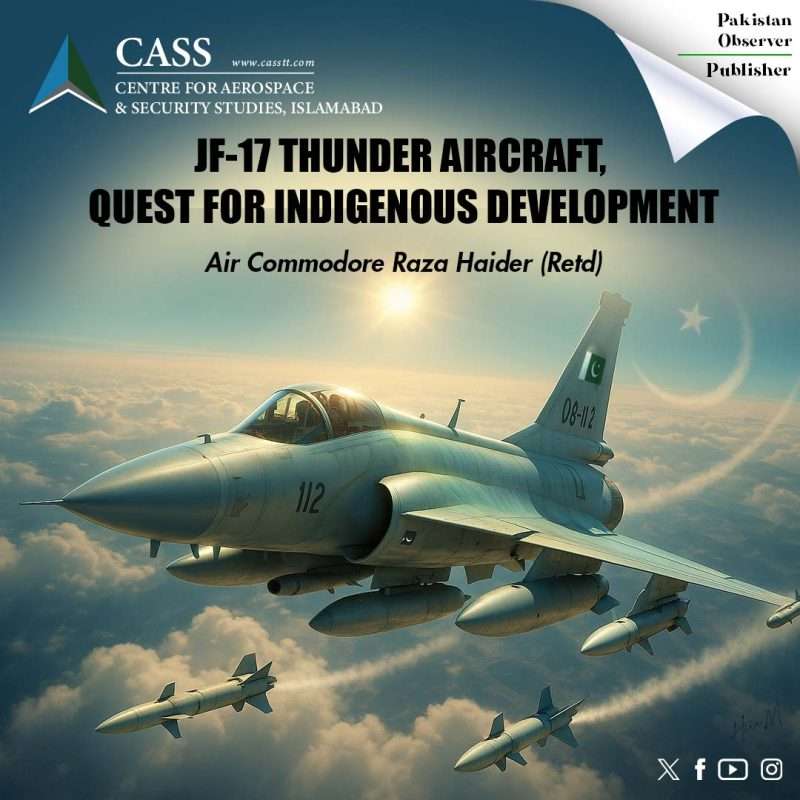
The battle tested JF-17 Thunder aircraft forms the backbone of Pakistan Air Force (PAF). With key roles in operation swift retort and air combat of May 2025, the JF-17 fleet represents not just a platform, but a combination of cutting-edge operational capabilities, self-reliance, and a national resolve. This article covers the roller coaster ride of development and production of JF-17 Thunder aircraft; a remarkable saga of multiple challenges and PAF’s integral strength and versatility. This initiative provided not only a multi-role fighter aircraft for replacement of ageing fleet, but also an opportunity of developing an aviation industry in Pakistan through indigenous production.
The foundation of JF-17 program can be traced back to late 1980s when the PAF began seeking upgrades and replacements of its fleet in response to the evolving geo-strategic realities. On account of the sanctions on Pakistan in the 1990s, Pakistan and China mutually decided to embark on a mission of joint development and co-production of a multi-role fighter aircraft under the name of ‘Super 7’ project, which was based on the principles of K-8 jet trainer co-production project. The requirement of an advanced combat aircraft stemmed from the need to replace PAF’s fleet of F-6s, F-7P, A-5s and Mirages that had served PAF for more than 40 years. This was a turning point for the aviation industry of Pakistan, which always aspired to see an indigenous advanced jet fighter ruling the sky.
In 1999, the development contract was signed and the aircraft was named as Super-7 in Pakistan and FC-1 Xiaolong (Fierce Dragon) in China. The project was conceived with two primary objectives: to develop a multi-role fighter aircraft and to expand the aviation industry of Pakistan. In this regard, human resource development was perceived as a challenge for which PAF personnel undertook rigorous training related to aircraft design, manufacturing and flight-testing. Decades of experience in maintaining and operating Western aircraft immensely contributed in refining the design of Super 7 aircraft. PAF teams trained in China during the aircraft development phase have contributed significantly in aircraft production, operations, maintenance and capability upgrades.
The first flight of Super 7 prototype-1 (PT-1) on 25 August 2003 at Chengdu, China marked the beginning of Flight Test Phase, followed by a ceremonial flight on 2 September 2003 to celebrate the historic occasion. Later on, a successful flight of prototype-3 (PT-3) was carried out on 9 April 2004. The Super 7 was re-named as Joint Fighter-17 (JF-17) and nick named “Thunder”in July 2004. While the newly developed avionics were ready for testing on aircraft, a new PT-4 aircraft encompassing airframe design improvements, as well as new avionics suite was manufactured. The first flight of PT-4 aircraft in May 2006 and of PT-6 four months later marked the achievement of a significant landmark in the program. A total of six prototypes were manufactured, out of which four were meant for flight testing while two were used for static and fatigue testing on ground through requisite instrumentation.
On 23 March 2007, the people of Pakistan witnessed JF-17 for the first time, executing a memorable flying display during the Pakistan day parade in Islamabad. On that day, JF-17 was awarded the title of “Pakistan’s Pride.” Keeping in view the aim of building and expanding the aviation industry of Pakistan through self-reliance, Aircraft Manufacturing Factory of Pakistan Aeronautical Complex (PAC) was selected for JF-17 airframe production. The manufacturing teams trained in China formed a core group, which undertook and accomplished the challenging task of establishing production facilities which have so far produced more than 150 JF-17 aircraft. The transformation of PAC’s role from overhauling to aircraft manufacturing was a result of consistent dedication and hard work that has given a new dimension to the aviation industry in Pakistan. Similarly in parallel, JF-17 avionics production facilities were established at Avionics Production Factory at PAC with an objective to build up an indigenous capability for designing and producing avionics systems. This capability was essential for not only gaining long-term supportability benefits, but also for acquiring requisite knowledge to indigenously develop new systems, in future.
The first in-country Serially Produced (SP) JF-17 rolled out on 23 November 2009, a historical milestone achieved after years of hard work. The first JF-17 squadron was inducted in February 2010 by replacing A-5s with the new indigenously built JF-17 Thunder at PAF Base Peshawar. As of today, JF-17 continues to fly in different squadrons actively participating in operations conducted in the defense of Pakistan, proving its multirole cutting-edge capabilities.
After the succesful development and production of Block-I and Block-II aircraft, an advanced version of JF-17 Block-III was developed and produced in 2022. The capabilities of JF-17 Block-III are compatible with any modern combat aircraft of the world. These include an advanced AESA radar, Electronic Warfare (EW), Helmet Mounted Display, state-of-the-art avionics, full glass cockpit, precision day/night attack, outstanding Man Machine Interface (MMI) with HOTAS and Beyond Visual Range missiles capability. Due to these advanced features and capabilities, a number of countries have shown keen interest in the purchase of JF-17 aircraft, particularly in the aftermath of current war with India. In its international appearance, JF-17 has received worldwide appreciation by the media and internationally reputed aviation magazines in different air shows. These include Farnborough, China and Dubai air shows and Centennial Celebrations Turkey. Recently, JF-17 Thunder made a notable performance at the Royal International Air Tattoo (RIAT) held at United Kingdom (18–20 July 2025), where it was awarded the prestigious “Spirit of the Meet” trophy in recognition of its excellent performance. The JF-17 program has progressed through multiple challenges to yield significant strategic and technological benefits, delivering wide-ranging gains to Pakistan’s aviation sector. The program has achieved the aim of replacing the ageing fighter fleet and currently more than 150 JF-17 aircraft are flying in operational squadrons. This number is continuously increasing as serial production is in progress at PAC. These efforts mark an important step towards building an aviation industry in Pakistan, with the JF-17 Program laying its foundation through the development of a ‘Made in Pakistan’multi-role fighter aircraft.
Air Commodore Raza Haider (Retd) is Director at the Centre for Aerospace & Security Studies (CASS), Islamabad. The article was first published in Pakistan Observer. He can be reached at: [email protected]