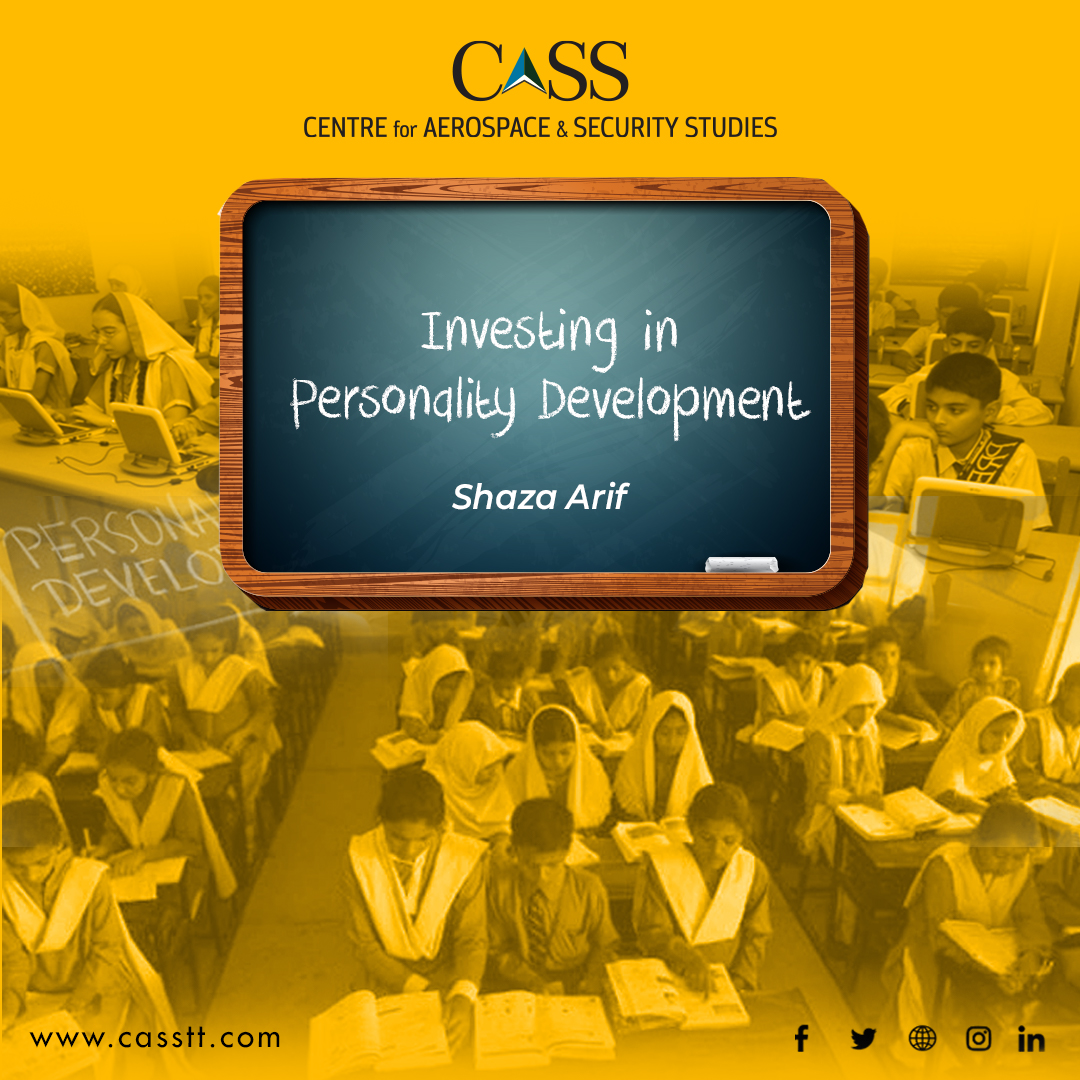
The value of education in perfecting life is matchless. Apart from growing one’s knowledge, it has the potential to play a central role in the development and nourishment of a good personality. Informed minds combined with good personalities instill positivity in society. Although home is the first place for personality development, educational institutions can play a remarkable role in mending, improving, and polishing citizen’s personalities. Unfortunately, Pakistan’s educational institutions have belittled the importance of personality development and have disregarded its value. Decision-makers are also not fond of investing in students’ personality development.
In Pakistan, one major flaw in the education system is that even in the initial classes, i.e., pre-school/kindergarten, the focus is primarily on root learning of exhaustive syllabus, whereas personality development takes a backseat. Undoubtedly, curriculum carries key significance. However, it remains imperfect when not supported by a healthy personality. Hence, personality development needs to be an integral part of the educational system.
The Chinese model, in this case, is an interesting example. Confucianism is knitted alongside academics, with emphasis on values, ethics, mental health, politics, and citizenship. From values and society in primary classes, thought and character in middle classes to the study of politics in higher classes, the blend of diverse aspects of life are not only taught but also practiced in schools.
In Pakistan, we need to think along similar lines and adopt a similar model to enrich the quality of education and groom our citizens. Furthermore, given that primary classes are the best time for character building, Pakistani schools need to have a directed focus on personality development in those classes. What is taught in the early years usually remains well-associated with growing minds, setting the foundation for their future and adapting it as a lifestyle. Ultimately, it can become a legacy for the succeeding generation to follow.
Indeed, children learn what they see, but it is also possible to pass on personality traits via planned activities. Hence, personality building should be given equal weightage and more importantly, equal time as compared to theory-based syllabus. Simple but meaningful exercises, i.e., helping their peers, reading more books, working as teams, tolerating opposing viewpoints, adhering to honesty, displaying responsibility, greeting properly, practicing mercy, and showing kindness, etc. should be central. Even if one whole month is dedicated to practicing each aspect (alongside the syllabus), it is worth the time and effort if these factors are later reflected outside the classroom. Self-awareness classes should also be compulsory for primary, middle, and high school at least once a week. Likewise, content that reinforces these practices should be reflected in textbooks and continue to resonate as students progress towards higher classes. The ultimate aim should be to create a civilised and caring community. Furthermore, such activities can help shift from a teacher-centred learning approach to a student-centred one.
While it is true that the textbooks and the related content is abundant, it is their true implementation that is scarce. We need to give meaning to our education by bridging the gap between knowledge and practice. We must nurture young minds with wisdom rather than fancy words, hollow and frail from inside. Both private and public schools should synchronize their syllabus/activities to treat personality development as an utmost priority. It is equally important to implement the same at religious schools (Madrassahs), a major learning platform for more than 2.5 million students in Pakistan.
Towering challenges stand strong in the way of streamlining and accelerating this process. As per the 18th Constitutional Amendment, education has been devolved to the provinces, adding another layer of complexity and giving a secondary role to the Ministry of Education in implementing major changes. Furthermore, the division of public, private, and religious schools, with each operating on different modes, poses hurdles in establishing and implementing a uniform policy. It goes without saying that approximately 5 million children, aged 5-9y, don’t even have access to primary schools (most of these students are females), which further compounds the situation. Moreover, no matter how well-articulated a policy is formulated in this regard, it is the implementation that matters. Unless properly implemented by the school administration, particularly teachers with full commitment, it won’t bring about significant change.
Investing in personality development will be beneficial at individual and collective levels. Despite the obstacles, there is a need to be more vocal on this issue and urge the concerned authorities to focus in this regard. It is time to start thinking beyond scores and grades to foster a society that can contribute effectively to national progress. We need to bring a paradigm shift into our education system, the contours of which may take considerable time to manifest, but it’s worth a try and a requirement of the time.