
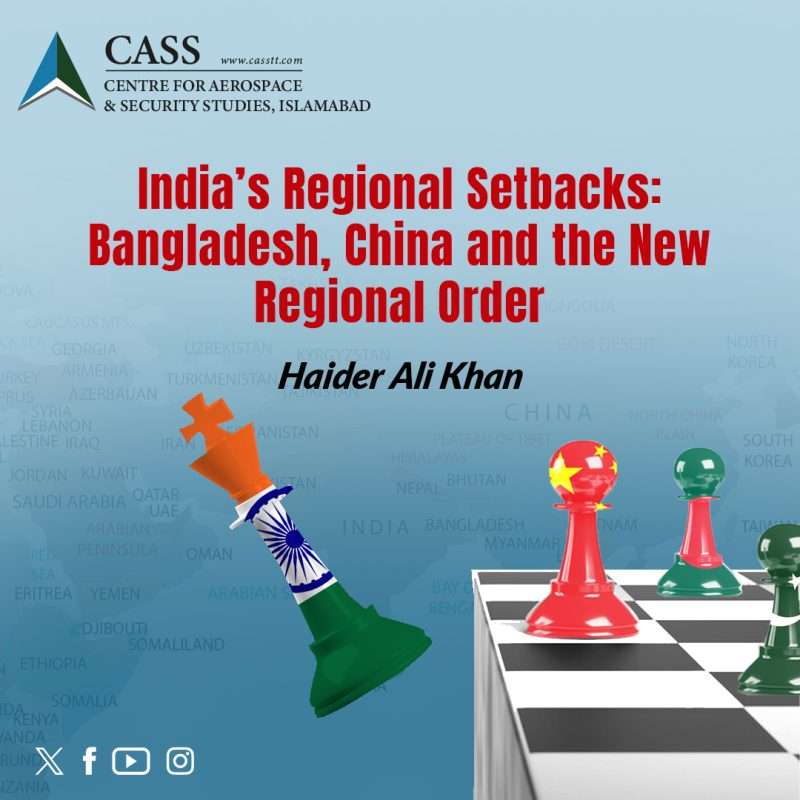
Once hailed as India’s key ally in the region, Bangladesh is drifting away due to India’s overbearing foreign policy. India’s unfriendly disposition has dealt a heavy blow to its regional influence, as even the states most dependent on India have begun exploring alternatives within the region and beyond. As nations in the region gravitate towards China, the inconsistencies in India’s perception of its character as a regional leader become increasingly evident. India’s self-identification as a leader in South Asia is rooted in historical and cultural perspectives that translate into its foreign policy. However, this notion is not shared by other states in the region which deem it coercive, paternalistic and dismissive of their sovereignty and national integrity. Bangladesh is a recent addition to the growing list of nations wary of India, shaped by a stark contrast between perception and identity, where nationalist identities, hegemonic ideals and state interests intersect and collide.
Sheikh Hasina, a long-term ally of India, was ousted from office in August last year in a popular uprising. The result was a swift deterioration of diplomatic relations between India and the new interim setup in Bangladesh, shaping the entire course of bilateral relations in a few months which took years to build. Despite notable economic development under Hasina, the Bangladeshi public resented her close ties with India. Although Hasina won the last elections and came to office for her fourth term, her legitimacy remained questionable. The anti-Hasina protestors in Dhaka chanted ‘India Out’ slogans to express their distrust of the government. This indicated a prevailing sentiment of Indian interference in the electoral process of Bangladesh, undermining its democratic instincts.
‘India Out’ protests also took place in the Maldives a year earlier, paving the way for Mohammad Muizzu’s government. Although Moizzu has taken steps to recalibrate ties with Delhi since coming to power, his policies remain predominantly independent. He has also signed key defence and economic agreements to enhance bilateral relations with China. Recent developments in China-Nepal bilateral ties also raised concerns in Delhi when Nepal’s Prime Minister Sharma Oli visited China in December last year breaking the long-standing tradition of visiting India first. Sharma Oli’s visit was focused on discussions regarding the much-awaited BRI cooperation framework.
China’s ingress plays a significant role in the contemporary geopolitics of South Asia, and Beijing’s growing contiguity with smaller South Asian nations has brought Delhi into a contest for power and influence in the region. Indian concerns arise from its economic advancements being overshadowed by its inability to forge stronger ties with neighbouring states – a gap increasingly filled by China’s strategic cooperation with South Asian nations. The failures of India’s ‘Neighbourhood First Policy’, due to its overbearing attitude have created strategic gaps for China to increase its regional influence by partnering with nations such as Bangladesh, Maldives and Sri Lanka on key strategic economic initiatives such as BRI and Global Development initiative, which is in line with China’s global initiative for south-south cooperation. Moreover, nations such as Nepal and Bangladesh are leveraging relations with China to balance India’s dominance and pursue a more independent foreign policy beyond Indian influence.
Unresolved bilateral issues with the neighbouring states also play a role in smaller South Asian nations steering away from the Indian sphere of Influence. Long-standing border and territorial disputes and disregard for settling disagreements with countries such as Bangladesh also add to the existing conundrum of mistrust and geopolitical rivalry. Moreover, the normative mismatch is also evident in the bilateral relations in the region, as India portrays itself as a benevolent regional leader but its smaller counterparts feel increasingly disenfranchised.
As India is embroiled in a diplomatic crisis with its eastern neighbour, its failures allowed China to advance its geopolitical objectives in South Asia. Strategic imperatives and geopolitical rivalries compel South Asian states to redefine their foreign policy postures in the regional context. This is imperative, as South Asian actors find the regional cooperation frameworks such as SAARC (South Asian Association for Regional Cooperation) and BIMSTEC (Bay of Bengal Initiative for Multi-Sectoral Technical and Economic Cooperation) largely ineffective. This provides ample room for China to pursue an independent foreign policy with the smaller nations, undermining Indian influence in the region. Geopolitical prudence demands a consensus in South Asia with the involvement of major stakeholders to redefine the role of inclusivity in the regional political milieu.
Haider Ali Khan is a Research Assistant at the Centre for Aerospace & Security Studies (CASS), Islamabad, Pakistan. He can be reached at [email protected].



