
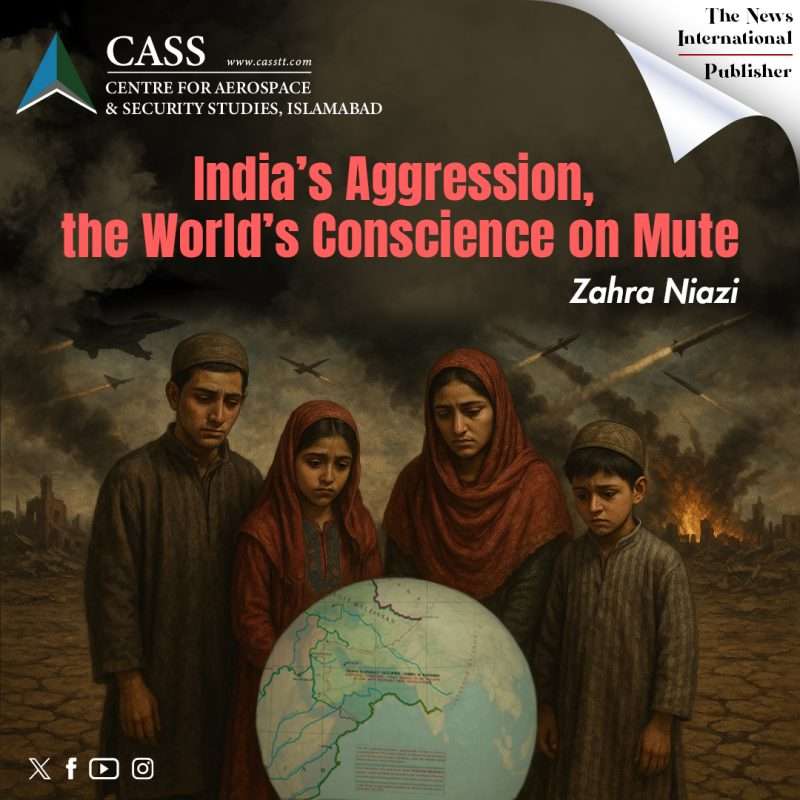
On May 6, 2025, India launched ‘Operation Sindoor,’ a series of missile strikes on targets inside Pakistan, leading to the martyrdom of 26 civilians, with another 45 injured as of this writing. Yet, despite the gravity of New Delhi’s blatant breach of legal norms, the immediate international response remained largely muted. A few international actors swiftly issued statements, but these, too, fell short of the response that the situation truly warranted. President Donald Trump, for instance, labeled the strikes ‘a shame’ while hoping the crisis would end quickly. The United Nations Secretary-General called for ‘military restraint’ urging that the world could not afford a military confrontation between both countries. China’s Foreign Ministry Spokesperson called India’s action ‘regrettable’ and urged both sides to act in the larger interest of peace and stability. Other major international actors have also echoed similar sentiments.
However, crucial questions such as – How did India justify such a dangerous strike without releasing any verified public evidence of Islamabad’s involvement? What evidence exists that the targets comprised terrorist infrastructure? Why did civilians die if New Delhi only targeted so-called ‘terrorist’ hideouts in Pakistan? How dangerous could the consequences of India’s repeated pattern of escalation and aggression against Pakistan be? – are not being asked.
International media, while covering the crisis widely, has also failed to extend a vociferous call for reflection on these critical questions. Such questions do not constitute interference; rather, they arise from logical inquiry and sound reasoning aimed at preventing a destabilising outcome of New Delhi’s aggressive move and its recurrence.
In the aftermath of the Pahalgam incident, India swiftly blamed Pakistan for the massacre, accusing Islamabad of sponsoring the attackers. The ‘Jammu and Kashmir Police’ released unverified sketches of three assailants, which they claim were developed based on recollections by eyewitnesses. Two of the attackers were allegedly linked to Pakistan. Yet, to date, New Delhi has not shared concrete proof with the world to substantiate this claim. It is well established that in the repressive environment of Indian Illegally Occupied Jammu and Kashmir (IIOJ&K), the prospect of an impartial investigation is systematically obstructed. Press freedom in IIOJ&K sharply declined following revocation of Articles 370 and 35A in 2019, with local journalists facing surveillance, harassment, and charges under anti-terror laws. Foreign correspondents are deported for critical reporting or denied access. On the other hand, Islamabad has been categorically demanding a ‘transparent, credible, and impartial’ investigation into the incident. International media were, in fact, taken to several areas in Azad Jammu and Kashmir that India has repeatedly labeled as hubs of terrorist activity in order to ‘debunk India’s baseless accusations.’
Even within India, opposition figures had called for a comprehensive scrutiny of the incident, citing concerns about security and intelligence failure in Pahalgam on April 22. By failing to forcefully condemn India’s illegitimate strike and demand independent investigation, the global community implicitly allows New Delhi to act unilaterally without the presence of credible proof.
Equally unfortunate has been a lack of global scrutiny of New Delhi’s unsubstantiated claim that ‘Operation Sindoor’ specifically targeted the terror infrastructure from where attacks against India have been planned and directed. New Delhi has not released any authentic (real-time) surveillance data of the existence of terrorist infrastructure at the target sites. Verified reports from the ground suggest that the missiles struck urban and civilian-populated areas, resulting in civilian casualties, including women and young children. When such a human tragedy is met with an underwhelming response, it lowers the bar for further illegitimate moves.
Likewise, while statements from world leaders reflected calls for maximum restraint and hopes for de-escalation, what remains absent is an open acknowledgement of the fact that it is New Delhi’s increasingly aggressive posture that has emerged as a recurring pattern and actively contributes to the escalation of tensions. Issuing neutral statements in such a context falsely equates both sides as equal aggressors, despite India’s repeated demonstrations of unilateral and provocative actions.
A similar pattern of global silence, surrounding India’s decision to unilaterally suspend the Indus Waters Treaty (IWT) and the dissemination of unverified allegations against Pakistan (and their potential consequences), was visible in the aftermath of the Pahalgam incident.
India’s ‘Operation Sindoor’ serves as a stark reminder that the pattern of international inaction and international media silence must not be allowed to persist. The global community must move beyond perfunctory statements and take urgent and decisive action: it must demand an independent investigation of India’s justification for the missile strikes, including the legitimacy of its claimed targets and the resulting civilian casualties, and hold India decisively accountable for its reckless, self-serving actions. World leaders must confront the deeper structural injustices in Indian Illegally Occupied Jammu and Kashmir rather than enabling their erasure through silence. Anything less would only fuel India’s hostile cycle where silence becomes complicity and innocent lives are buried underneath.
Zahra Niazi is a Research Associate at the Centre for Aerospace & Security Studies (CASS), Islamabad. The Article was first published in The News International. She can be reached at: [email protected].



