Concept Note
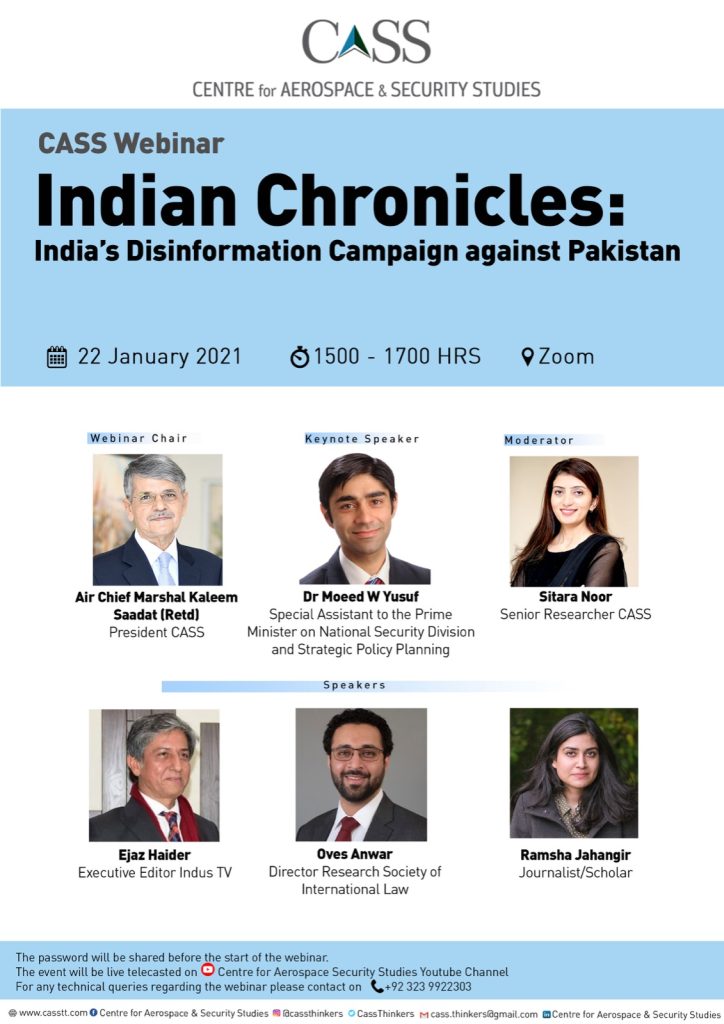
EU DisinfoLab European non-governmental organization (NGO) has published a report entitled “Indian Chronicles” that brought to surface the extent of India’s disinformation campaign targeting Pakistan through fake news, false testimonies at the UN Human rights Commission and malicious propaganda involving the EU members of Parliament. Earlier in 2019, the DisinfoLab had unearthed 256 pro-Indian websites that were operating across 65 countries and conducting a massive disinformation campaign against Pakistan. All those websites traced back to a New Delhi based company, the Srivastava Group. According to the new report, the campaign also involved regular media outlets such as Asian News International (ANI) – India’s largest wire service and various fake NGOs including ten U.N. Human Rights Council-accredited NGOs, that were being used to target members of the EU and the U.N. Not just that, the campaign impersonated leading personalities such as Harvard Law faculty member Professor Louis B Sohn after his death as well as some regular media outlets such as EU Observer. Commenting on the scale of this network, Alexandre Alaphilippe, the executive director of the EU DisinfoLab rightly stated that, “it is the largest network we have exposed, that was designed primarily to discredit Pakistan internationally.”
Disclosure of the disinformation campaign hints at the depth and complexity of hybrid warfare against Pakistan that is centred around false propaganda and other subversive activities. Although the report did not directly implicate the Indian government, the sheer sophistication and extensive nature of the campaign indicates that such an operation is not possible without direct government involvement and support. The report came soon after Pakistan shared a dossier of proofs of Indian involvement in terrorism activities inside Pakistan and according to the Pakistani officials “Indian Chronicles” vindicates Islamabad’s long-held position on Indian mischievous activities. However, despite the unprecedented nature of the report and the challenge it had posed to the credibility of the functioning of UN and EU members, the report has received a lukewarm response from the international community. Till date, the involved news agency and other dubious NGOs are functioning and carrying out their activities with impunity. While steps are being taken at the diplomatic level, their impact is yet to be seen. The webinar on “Indian Chronicles: India’s disinformation campaign against Pakistan” aims to discuss the nature of Indian disinformation campaign, assess the damages it has caused and explore a way forward to detect and stop such activities in future.