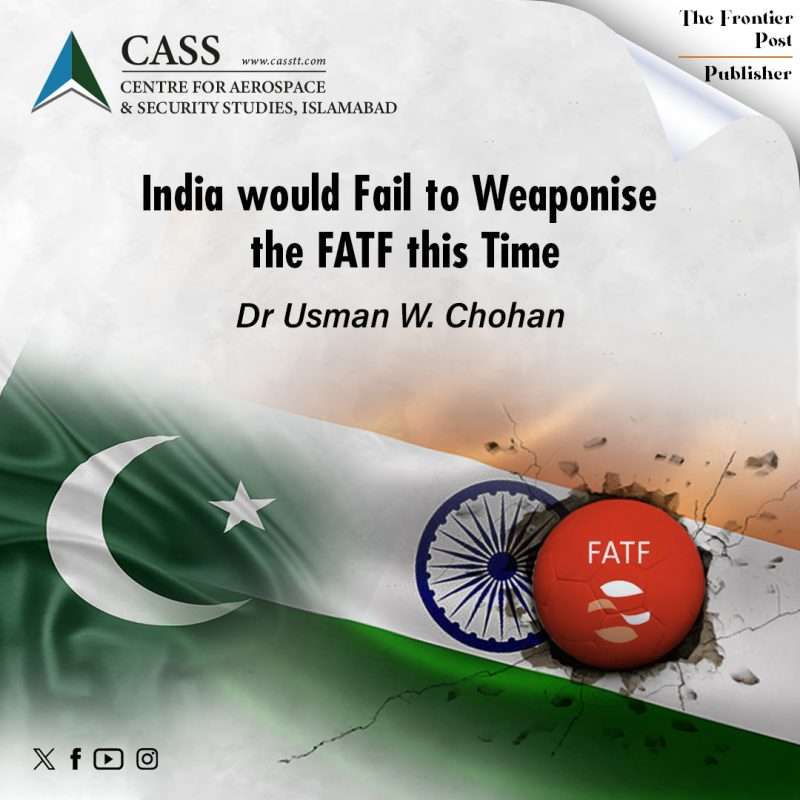
Since facing the fury of Operation Bunyan-um-Marsoos and seeing the folly of instigating kinetic conflict, India has been looking towards alternative means of harming Pakistan. It has mentioned various global financial instruments as an alternate domain of warfare, but so far, its efforts have fallen on deaf ears. For example, the International Monetary Fund (IMF) rejected India’s appeal to withhold the most recent tranche of the ongoing Extended Fund Facility. Next, India may look to the Financial Action Task Force (FATF) and attempt to weaponise it, as it did in 2018.
By India’s own admission, specifically that of its External Affairs Minister, India used the FATF as an instrument of coercion against Pakistan. The FATF put Pakistan on the ‘grey list’ in 2018, as it is commonly known, at the behest of India, and a long list of action items was imposed with threat of sanctions under non-compliance. In response, Pakistan undertook a two-pronged approach to exit the grey list.
First, Pakistan seriously pursued the Anti-Money Laundering and Counter Financing of Terrorism (AML/CFT) measures stipulated by the FATF, and ended up with an impressive, integrated financial oversight regime in the process. This involved a multistakeholder and meticulous whole-of-government approach. To its credit, Pakistan exited the list with standards higher than developing countries and comparable to those of some developed countries, vowing never again to end up on the grey list.
Second, Pakistan pushed back on many international fora, including the United Nations, against the FATF, openly decrying its hypocrisy and duplicity as a task force. After all, if one really cared about AML/CFT, wouldn’t one target all the offshore tax havens of the world? Better yet, the onshore havens such as London, Delaware, Guernsey, or Miami?
More specifically, whether the FATF cares to admit it or not, India violates all of the areas under the FATF’s self-ascribed purview: India finances terrorism in many countries, it has a massive black economy fueled by money laundering, and has even had sensitive nuclear material found in briefcases. Jaishankar’s India belongs not simply on the grey list, but at the bottom of the blacklist.
All in all, Pakistan’s push back against the FATF put the task force itself on the defensive, raising questions around the world regarding the competence, impartiality, and neutrality of what increasingly appeared to be a highly toxic self-appointed financial watchdog.
As such, any Indian push to have Pakistan re-listed on the FATF is unlikely to work à la 2018. New Delhi’s long-standing strategy of lawfare and abusing international financial governance appears unsustainable. The three reasons that the Indian External Affairs Minister and other hardline manipulators should desist from trying to weaponise the FATF again include: the FATF’s own reputational decline, Pakistan’s technical compliance, and India’s political miscalculations.
First, Pakistan has already exposed FATF’s political vulnerabilities since 2018 by framing the grey listing as a politically motivated move rather than a merely technical one. This has weakened FATF’s image as a neutral arbiter, and it is now more cautious, aware that overplaying political influence risks further damage to its credibility among Global South nations that increasingly view the body as biased.
Second, Pakistan has implemented the vast majority of action points mandated by FATF, positioning itself as an exemplar in technical compliance for a developing country. Any attempt to re-list Pakistan would lack a defensible technical basis, making FATF vulnerable to accusations of double standards, further eroding its legitimacy.
Third, Indian officials have already played their hand by publicly admitting to lobbying to keep Pakistan on the grey list as part of India’s strategic agenda. When Pahalgam’s tensions began to fume, mainstream (Godi) media and social media openly echoed such weaponisation. But such open politicisation undermines the viability of an Indian campaign, signalling to FATF members that this is less about technical compliance and more about geopolitical rivalry. Such transparency about intent reduces the likelihood of building a credible coalition within FATF for re-listing Pakistan.
As such, an Indian attempt to weaponise the FATF is unlikely to succeed given FATF’s damaged reputation, Pakistan’s demonstrated compliance, and India’s own diplomatic errors. Moving forward, the effectiveness of FATF as a neutral body depends on insulating it from geopolitical manipulation. Both FATF and its member states must prioritise technical integrity over political agendas if they are to retain relevance in the global financial governance landscape.
Dr Usman W. Chohan is Advisor (Economic Affairs and National Development) at the Centre for Aerospace & Security Studies, Islamabad, Pakistan. The article was first published in The Frontier Post. He can be reached at [email protected].