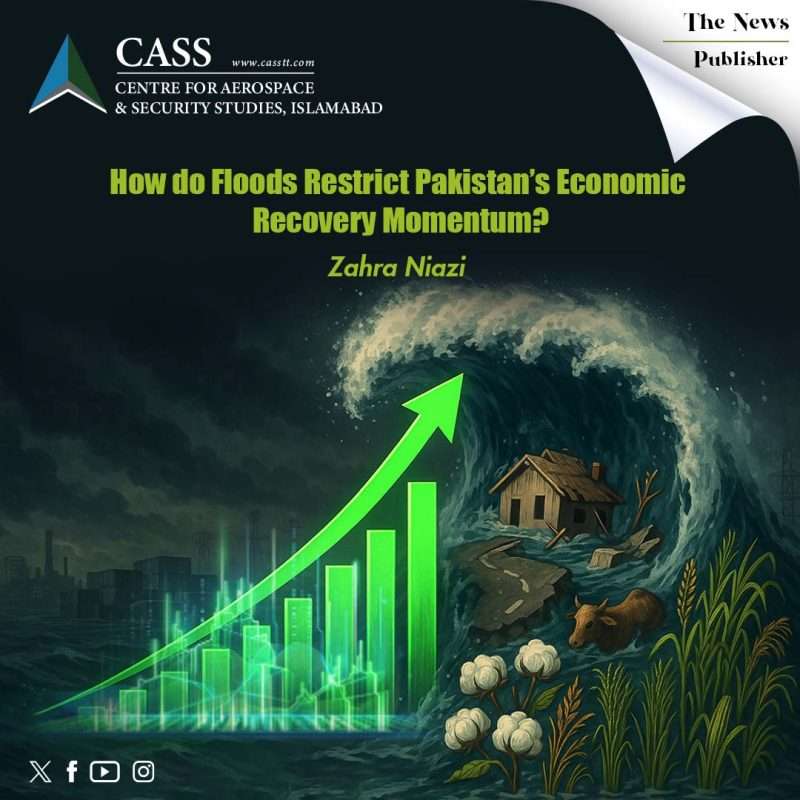
The tragedies of the 2025 floods in Pakistan continue to unfold. While over a thousand people have lost their lives, no number can ever truly capture the depth of the human tragedy. Beyond the immeasurable loss of lives, the floods have also inflicted widespread destruction, with the full extent still unknown, as many areas remain inundated.
Even before the super floods had entered Sindh, estimates released by a leading brokerage firm in early September indicated that about 1.3 million acres of key crops, including rice, maize, sugarcane, and cotton, had already been submerged in Punjab. Nationwide, more than 9,000 houses had been destroyed or damaged, large areas of transport infrastructure damaged, and over 6,000 livestock perished, with the total losses exceeding USD 1 billion, posing fresh challenges for Pakistan’s economic recovery pathway.
Pakistan entered the fiscal year 2025-26 with positive momentum, and expectations for the economy, assuming a benign monsoon season, were largely optimistic. The year-on-year (YoY) inflation rate in August was recorded at 3 per cent – lower than in the preceding three months, driven primarily by a decline in the prices of perishable food items and electricity charges. Overall, inflation for the fiscal year was projected to remain within the State Bank of Pakistan’s (SBP) target range of 5-7 per cent.
In the agricultural sector, growth was projected to rise from a meagre 0.6 per cent in FY 2025, supported by improvements in livestock and crops. The recovery in the large-scale manufacturing (LSM) sector was expected to remain on track, bolstered by lower input costs due to budgetary support measures, including a reduction in import duties, and the impact of earlier policy rate cuts. With these trends, real GDP growth in FY 2025-26 was projected to remain between 3.25 and 4.25 per cent.
On the fiscal side, the FY 2025-26 budget targeted a reduction in deficit from 5.9 per cent of the GDP in the previous year to 3.9 per cent. The current account front, however, remained an area of concern, as imports were expected to rise due to reduced import tariffs and improved domestic activity, while the outlook for exports remained clouded. Reflecting this, the trade deficit increased by 29.63 per cent in July-August 2025 compared to the same period last year.
Following flood-related damages and disruptions, there are fears that pressures on the current account could increase, while the performance on other indicators may also fall short of expectations. Early impacts are already evident in rising weekly prices of essential food commodities, with analysts warning inflation could exceed the SBP’s 5-7 per cent target.
These concerns are directly linked to losses in the agricultural sector. Current estimates suggest flood impacts could halve the sector’s forecasted FY 2025-26 growth, from 2.2 per cent to 1.1 per cent. Impacts of agricultural damages, particularly to the cotton crop, are also likely to spill over into the LSM sector, potentially weakening its recovery momentum. Textile manufacturers predict the value of cotton imports could double that of last year due to flood-related shortages, which could raise the production costs. Pressures on the LSM sector could mount further should the SBP be forced to raise the policy rate in the event of accelerated inflation, increasing business borrowing costs.
This will directly weigh on GDP growth, which could also see additional pressures from widespread labour displacement and the resulting squeeze on household disposable incomes.
On the current account side, the need to import more cotton and food commodities, combined with export losses in agricultural and textiles, could strain the trade balance, while also placing pressure on the rupee. Initial estimates suggest that the flood-related impacts could weaken Pakistan’s trade balance by around USD 1.93 billion in the current fiscal year.
On the fiscal front, recovery and rehabilitation needs, coupled with potentially lower revenues, particularly from the agricultural sector, could restrict the government’s ability to narrow the budgetary deficit. Only the initial estimates from early September placed the reconstruction cost, excluding agriculture, at USD 364 million – the equivalent of over one-tenth of the budgetary allocation for the federal Public Sector Development Programme (PSDP).
Nevertheless, these outcomes, while possible, are not inevitable, and there is still room for timely interventions. External financing support following the crisis has been modest compared to past disasters. While the government is considering a mini-budget to raise funds for flood rehabilitation by imposing additional taxes on luxury goods, these alone may not be sufficient.
In the immediate term, the government should mobilise faster financing, such as through diaspora support and domestic private sector contributions, not only to ease fiscal pressures for recovery and rehabilitation but also to support targeted measures that limit flood impacts on other key economic indicators. Targeted measures could range from extending subsidised inputs for farmers in flood-hit areas and providing fodder and veterinary care for livestock to offer temporary relief for industries directly affected by flood-related shortages, and introducing cash-for-work programs for the displaced labour.
However, without long-term resilience, Pakistan’s economy will continue to face similar setbacks every few years. A comprehensive resource mobilisation strategy must be adopted with a clear plan to channel funds into priorities such as early warning systems and climate-resilient infrastructure, supported by strong institutional coordination and effective monitoring. The writer is a Research Associate at the Centre for Aerospace & Security Studies (CASS), Islamabad. She can be reached at: [email protected].