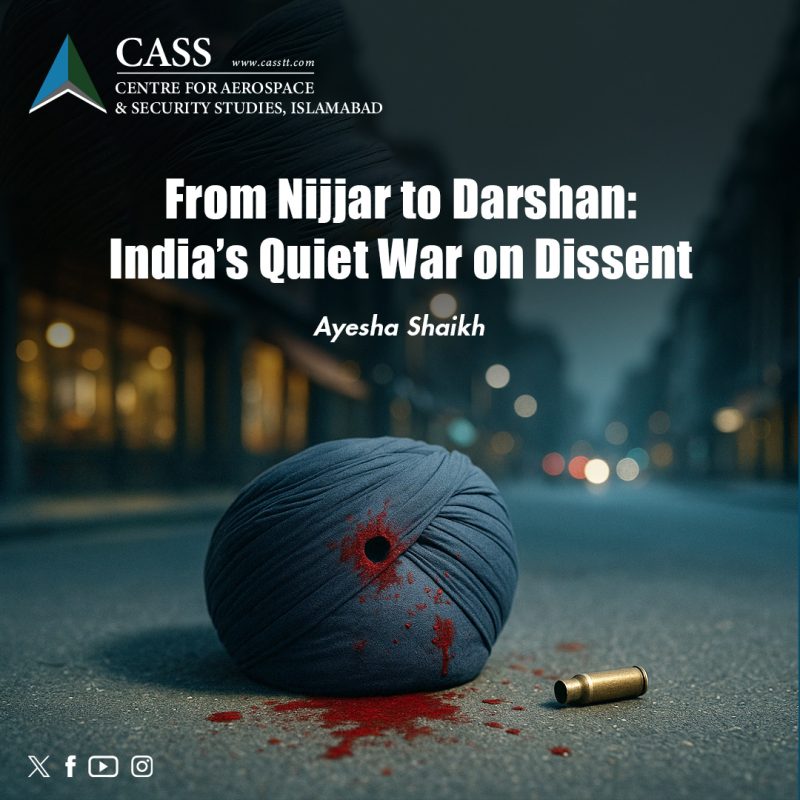
Darhsan Singh Sahsi was shot dead outside his residence on the 29th of October 2025. He was not only a prominent name in the recycled-textile industry of Canada, but a popular Sikh philanthropist back home in Ludhiana, Indian Punjab. This is not a standalone incident, rather one in the chain of many extrajudicial target killings of Sikhs by the Indian hyper-nationalist government. Persistence in the course of Indian action indicates failure of the International community to uphold the normative order against such blatant breaches.
India’s domestic politics has always been Hindu-nationalist in nature; however, the Bharatiya Janata Party (BJP) government has amplified the majoritarian sentiment and validated the ethno-religious violence. BJP is the ruling political party of India, backed by the extremist organization Rashtriya Sawayamsevak Snagh (RSS). It is a staunch advocate of Hindu nationalist ideology, Hindutva. According to this political ideology, Hindus are the inherent heirs of the Akhand Bharat (greater India), and the remaining ethno-religious groups are not entitled to the right of citizenship. Thus, it validates the use of violence against non-Hindu fragments of society.
Ever since in rule, the BJP has opted for a violent approach against the non-Hindu segments of India. Apart from the unjust legal and constitutional moves to restrict civil liberties, the government has promoted the target killing of the minorities. For instance, in the Indian Illegally Occupied Kashmir (IIOK), more than 636 Muslims were martyred in 2019 alone, under the ‘cordon and search operation’ of India. Moreover, EU DisinfoLab released a report exposing illicit Indian involvement in 115 countries, for the past 15 years, with the intent to export anti-Pakistan propaganda. The Government of Pakistan has recurrently condemned Indian aggression at home and abroad. Pakistan’s foreign office also presented evidence of Indian involvement in killing-for-hire cases on the soil of Pakistan. Therefore, execution of extrajudicial crimes beyond the legitimate borders, is a frequently used tactic by India.
The authoritarian outlook of BJP government contradicts with the heterogeneous social fabric of India. In addition to other communities, it is home to 95 per cent of the global Sikh population as well, which comprises only 2 per cent of the overall Indian population. The remaining 5 per cent of the Sikh population is dispersed in over 47 countries. Thus, by virtue of their status as a non-Hindu faction in India, Sikhs, in addition to Muslims and Christians, are vulnerable targets of the Hindu majoritarianism. Nevertheless, India’s anti-Sikh onslaught is transcending borders.
The Sikh massacre of 1984 depicted the extent of ethno-religious sentiment. Successive Indian governments have actively securitised the Khalistan movement led by the Sikh community as a national security threat. Nevertheless, the BJP government has used domestic legal instruments to validate violence against Non-Hindu fragments of society, in the name of nationalism. The pattern of transnational extrajudicial target killing is an extension of the same nationalist zeal, without any international legal mechanism in place.
Over the past few years, the Indian government has been on a mission of Sikh assassinations abroad. Canada is home to around 770000 Sikhs. A prominent pro-Khalistan activist, Hardeep Singh Nijjar, was targeted in Canada in 2023. In 2024, U.S. Attorney’s office charged an Indian government official with an assassination attempt at Gurpatwant Singh Punnun, another Khalistan activist based in the U.S. The whole episode culminated in the diplomatic row between India and Canada, where both states expelled the diplomats after heated exchange between the leaders.
Nonetheless, the recent killing of Darshan Singh, allegedly linked to India, indicates that the International community has failed to sanction India for violation of International legal principles as well as the sovereignty of other states. Duplicity of the West is responsible for the impunity.
India has enjoyed the status of the world’s largest democracy, despite the chronic breach of democratic principles by the state. The Strategic indulgence of the West in the Indo-Pacific strategy has served as a catalyst for the hyper-nationalist BJP government to exempt itself from moral responsibilities. Two days after the killing of Darshan Singh, the U.S reached a 10-year defence pact with India. The deal is an indirect reassurance of the Indian course of action. Hence, the lack of sufficient diplomatic consequences has acted as a facilitator for the breach of humanitarian principles as well as the sovereignty of states like Canada and the U.S.
The incident, therefore, is not just a loss of life, but also an indicator of the loss of credibility of the international order. India has been violating morality and humanitarian order with impunity because of the lack of a sanction mechanism. If the pattern persists, it will set the wrong precedents for other democratic and non-democratic states. Thus, the International community needs to take such humanitarian breaches into account; otherwise, the continued pattern will cause further erosion of the existing global order.
Ayesha Shaikh is a Research Assistant at the Centre for Aerospace & Security Studies (CASS), Islamabad, Pakistan. She can be reached at [email protected]