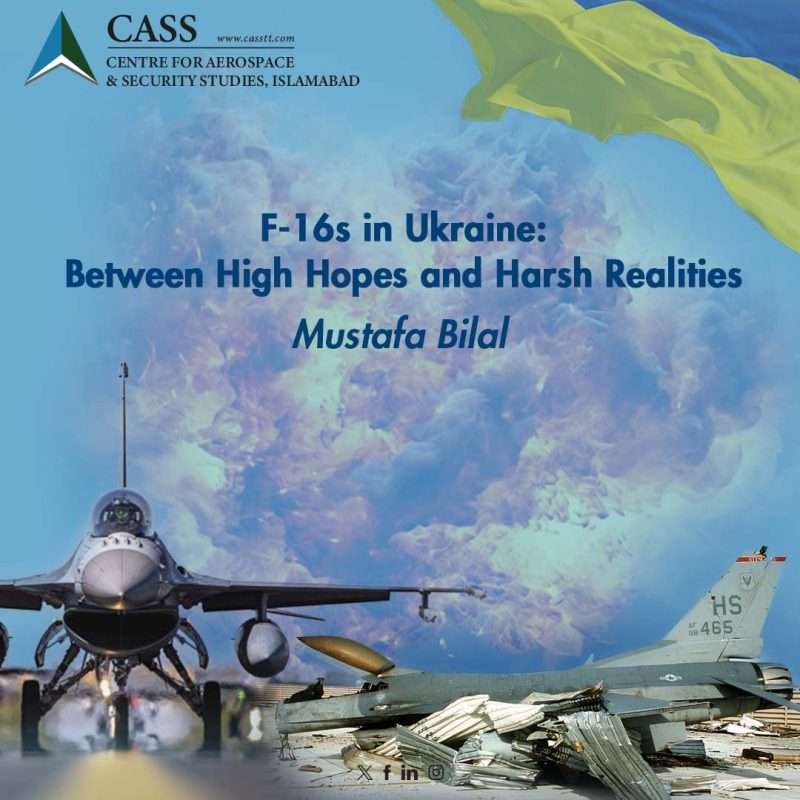
The recent crash of a Ukrainian F-16 has added to the woes of the Ukrainian Air Force (UAF). Since the beginning of the Russo-Ukrainian War, the UAF was handicapped while flying outdated fighter aircraft. Significant difference in assets and capabilities and challenges of maintaining a vintage fleet combined with overtaxed Ukrainian air defence, could have contributed to the loss of nearly 70 aircraft by August 2023. No wonder then that absence of modern fighter aircraft was identified by Former Commander-in-Chief Valerii Fedorovych Zaluzhnyi as a significant factor behind the failure of Ukraine’s counteroffensive in the summer of 2023.
Ukraine’s President Volodymyr Zelenskyy agreed with Zaluzhnyi’s assessment and repeatedly highlighted the imperative of acquiring F-16s for Ukraine’s defence. While the Ukraine Defense Contact Group (UDCG) – a consortium of military leaders from more than 50 states led by the US -had supplied Ukraine with sophisticated air defence systems and long-range precision missiles, President Biden declined to transfer fighter aircraft because of concerns related to a dramatic Russian retaliation. However, the Institute for the Study of War (ISW) dismissed such concerns as self-deterring in the face of Russian nuclear brinkmanship.
Nonetheless, Ukraine’s dwindling air prowess and accompanying setbacks likely led to extensive deliberations between NATO allies. Thus, the US finally relented and gave the green light to several European states willing to transfer their F-16s to Ukraine. After more than a year, President Zelenskyy finally unveiled the long-awaited F-16 fighter aircraft on 4th August in a televised ceremony. Delay in transferring F-16s was attributed to months-long training that Ukrainian pilots and maintenance technicians had to undergo in various European states and the US.
While sceptics have argued that arrival of F-16s may be ‘too little, too late’, one must recognise that unlike retrofitted Ukrainian aircraft, F-16s can unlock the full potential of the AIM-9 and AIM-120 AMRAAM missiles supplied by NATO to partially suppress and destroy Russian air defences (SEAD) in occupied territories. Plus, once all pledged F-16s are delivered, they will likely assist in augmenting air defences considering Ukraine’s overextended air defence systems cannot secure such a vast area. Thus, those who are more optimistic about the prospects of F-16s in Ukraine expect that F-16s could provide an additional layer of protection for Ukrainian cities and critical infrastructure.
Similarly, military analysts have contrasting perspectives regarding the total number of F-16s that Ukraine is likely to receive. The dominant viewpoint is that fewer aircraft have been pledged than President Zelenskyy or Western think tanks deem necessary to confront Russia’s large fleet. Moreover, delivery timelines are not well-defined and shrouded in uncertainty. However, while short-term military impact of the F-16s might be debated, their symbolic significance is underscored by the accompanying technological advancements compared to Ukraine’s current fleet which is technologically obsolete. This is likely to empower Ukrainian pilots, helping them overcome the sense of being technologically outmatched. Moreover, with the F-16s, they can now try to fully integrate with Western air defence systems, military data links, and early warning and control aircraft recently provided by Sweden.
Ultimately, the true test of the F-16s’ impact will be the proficiency of the Ukrainian pilots who fly them. Notwithstanding the advanced technology these aircraft bring, aircraft effectiveness (in the face of formidable Russian fighter aircraft and air defence systems) will largely depend on how swiftly and effectively Ukrainian pilots can adapt to Western training while unlearning deeply rooted Soviet tactics. The crash of the Ukrainian F-16, even under the control of one of their most skilled pilots, has intensified concerns regarding the adequacy of pilot training. Under typical conditions, pilots require years to achieve the level of proficiency needed to safely and effectively operate such advanced aircraft. Hence, continuous training of Ukrainian pilots and technicians in NATO states, along with the phased replacement of military aviation assets with Western equivalents, will be crucial in the long run for the beleaguered UAF.
For now though, concerns about the F-16’s operational deployment would persist, particularly regarding the substantial logistical support required to sustain these aircraft. This challenge could become more complicated for Ukraine’s allies if US policy on military aid shifts following the upcoming presidential elections. Compounding these logistical challenges, Russia has preemptively increased attacks on potential air bases in anticipation of the F-16s’ arrival, raising serious alarm about the vulnerability of these aircraft.
In this context, the loss of an F-16 in Ukraine shortly after its arrival serves as a stark reminder of the need to temper expectations and avoid media hyperbole that labels fighter aircraft as ‘game-changers.’ Ukrainian officials have already acknowledged that F-16s are not silver bullets, rather tools in a gruelling war of attrition. Hence, whether the F-16s would be enough to tip the scales in Ukraine’s favour in contested skies, remains uncertain. What is certain, however, is that the Russo-Ukrainian war is complex and continuously evolving; a month ago, hopes were high among the UAF but just weeks later, Ukrainians were confronted with the harsh reality of warfare that no single tool in a conventional arsenal can determine the outcome.
Mustafa Bilal is a Research Assistant at the Centre for Aerospace & Security Studies (CASS), Islamabad. He can be reached at [email protected]