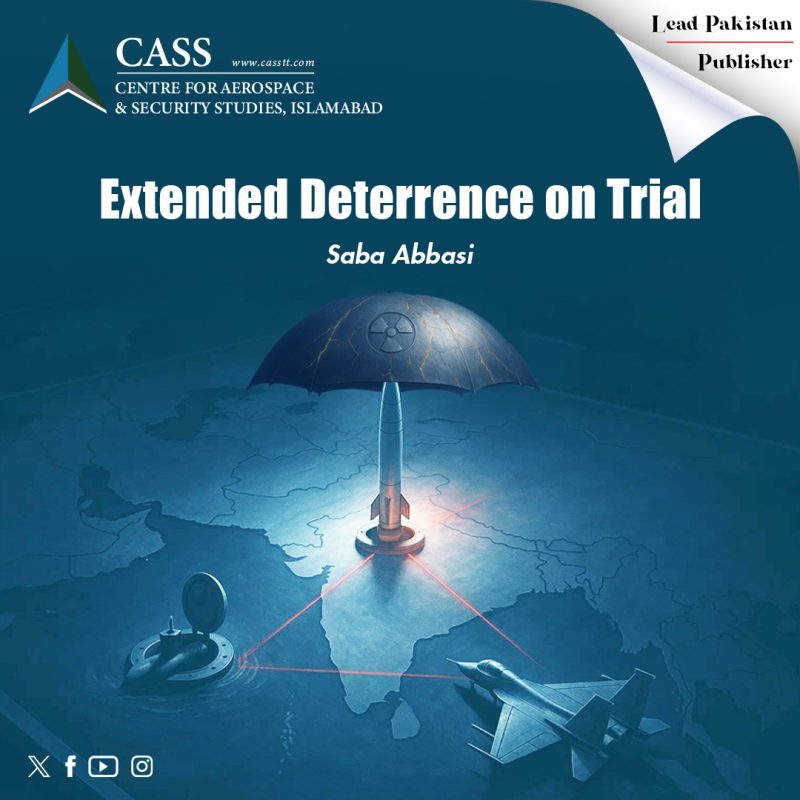
The concept of deterrence is being tested in these times. Among other factors, the intricacies of alliance politics add nuance and complexity to deterrence paradigms, particularly extended deterrence. Recently, the idea and execution of extended deterrence were practically put on trial after Israel’s attack on Qatar. This raised a question: can a concept that appeared so promising and benevolent in post-Cold War literature truly live up to its definition?
Extended deterrence involves discouraging attacks on third parties, such as allies or partners, by a hegemon providing a security umbrella. For obvious reasons, extended deterrence is more challenging than direct deterrence, as it demands the projection of military force, sometimes thousands of miles away. In this case, Qatar already hosts America’s largest air base – Al Udeid. Moreover, extended deterrence often includes stationing significant numbers of troops from the deterring state on ally’s territory, another condition already met, since the US has a large number of troops on Qatari soil.
The fulfilment of these key conditions of extended deterrence, and yet Israel attacking Qatar and violating its sovereignty, indicates that more factors determine its success or failure. It shows that extended deterrence relies not only on capability but also on political will. The US did not retaliate or punish Israel, suggesting limits to its commitment. The limits stemmed not from lack of capability but from lack of political will. For a hegemon, extending security often means one ally is prioritised over another. In this case, the US’s more important ally is Israel. Although Trump discouraged and distanced himself from Israel’s actions, he still made a concession by calling Israel’s target (Hamas) “worthy.”
Had Israel succeeded in its attack and killed all Hamas representatives in its strike on a Qatari residential complex, the US might also have forgone even the mild rebuke it extended after the airstrike. This highlights the selective application of deterrence, implying that extended deterrence may be effective against adversaries but not necessarily against hegemon’s own allies. It also creates ambiguity for allies under the security umbrella. In this case, the threat to Qatar did not come from Iran or non-state groups but from within the US alliance system.
Naturally, for Qatar and other US allies, reassurance was shaken. The security umbrella began to appear less about territorial protection and more about US operational convenience. It also meant that within alliance networks, smaller partners are more exposed to harm from larger allies, as the US prioritises its hierarchy of relationships.
The Ukraine-Russia war is another instance of failed extended deterrence. Under the 1994 Budapest Memorandum, Russia, the US, and the UK pledged to respect Ukraine’s independence, sovereignty, and borders. They also promised “to refrain from the threat or use of force” against Ukraine. In return, Ukraine gave up the nuclear weapons (and its deterrence) it had inherited from the Soviet Union and joined the Non-Proliferation Treaty (NPT) as a non-nuclear state. Ukrainian President Zelensky’s statement last year—“Not a single day did this document work” reveals that effective guarantees, real alliances, and a realistic security foundation require readiness to confront. No wonder, deterrence collapsed in 2022. Instead of preventing war, assurances shifted into damage control through aid, sanctions, and further security commitments.
Similarly, the United States also asserts that it will ensure robust, ready, and credible deterrence across the Taiwan Strait. However, analysts note that President Donald Trump’s “America First” approach could weaken America’s security commitment in the region. Although US reaffirmations serve as an extended deterrence signal meant to discourage Beijing from considering force, only time will tell how the US’s extended deterrence will play out when push comes to shove.
During the Cold War, there were constant debates about the credibility of the US promise to “sacrifice New York for Paris.” These debates are relevant again today in the context of ongoing geopolitical circumstances, raising the question of whether global powers like the US would actually commit to an automatic response if vital national interests are not at stake. Historically, the most famous cases of extended deterrence failure involving the US were the Korean War in 1950 and Kuwait’s invasion in 1990. Its failure can be partly traced to the US’ unwillingness to demonstrate the automaticity of response seen in direct deterrence, which seeks to prevent attacks on one’s own territory. Moreover, the United States’ tacit approval of Kuwait’s invasion, coupled with its inability to reconcile defense commitments with broader strategic alliances, also highlights the limitations of its extended deterrence posture. Taken together, these examples underscore a recurring pattern. In most cases, if not all, direct deterrence will take precedence over extended deterrence. States ultimately look after their own strategic interests, and external assurances often remain rhetorical. Deterrence, thus, remains a function of self-help.
Saba Abbasi is a Research Assistant at the Centre for Aerospace & Security Studies (CASS), Islamabad, Pakistan. She can be reached at [email protected]