
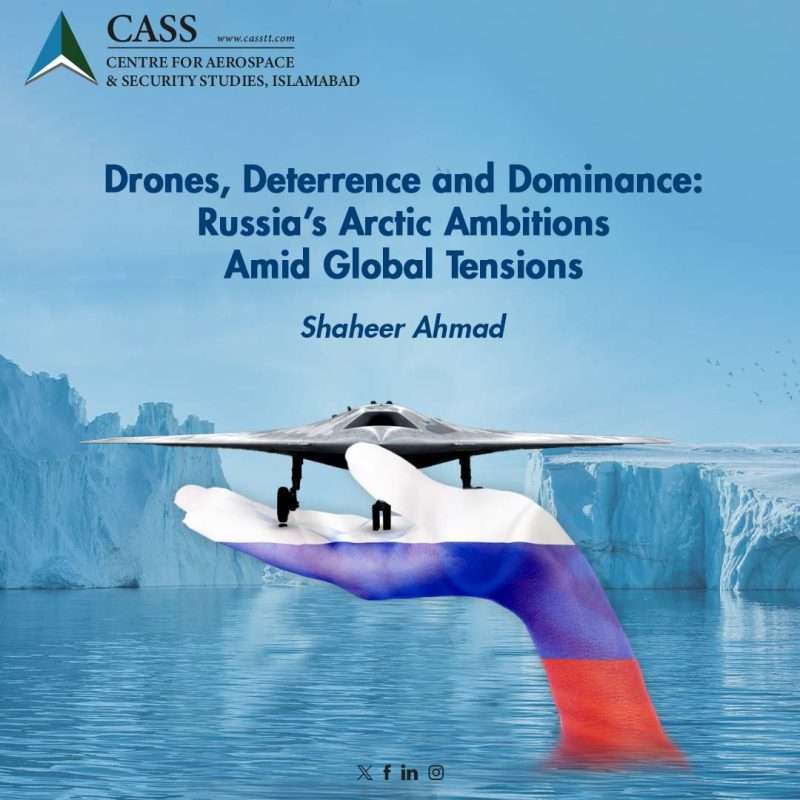
With the outburst of the Russia-Ukraine war and the seismic effects of climate change, the Arctic is once again in the geopolitical spotlight. The growing accessibility to the untapped hydrocarbon reserves and increased maritime traffic along the Northern Sea Route (NSR) has catalysed the ante for strategic competition in the northern frontier of the globe. Russia, a geographical behemoth owning nearly 53 percent of the Arctic territory, is striving to dominate the geopolitical chessboard by building oil and gas terminals and refurbishing its Cold War-era military bases. These unprecedented developments provide a befitting context for drones that can bridge security gaps, undertake long-range ISR missions, and cast a protective dome to secure Russia’s Arctic infrastructure amidst dropping Celsius.
The ongoing Ukraine war has impinged the Arctic region, which was largely unscathed from geopolitical happenings in the recent past. A notable development that captured attention in this regard was a drone attack on Olenya airfield which inflicted significant damage to Russia’s Tu-22 bomber, followed by another unmanned attack in the Murmansk region. Proximity of the targeted area to the Kola Peninsula – home to Russia’s second-strike capability – has prompted increased security measures around its bastion-based deterrent and nearby military infrastructure in the High North. Likewise, Ukraine’s relentless attacks on Russia’s energy infrastructure, raise concerns regarding the safety of key projects like Yamal and Arctic LNG-2, prompting Moscow to increase security measures around its energy assets along the Arctic coastal rim.
To enhance security and maintain constant oversight, Russia is deploying its Arctic drone squadrons to safeguard critical infrastructure. The cobweb of Zala, Inokhodets, and Forpost drones are designed to patrol remote terrain in extreme blizzards and dropping temperatures. Back in 2021, Russia earmarked USD 52 million to a jet-powered Sukhoi-S-70 Okhotnik stealth drone (with full deployment planned for this year), which can efficiently perform at the frosty temperature of -12oC. Stationing these unmanned systems constitutes part of Russia’s virtual net of high-tech military systems which will likely strengthen its perimeter defence, enhance domain awareness, conduct long-range ISR missions, and cast a monitoring net able to track and detect any ‘unwanted guests’ along its Arctic coast. Drones are a cutting-edge tool for Russia in the Arctic that can enhance operational efficiency by minimising the cost of crewed military assets. Besides this, long-range drones, like the S-70, will likely assist the Russian Air Force (VKS) in undertaking complex air campaigns, posing grim threats to NATO’s airborne early warning (AEW) systems, air refueling assets, and joint surveillance target attack radar (JSTAR) systems.
Despite the sheer optimism attached to the Arctic drones, these unmanned agents come with a minefield of challenges. To pursue its Arctic ambitions, Russia is deploying drones as part of its broader strategy to establish a network of military installations, enabling swift responses to the increasing military capabilities of the US and NATO allies on its western flank. However, this expansion comes at a time when Western sanctions and the war in Ukraine are hampering Russia’s military modernisation efforts, particularly affecting its land forces in the High North. This has implications for Russia’s Arctic force readiness and preparedness for a conflict in its northernmost expanse The harsh icebound weather, with gusting storms and freezing temperatures possibly to -50oC in some areas, may also hinder drones’ operational efficiency to monitor distant waters and vast swaths of snow. Such a scenario has, in turn, implications for the reconnaissance and long-range patrolling tasks in the harsh environment. In addition, total darkness of polar nights and treacherous satellite communications in far-flung areas could impede autonomous operations if the link between the drone and its operator is disrupted. Furthermore, potential deployment of long-range drones, particularly the S-70 – Russian variant of the ‘loyal wingman’ – is also likely to intensify the security dilemma between Russia, the United States, and NATO allies, prompting them to adjust their Arctic capabilities in response.
Following the attacks on Olenya airfield and Murmansk region, the Arctic region is experiencing shockwaves of the conflict in Ukraine. The proximate presence of nuclear-powered submarines, oil and gas terminals, and newly emerged NSR, aggrandise Moscow’s strategic anxieties about its ambitious Arctic agenda. As an impregnable power in the High North, multidomain awareness is crucial for Russia to sustain its military stature which makes unmanned agents an attractive avenue to maintain polar drone superiority in the Arctic.
Shaheer Ahmad is a Research Assistant at the Centre for Aerospace and Security Studies, Islamabad. He can be reached at [email protected]



