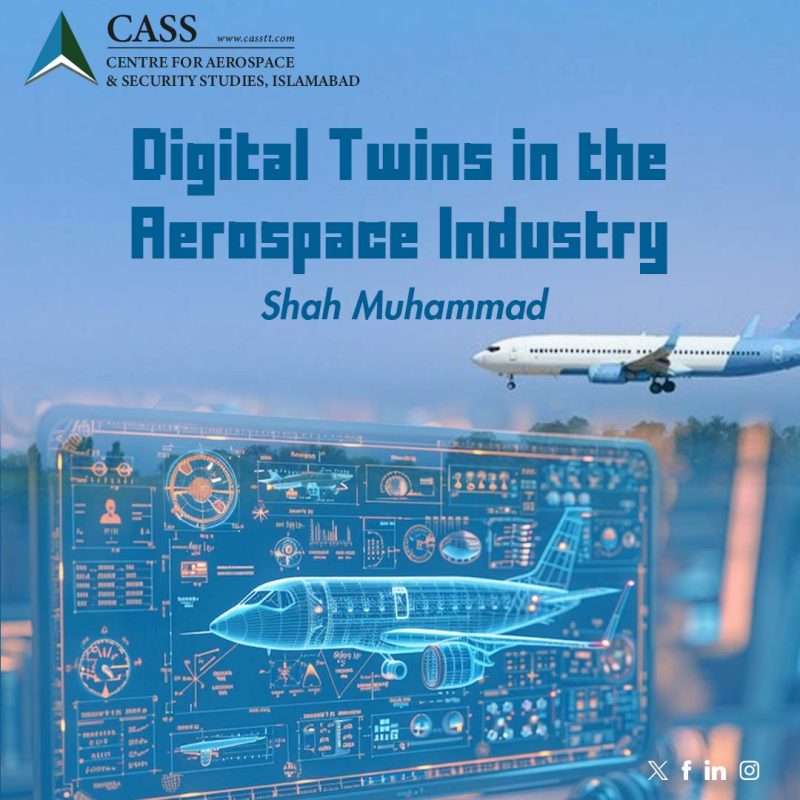
The ‘blurring of boundaries’ between physical entities and digital models is one of the hallmarks of the Fourth Industrial Revolution driven by advancements in technologies such as the Internet of Things (IoT), Artificial Intelligence (AI), robotics, and digital twins. Fascination associated with the idea of creating replicas is now gaining substantial viability. Around 70 percent of top executives at technology enterprises are exploring and investing in digital twin technology. This essentially refers to the creation of a digital replica of a physical object, enabling virtual and real-time mirroring of the object through smart sensors. The digital replica or virtual model undertakes real-time monitoring, simulations and diagnostics of the physical object (its twin) to enhance its operations. Given that aerospace is at the forefront of technological advancements, it is crucial to analyse digital twin technology in this sector.
From design to manufacturing, digital twins could augment development of aircraft at various stages. In this regard, Airbus’s virtual model of its A350 XWB aircraft is a prominent example. It facilitates real-time monitoring and analysis of factors such as fuel consumption and engine efficiency. Data analytics associated with virtual modelling augments decision-making of operators, leading to upgradation of aircraft’s operational efficiency. Furthermore, the IntelligentEngine vision of Rolls-Royce is characterised, in part, by digital twins to undertake predictive maintenance and simulations of their pioneering aero engines. Being at the forefront of the commercial space race, SpaceX is also capitalising on this technology to generate virtual replicas of its Dragon spacecraft. Operators at Mission Control are substantially equipped to keep tabs on the propulsion systems and orbital flight of the aircraft. Digital twin technology essentially complements SpaceX’s endeavors to upgrade the performance and safety of its spacecraft.
This technology not only improves energy efficiency but also resonates with environmental sustainability. Through its effective adoption of digital twins, Airbus was able to cut emissions by 1250 tonnes and conserve energy worth 3.65 GWh annually. Needless to say, optimisation of energy efficiency would eventually entail cost reduction for aerospace companies. Integration of digital twin technology with Big Data, AI and the IoT may considerably add to these advantages while raising the magnitude of a digital replica’s viability.
One needs to be cautious though as excessive reliance on large data sets could imperil data management involved in virtual models, particularly when there is little integration of advanced storage and processing systems. Improper data handling could undermine accuracy and reliability of virtual models of physical aircraft. Secondly, linkages with multiple data sources could act as caveats vis-á-vis cyber threats. Data breach and subsequent tampering could take a toll on operational efficiency and safety of a physical aircraft. In this regard, it is unclear if aerospace companies are building their own cyber defences or hiring third-party cybersecurity firms. Thirdly, components and tools utilised in the development of digital twin technology are acquired from different sources. Therefore, there might be complexities in terms of compatibility and seamless integration of various components. This is essentially known as the interoperability problem in virtual models.
A series of well-directed endeavours may be undertaken to prevent this technology from hitting a snag. AI-enabled systems could significantly upgrade data processing and analysis, paving the way for precise real-time mirroring and effective data management. Machine Learning (ML) can spontaneously flag inconsistencies in data and improve accuracy as well as reliability of virtual replicas. Additionally, certain key cybersecurity measures such as cryptographic advancements and regular security audits could enlarge the digital walls of cyber defence. Collaboration with cybersecurity experts and regular training of employees would also go a long way in terms of protecting digital twins from unauthorised access. With regard to the interoperability problem, companies and stakeholders would be well-advised to develop coherence and standardisation in the development of digital twins. This may actualise seamless integration and compatibility among different components of this technology.
Digital twins have the potential to acquire greater traction in the aerospace sector in the future. It would not be an exaggeration to argue that virtual models could revolutionise this sector. Although implementation of this technology continues to be marred by various irritants, a series of technical and operational measures might offset the challenges and elevate its viability in the aerospace sector. In essence, the future of aerospace could be characterised by a dynamic interplay between digital twins, AI and IoT.
Shah Muhammad is a Research Assistant at the Centre for Aerospace & Security Studies (CASS) in Islamabad, Pakistan. The article was first published in Modern Diplomacy. He can be reached at [email protected].