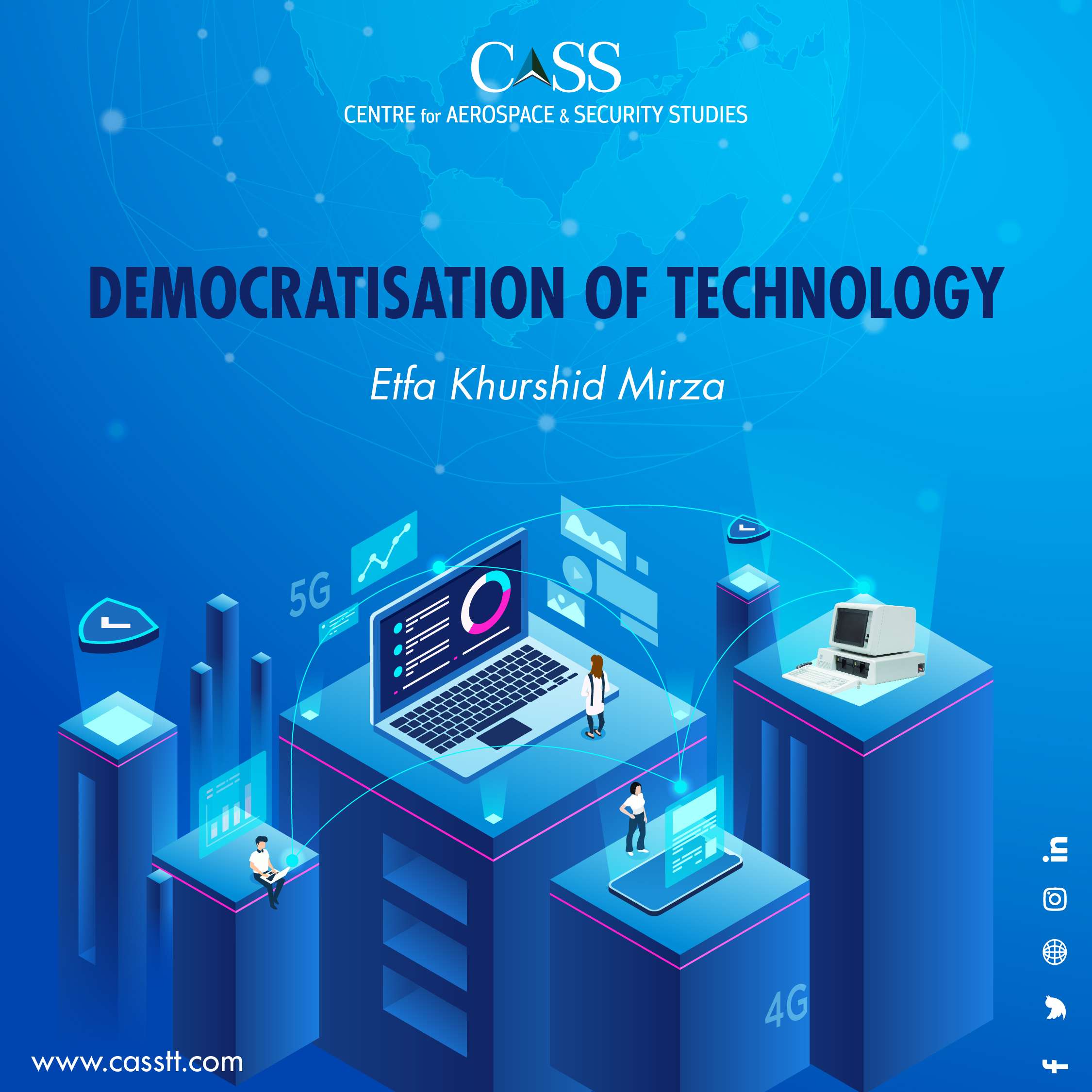
As technology progresses, it becomes more complicated. At the same time, it becomes easier for users of technology to use and access it. Hence, we can say that technological complexity and its application are inversely related to each other. And as more and more people use technology, more technological innovation and advancement occur. This is what the democratisation of technology is all about.
With the invention of the Electronic Delay Storage Automatic Calculator (EDSAC) in 1949, the process of democratisation of technology began. As individuals gained more access to computers, they began to explore more, and technology began to advance.
The Internet has not always been this accessible to the general populace. It was first used as a means of communication between scientists and the government when it was invented in 1969. It was not until the 1990s that more and more people had access to it. The United States government made the internet available for commerce in 1993, and the invention of HTML at the time meant that everyone could publish online content. Since then, the Internet has increased in speed and quality at an incredible rate. The platform has now made it possible to easily share ideas. It is the primary reason we see technology being democratised in the present age.
The introduction of Fifth Generation (5G) technology, which enables 20 times more speed than 4G, has revolutionised connectivity and communications. Due to its integration with other technologies, life has become easier. The introduction of automation and robotics has become a norm in our daily life. From smartwatches and automobiles to drones and the Internet of Things (IoT) is gradually taking over the world. Introduction of 1G introduced cell phones, with 2G people began to send text messages through mobiles, 3G was the dawn of the Internet, and the experience has become better with 4G and even better and faster with 5G.
We are living in the age of information sharing, as more people realise how simple it is to use technology to create content and share information at a fast pace. The ubiquity of smartphones, and entertainment applications such as the introduction of social media apps, search engines and video games has served as a catalyst for the democratisation of technology. Take social media, where a person sitting in a far-flung area in Africa can interact with someone in Silicon Valley and exchange ideas.
The interesting aspect of technological democratisation is that it has the potential to accelerate industry development. Earlier, problems that required supercomputers are now just a click away. With the advent of data science, Artificial Intelligence and machine learning, novel discoveries are taking place. Advancements that formerly took years are done in far less time. This has the potential to transform people’s lives by allowing them to find new ways to make money, market and promote their ideas, and create new inventions through Research and Development. People can achieve goals that seemed unattainable a decade ago.
In essence, technology democratisation is about shifting opportunities and possibilities at the grassroots level. The post-1990s generation that grew up with technology has the potential to grasp technological knowledge and use it for innovation and invention. Education has become more accessible as a result of technological advancements. During the COVID-19 pandemic, universities switched from on-campus to online communication, which was a worldwide success.
The ‘new normal’ will be increasingly tech-driven in the future, and the young generation must be prepared to meet its difficulties. For a technologically developing country like Pakistan, it is important to take steps towards revising the educational curriculum and including STEM education. Moreover, investment in Research and Development, teachers’ training, and the introduction of space subjects at an advanced level is also important.
There is no limit to what can be accomplished through the democratisation of technology, and this industry will undoubtedly continue to evolve at a breakneck pace if challenges are addressed at a right time.
Etfa Khurshid Mirza is a Researcher at the Centre for Aerospace & Security Studies (CASS), Islamabad, Pakistan. Her area of interest is warfare and emerging technologies. She can be reached at [email protected].