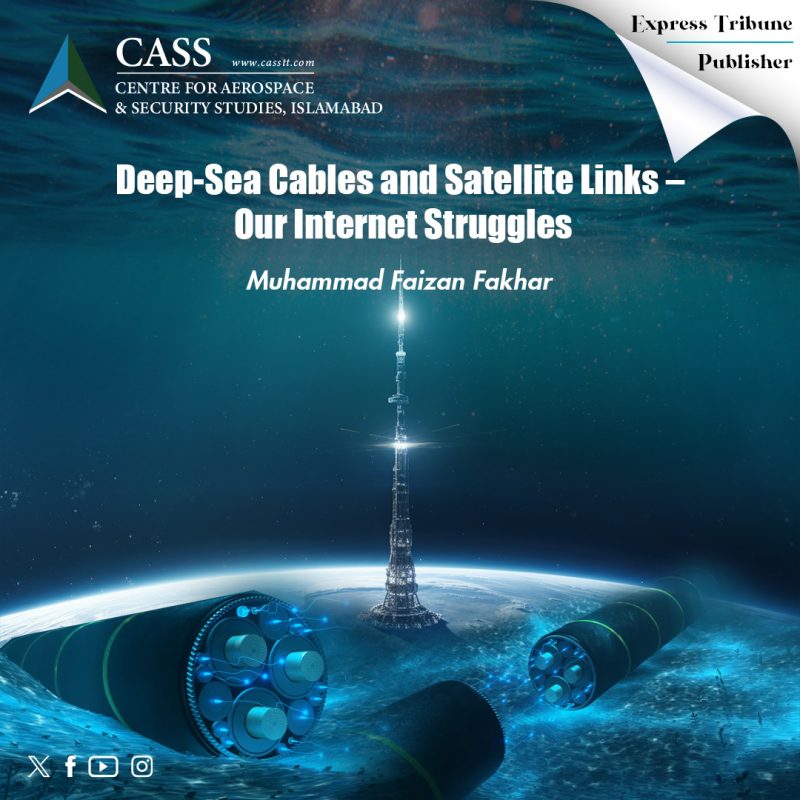
Undersea cables are the lifeline of the global internet and therefore, of the entire global digital ecosystem. The global internet traffic relies on the vast network of undersea cables, also known as submarine cables, which are responsible for transmitting almost all of the internet data. These undersea cables are essentially bundles of fibre optics, laid between land-based stations, stretching for about 1.4 million kilometres across the seabed. Around 99 per cent of the global internet data is estimated to be carried by these very cables. Thus, from trade, banking transactions, navigation and e-commerce to students taking online classes, all digital activity relies on smooth functioning of the undersea cables. Yet, despite their critical role, these cables are quite fragile. They are extremely vulnerable to being damaged by ship anchors, fishing activities or even by deliberate sabotage. On average, around 150-200 incidents of undersea cable damages are recorded every year. The impacts of these damages are felt worldwide in the form of service delays and connectivity issues.
Most recently, the submarine cable network in the Red Sea was damaged causing severe packet losses and increased latency across Asia and the Middle East. At least four major cables were damaged this time, including South East Asia–Middle East-Western Europe 4 (SMW4), India–Middle East–Western Europe (IMEWE), the Europe India Gateway, and the FALCON GCX. Services of Microsoft Azure, world’s second largest cloud computing platform, were also affected due to this incident. Since these cables lie deep under the ocean floor, fault detection and repairs become highly technical and time consuming.
There are some alternatives being pursued globally to cope with the undersea cable vulnerabilities, such as cable redundancy and satellite internet. Cable redundancy is a system of duplicate and extra cables that continues to work even if one fails due to damage. However, this solution is not only expensive but also remains exposed to the same cable vulnerabilities. On the other hand, satellite internet offers fibre–less internet services as it relies on satellite in orbit to provide an internet connection, especially Low Earth Orbit (LEO) constellations. Satellite internet, therefore, offers an alternate internet completely secure from the risk of cable damages. However, it also comes with some inherent limitations, including higher latency, limited bandwidth capacity and higher service costs. Another alternative is to build terrestrial overland fibre links with neighbouring countries and regions, with the advantage of not only being protected from underwater damages but also bypassing chokepoints.
For countries in the developed world, damages to the underwater cable usually only mean slowdowns in service that might last for a while. However, the situation becomes a lot worse for countries like Pakistan who rely on limited internet cable connections and routes. Pakistan is currently linked to eight international submarine cable systems. However, since all of these cable systems follow similar routes, Pakistan is primarily dependent upon only a few of them, including Asia-Africa-Europe-1 (AAE-1), SEA-ME-WE 4 (South East Asia-Middle East-Western Europe 4) and IMEWE. In contrast, Singapore is connected to over 25 submarine cables and United States to around 80, which are spread in different directions. In January 2025, AAE-1 was damaged leading to significant bandwidth losses of around one terabit per second (tbps) in Pakistan. On the other hand, the terrestrial backup of Pakistan is also limited to only one major land route of Pakistan-China Optical Fibre.
Satellite internet is also being considered in Pakistan, however progress in this direction has been lethargic so far. Five companies, including prominent names such as Starlink, Amazon, Shanghai and Spacecom, are reportedly interested in accessing the market of Pakistan. Starlink even obtained temporary registration from Pakistan Space Activities Regulatory Board (PSARB) in March 2025; however, full license will only be issued once the regulatory framework is finalised by Pakistan Telecommunication Authority (PTA). A licensing and regulatory framework has been drafted by PTA for fixed satellite services (FSS), including LEO internet providers. This draft includes certain requirements for the service providers, such as to install fixed gateway earth stations in Pakistan, to store data locally and to comply with requests for blocking content. Therefore, services of satellite internet in Pakistan could remain stalled due to the procedural bottlenecks and regulatory requirements.
Pakistan needs to invest in diversifying its international submarine cable systems. This can be achieved by establishing new cable landing stations in the country and by investing in those subsea cable projects that follow different routes than the existing ones. As a result of this, Pakistan can reduce its dependency on the existing chokepoints such as the Red Sea. Moreover, Pakistan could also expand its terrestrial overland fibre links with neighbouring countries and regions, which can efficiently reduce the stress of internet traffic in case of degradation of international links. Finally, regulations are critical in ensuring safety and sovereignty in the digital domain, but they must be balanced with speedy licensing to avoid unnecessary delays. These delays will keep Pakistan dependent on the fragility of the undersea cables. Therefore, there is a need to expedite licencing and spectrum allocation for the satellite internet providers in Pakistan.
Every incident of undersea cable damage is a stark reminder of how fragile the idea of global connectivity is in reality. In today’s digital age, problems in digital connectivity means hampered economic growth, lag in exports, and unreliable digital services. Therefore, Pakistan cannot afford to leave the internet services to be solely dependent on a few cables at the bottom the sea.
Muhammad Faizan Fakhar is a Senior Research Associate at the Centre for Aerospace & Security Studies (CASS), Islamabad, Pakistan. He can be reached at: [email protected]