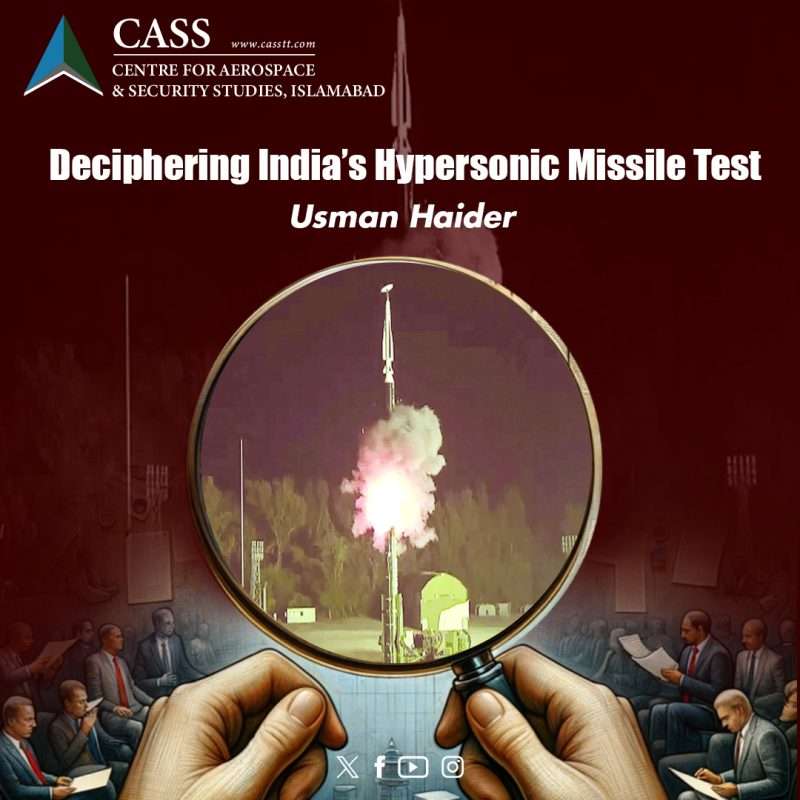
India’s hypersonic missile test in November has positioned it as the fourth country, after China, Russia, and the United States, to possess this critical technology. The test demonstrates that India’s missile manufacturing capabilities have progressed considerably. While the exact details about the actual performance of the missile are still unknown, the Indian media has continued to glorify the country’s efforts to indigenously design and build a hypersonic missile. Given India’s past hostile behaviour, notably the 2019 Balakot aggression, this new capability has the potential to affect prevailing regional stability.
As per its definition, a hypersonic missile, travels faster than Mach 5 while having the capability to manoeuvre during its flight. It comes in two configurations: hypersonic cruise missiles (HCMs) and hypersonic glide vehicles (HGVs). Unlike ballistic missiles that travel through high altitudes on a parabolic trajectory, hypersonic projectiles fly at lower altitudes with greater maneuverability and agility. This enables them to evade mid-course defence interceptors and reduces detection time for terminal missile defences. Their depressed trajectory also makes them harder to detect using radars and space-based sensors, posing tracking challenges even for advanced systems like those of the US.
India’s ambitions to develop hypersonic weapons were first unveiled in 2007 by former Indian President Abdul Kalam. The following year, Indian scientists began work on hypersonic systems, initiating tests in a 0.5-meter wind tunnel in Bangalore to study model behaviour at speeds beyond Mach 5. In 2016, India successfully tested scramjet engine technology, marking a significant milestone. By 2020, the country established its first true hypersonic wind tunnel (HWT), capable of testing materials at speeds between Mach 5 and 12. That same year, a successful field test of a hypersonic cruise system powered by a scramjet engine provided critical data for developing a combat-ready hypersonic missile.
The missile’s operational range exceeds 1,500 km. Various media reports claimed it to be a long-range anti-ship missile. However, given its extended reach, the missile will be used for land-attack missions as well. In addition, the firing visual shows the projectile launching from a canister, a new trend associated with most of India’s frontline ground-launched missiles. This canisterisation feature allows the firing of a missile in seconds rather than minutes. Reportedly, the tested missile is able to perform manoeuvres at the terminal stage, a key trait associated with hypersonic projectiles.
The hypersonic speed of the missile reduces its flight time to the target, thus shrinking the available time for interception by the adversary. These missiles are particularly effective against time-sensitive targets like mobile missile launchers and can penetrate reinforced underground bunkers and storage sites with conventional warheads. Furthermore, in an anti-ship role, they enhance anti-access/area denial (A2/AD) capabilities by targeting enemy warships at extended ranges.
Introducing this new system is part of New Delhi’s broader strategy to bolster its conventional counter-force strike capability. It is a continuation of India’s objective of establishing a new Integrated Rocket Force (IRF) which will entail missile systems carrying only conventional warheads to avoid nuclear entanglement.
While there has been hype about the impact of hypersonic missiles in recent years, the fact remains that there exists a dearth of information about the true capabilities of these missiles presently available in the inventory of different countries. The term ‘hypersonic’ is also sometimes used misleadingly to include missiles which actually do not satisfy the academic definition. Russia, for instance, has claimed using hypersonic missiles against Ukraine which did have a significant impact but were also frequently intercepted. Moreover, the substantial problems associated with designing and manufacturing of a hypersonic projectile, including its metallurgy and engine efficiency, also impinge upon the actual capability of these missiles.
While the addition of a hypersonic missile to India’s arsenal expands its attack options, it does not fundamentally alter the regional threat matrix, especially since similar capabilities are possessed by neighbouring countries. However, maintaining balanced power dynamics requires ongoing enhancement of existing capabilities through a comprehensive approach. This includes the induction and indigenisation of hypersonic technology and the development of a highly skilled workforce to support its advancement.
Usman Haider is a Research Assistant at the Centre for Aerospace & Security Studies (CASS), Islamabad, Pakistan. He can be reached at [email protected].