Pakistan’s economic woes continue without any worthwhile respite to the people of the country. In spite of the incumbent government’s efforts and claims about the stabilisation of macroeconomic indicators and positive projections about the growth rate, Pakistan is regularly forced to look for emergency inflows, sometimes from International Monetary Fund (IMF) under strict conditions, and sometimes from China and Saudi Arabia under relatively softer conditions.
Without going into the historical background of the economic morass that Pakistan is faced with today, this article aims to highlight the need to seriously nab the money made through corrupt practices and document the economy so that people are accountable for their earnings, savings, investments, and expenditures.
Pakistan’s economy needs some serious efforts to control corruption and document itself so as to satisfy the conditions of the Financial Action Task Force (FATF), as well as increase much-needed revenue collection. However, in spite of its best efforts, the government could add mere 2.4 million filers, taking the figure to seven million only in a country of 220 million.
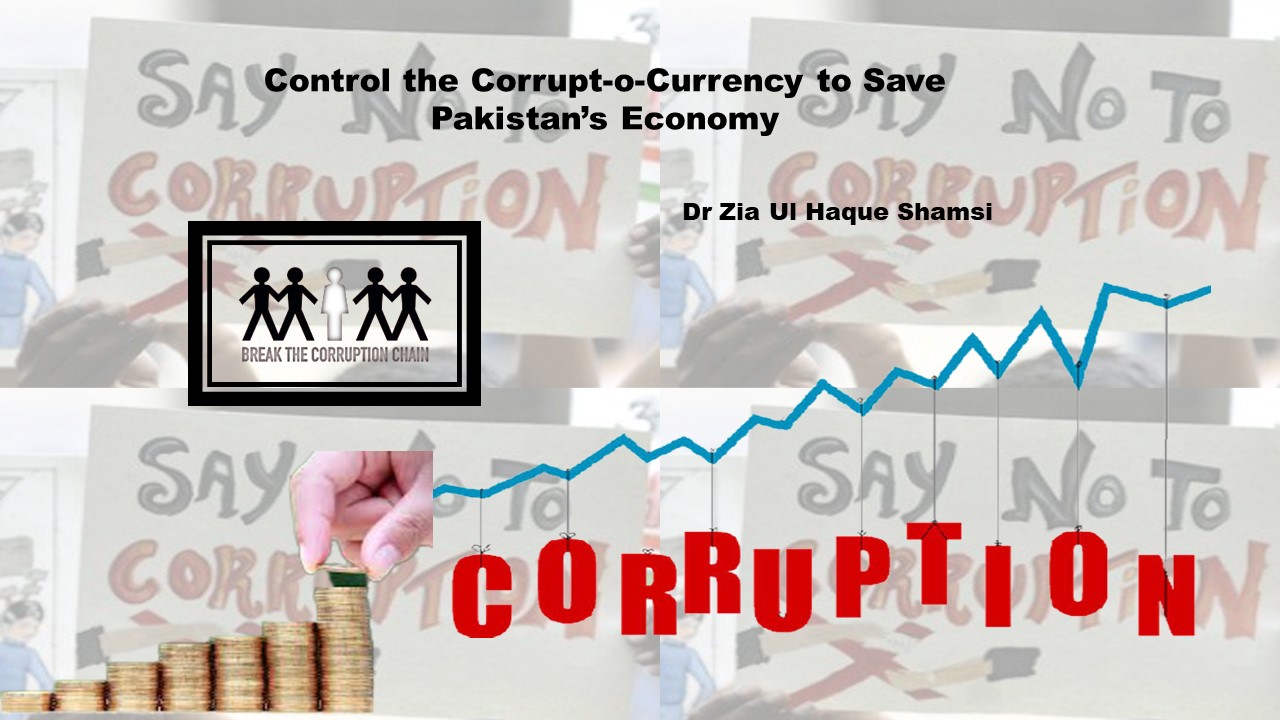
Let me first define the term “Corrupt-o-Currency.” It is the money made out of corrupt, and illegal practices, which are undocumented, and behind walls to avoid falling into different taxation nets. According to Transparency International’s Corruption Perception Index for 2020, Pakistan ranks 124th out of 180 states with a score of 31 per cent. Whereas, according to the former chairman of the National Accountability Bureau, Fasih Bokhari, “Pakistan loses up to seven billion rupees daily to corruption.” Likewise, it is necessary to explain the phenomenon of corruption so as to fully understand the real loss that Pakistan’s economy is suffering for decades.
According to Transparency International, “We define corruption as the abuse of entrusted power for private gain. Corruption erodes trust, weakens democracy, hampers economic development, and further exacerbates inequality, poverty, social division, and the environmental crisis.”
However, the corruption in Pakistan has reached a level where it is likely to have an adverse impact on the national security of the state.
While corruption has numerous dimensions with varying degrees of impact on Pakistan’s economy, the unfortunate part is that the people of Pakistan have started to accept it as a norm with no visible resentment or effort to convey displeasure on the corrupt practices across the board.
The flight of capital is another area of serious concern that Pakistan is faced with for decades. This laundered money is mostly earned through illegal commissions on large projects, which are kept at safe havens and invested mostly in expensive properties in Western capitals. Political opponents have been claiming to know about such properties against each other, but only for political purposes, and no serious effort was made to recover the looted money kept abroad. This alleged money laundering by the elites across the board has been an unaddressed and outstanding observation by FATF requiring legislation and recoveries. The claimed amount on the floor of the Parliament is around USD 200 billion but used only to point allegations against each other.
The other faces of corruption in Pakistan include bribery and commissions at every stage of projects and that too at each level. The recipients blatantly ask for money in exchange for favours and givers do not have any issues in fulfilling these demands as long their job is accomplished conveniently. According to a Borgen Project report, people have to pay bribes for every official or unofficial work to get a favourable nod for their requirements.
Likewise, there is large-scale corruption in tax collection in Pakistan. Unfortunately, the report quotes Transparency International that taxation officials are the primary cause of meagre tax collection and remain heavily involved in corrupt practices. The Chr Michelsen Institute found large-scale corruption in the judiciary and more than 44 per cent of people who interacted with judicial officials had to pay money to get their job done at various stages.
Nepotism also contributes negatively to corruption in Pakistan. Whether it is for admission in a professional institution or employment in a government department, favouritism overrides merit and leads to disappointment for talented youth as well as the growth of incompetent officials.
The corrupt practices in vogue in official procurements and construction of mega road projects have been reported and investigated at different levels against all previous and even the present regime.
There have been efforts to nab the corrupt-o-currency by different governments at different times through various amnesty schemes. However, this article does not propose the continuation of the same because this in itself promotes corruption. The grant of tax amnesty under the FBR Amnesty Act of 2007, may, nonetheless, be a better option to incentivise people to participate in tax schemes. Moreover, NAB and anti-corruption departments at the Federal and Provincial levels may be made more effective to increase collection, exit FATF, and reduce economic woes in Pakistan.
Dr. Zia Ul Haque Shamsi is Director Peace and Conflict Studies at the Centre for Aerospace & Security Studies (CASS), Islamabad, Pakistan. The article was first published in Daily Times. He can be reached at [email protected].
Image Source: Etfa Khurshid Mirza