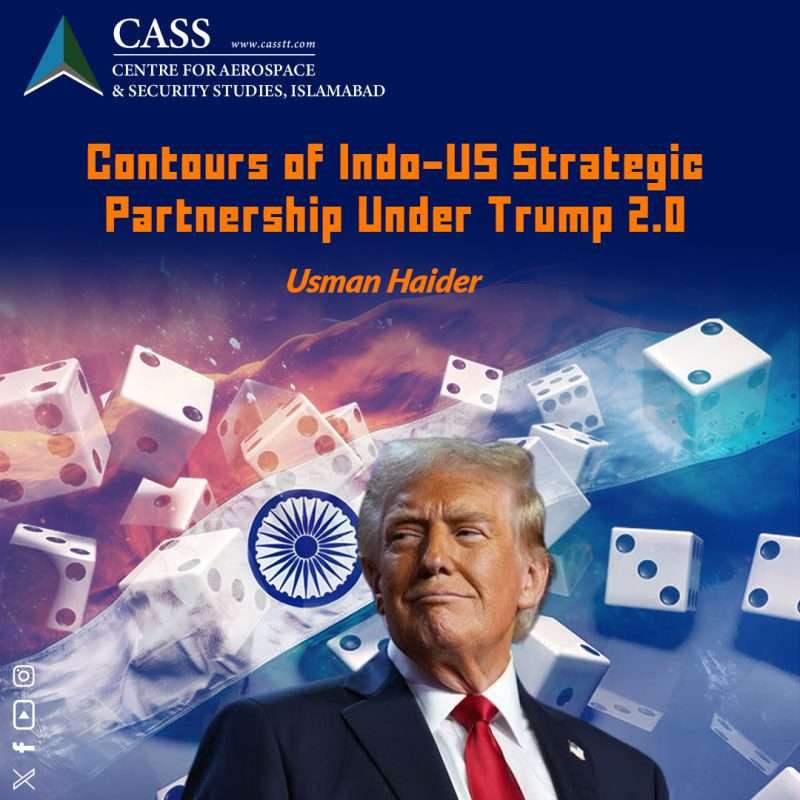
Donald Trump’s return to the Oval Office appears to be a positive sign for the Indo-US strategic partnership. Considering Trump’s policies in the previous era and the campaign rhetoric, the United States’ foreign policy under his second tenure is likely to adopt an aggressive posture against China. This will intensify ongoing global power competition in the Asia-Pacific, in which, India, a lynchpin in the US’s China containment policy, will expectedly play a critical role. Some of Trump’s nominees for the next term also suggest more leaning towards New Delhi and a cold shoulder towards Beijing. For instance, one of the nominees, played an instrumental role in drafting the US-India Defence Cooperation Act, which accentuates the endeavours towards securing Indian interests against China.
The economy remains a cornerstone in the Indo-US strategic partnership. Trump’s stance on tariffs did cause concerns in New Delhi about its negative fallout on Indian exports. Luckily for India, Trump has threatened an increase in the tariffs on Chinese products to 60 percent. This increase in tariff suits India because businesses in the US will likely de-couple their commercial operations with China to protect their supply chains. This will provide India a considerable opportunity to plug this gap because it has the required industrial base, which can fulfill US demands. However, accomplishing this objective will be a challenging process, because Indian exports to the US differ from Chinese exports. Nevertheless, a sign of hope still exists for the Indian economy because to counter China, Trump may reconsider its tariffs policy vis a vis New Delhi, to strengthen bilateral strategic partnership, in upcoming months.
The defence and security collaboration between the two countries is also expected to continue its upward trajectory under the new regime. New Delhi could receive enhanced access to advanced US weaponry and technology. In the present situation, the IAF lacks the ability to deploy 5th-generation combat aircraft soon. To overcome this challenge, New Delhi may even request Washington for the sale of F-35 aircraft because the IAF’s indigenous AMCA 5th-generation fighter programme will not become fully operational before 2034. Moreover, both countries are working together to exchange expertise on aircraft carrier technology. India may receive US assistance to build a homegrown naval reactor, a critical technology, for its new aircraft carrier INS Vishal.
Under Trump’s first term, the two countries had signed critical agreements, including LEMOA, COMCASA, BECA, Industrial Security Agreement (ISA), and Strategic Trade Authorization (STA-1). This precedent is likely to continue. In this regard, India could sign the Reciprocal Defense Procurement (RDP) agreement with the Trump administration to bring more productivity and add value to the ‘Make in India’ policy. In addition, both sides are likely to try and accelerate progress on existing co-production defence agreements by not allowing them to become ‘sluggish’ as in the case of the Defense Trade and Technology Initiative (DTTI). Rapid transfer of relevant technology from the US to India would enhance conventional asymmetry between India and Pakistan. This may pose a serious challenge to the existing balance of power in the region.
The partnership’s primary focus is to counter China in the Asia-Pacific region. In this context, India will be backed as a net security provider, a role assigned to the country by Trump in 2017 under his ‘Free and Open Indo-Pacific’ policy. India would especially like to have US backing in the Asia-Pacific region where growing Chinese influence manifested in the shape of the Belt and Road Initiative (BRI) threatens India’s role. US support to India in this region will create implications for Pakistan as well, due to existing sea lines of communications (SLOC).
Notwithstanding converging interests, there are a few irritants, which exist in the relationship between the two countries, including the row created by the involvement of senior Indian officials in the plot to assassinate Gurpatwant Singh Pannun, a US-Canadian citizen living in the US, as well as recent indictment of Gautam Adani by federal prosecutors. The latter even evoked a strong response from the Bharatiya Janata Party (BJP) accusing the U.S. State Department of ‘funding a media group destabilising India’. While such issues are not expected to overshadow the future of the strategic partnership, Trump’s transactional attitude and unpredictable style of leadership may create occasional irritants. However, India is expected to benefit from the convergence of interests, existing geopolitical imperatives, and the new White House team.
Usman Haider is a Research Assistant at the Centre for Aerospace & Security Studies (CASS), Islamabad, Pakistan. The article was first published in Modern Diplomacy. He can be reached at [email protected].