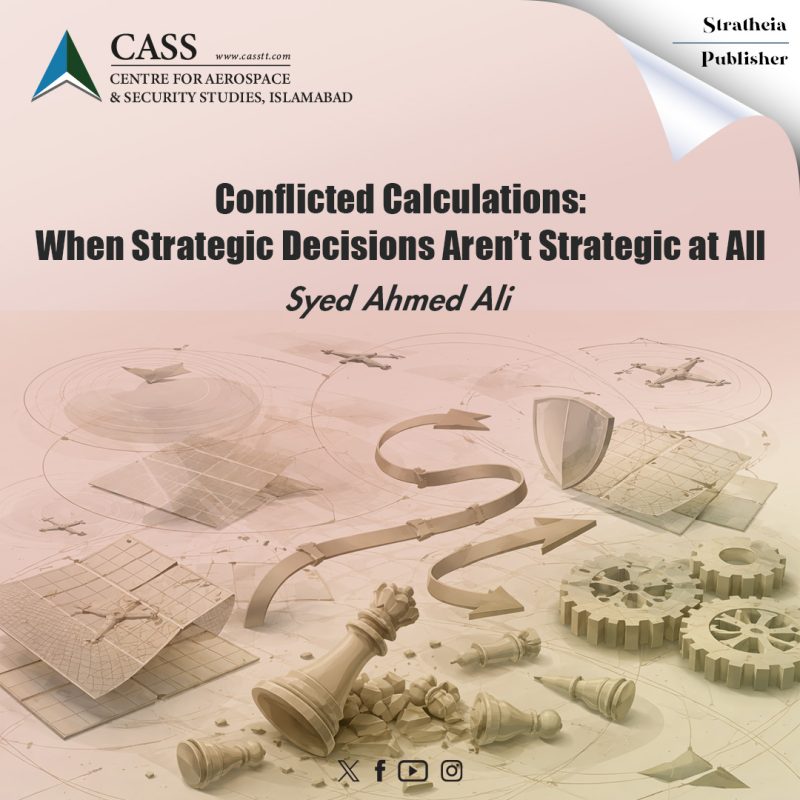
Perhaps the most consequential aspect of any military campaign or national policy is strategic planning. Unfortunately, these decisions are often driven by ideological and political motives rather than reason. This often results in catastrophic result as actors often make decisions that are contrary to realistic possibilities. To avoid such outcomes it is necessary to provide a framework that will ensure decision making be guided by pragmatism.
During an address to the Pentagon the then Defence Secretary Donald Rumsfeld points out three types of variables, known knowns, known unknowns and unknown unknowns. The description highlights the unpredictable nature of strategy. Where players plan with known known, they prepare contingencies against known unknowns and are caught off guard with unknown unknowns. The US intervention of Afghanistan demonstrated this lack of situational awareness where the American’s were uninformed of the political landscape and social dynamics of Afghanistan. This resulted in the American’s being drawn into a forever war which dragged on for decades that ultimately failed to destroy the Taliban.
The strategic domain is not only composed of variables but also includes actors that operate within it. In their book “Thinking Strategically,” Avinash K. Dixit and Barry J. Nalebuff talk about strategic behaviour. The authors argue that strategy cannot be formed in isolation, rather it is an interaction between thinking actors each pursuing its own goal. Operation within the strategic domain requires an understanding these forces, which are not always physical in nature, but can also include abstract entities such as ideologies or disruptive technologies. A notable example can be seen during World War I where France had adopted mass assault tactics which resulted in massive casualties. The French high command’s inability to understand the nature of trench warfare was one of the contributing factors for early German advance.
Aside from the nature of threat, the strategic domain also contains a web of complex interdependent variables where the impact on one entity effects the other creating a dynamic landscape. As such actors often find themselves wrapped in the dilemma of unintended consequences a recent example of this would be Operation Rising Lion, where the Israeli’s had conducted decapitation strikes against Iran. The assassinations failed to achieve its primary objective of regime change, instead it initiated a series of protests which denounced Israeli strikes creating rallying around the flag effect. The US invasion of Iran can be seen as another example of unintended consequences as the toppling of Saddam Hussein’s regime creating a vacuum which eventually led to the rise of ISIS. Such examples are a textbook case of the security dilemma, where states reduce their overall security in an attempt to increase it.
The above cited case studies highlight another recurring failure in strategic thought where strategic actors demonstrate a lack of understanding of an adversaries capabilities. The inability of a strategic actor to gauge the capability of its opponents often leads to unexpected vulnerabilities leading to a disastrous result. Such was the case with India in May, 2025, which crafted a political motivated narrative of Indian Air Force (IAF) superiority. This led to faulty assessment of Pakistani Air Force’s (PAF) capabilities which resulted in a strategic shock as several Indian aircraft were shot down.
The underestimation of an adversary’s capability by and a lack of understanding of their own often leads to a strategic overstretch where states often overstate their goals which go beyond the finite resources and technology available. Such limitations are in stark contrast to the political and ideological compulsions of the decision maker. The failure of Operation Barbosa is a classic example of such a phenomena where overambitious objectives which was driven by Lebensraum. Adolf Hitler believed that the survival of the German state was contingent upon the eastward expansion towards Ural Mountains. The German high command like the Japanese had underestimated the Soviet fighting and production capabilities. Though not all shared such optimistic views as Admiral Erich Raeder and Foreign Minister Joachim Von Ribbentrop opposed Soviet invasion. The German high command’s inability to critically evaluate Operation Barbosa resulted in a catastrophic, protracted war with Russia, which eventually spiralled into a two-front war.
The above framework is not an exhaustive list, rather it is an attempt to show how strategic calculations driven by ideology, political rhetoric or lack of intelligence can result into disastrous decision making. Such observations are an important reminder of the complexity of the strategic landscape and must be considered when analysing conflict such as the Russo-Ukrainian war or US intervention in Venezuela. To avoid such outcomes strategic decision making must be guided by rational considerations and credible intelligence, as strategy deals with what is possible, not ideal.